|
MarkeTrak VI: The VA and Direct Mail Sales Spark Growth in Hearing Aid Market |
| |
by Sergei Kochkin, PhD |
| |
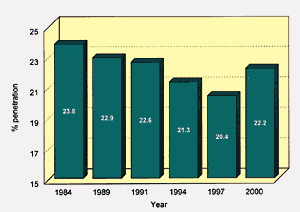
MarkeTrak VI indicates that there are now 28.6 million people reporting hearing difficulty and 22.2% of these people now use hearing aids (up from 20.4% in 1997). Binaural fittings have increased to 74.2% of all purchases, physician hearing screenings have fallen to 14%, and there are now fewer in-the-drawer aids (11.7%) than in 1997 (16.2%). The new study also indicates that VA and mail-order sales account for half of the incremental hearing instrument penetration increases over the last 3 years. |
 |
 |
 |
Efficacy of CIC Hearing Aids for Children and Adolescents |
| |
by Richard H. Nodar, PhD, & Tony H. Sahley, PhD |
| |
Despite the known benefits of completely-in-the-canal (CIC) instruments, hearing care professionals have been reluctant to fit CICs on children for several reasons. This article presents the results of a field study and provides information on fitting CICs on children ages 2-16 who, for various reasons, refused to wear other styles of hearing aids. |
 |
 |
 |
Efficient Software Solutions: Tips for Streamlining Technical Support |
| |
by Brad Ingrao, MSEd |
| |
When confronted with software problems, there are some basic approaches to take and information to obtain that can help solve the issue. Heres what you need and how to get it. |
 |
 |
 |
CIC Buyer's Guide |
| |
A review of the latest in CIC product technology. |
 |
 |
 |
Additive SNR Benefits of Signal Processing Features in a Directional DSP Aid |
| |
by Victor Bray, PhD, & Michael Nilsson, PhD |
| |
Statistical analysis of noise-front and noise-diffuse environments demonstrate significant benefits for added speech intelligibility in noise due to a noise reduction algorithm. |
 |
 |
 |
Assessment Methods for Bone Anchored and Bone Conduction Hearing Aids |
| |
by Marshall Chasin, MSc |
| |
Functional gain, in conjunction with an appropriate skull simulator, can yield data that is both reliable and valid for the BAHA and other bone conduction aids. Frequency-specific information can be determined within reasonable clinical time requirements to verify or make adjustments to these fittings. |
 |