HR Web Site Review
A look at available hearing care resources on the Internet.
Read More
A look at available hearing care resources on the Internet.
Read MoreA laboratory study on a new hearing aid receiver technology.
Read More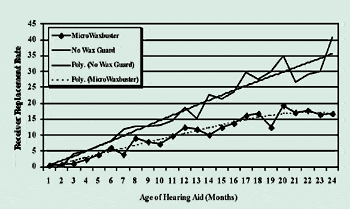
A blinded clinical study in which three levels of hearing instrument technology—linear, first-generation DSP utilizing WDRC processing, and second-generation DSP with advanced features—are assessed.
Read MoreFive solutions that have the potential to immediately improve your patient care, as well as customer satisfaction with your products and services.
Read More
Dispensing professionals would do well to identify consumers’ volume control needs; only 48% of those consumers who want a volume control and don’t have one are satisfied with their hearing instruments.
Read More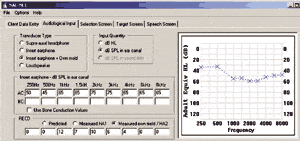
Research from the National Acoustics Laboratory in Australia shows that significantly different outcomes can result from the two amplification strategies, particularly when fitting flat and steeply sloping hearing losses.
Read More