|
 |
April 2004 |
 |
| Features |
 |


 |
Is the End Near for Acoustic Feedback? |
| |
by Chester Pirzanski, BSc, and Brenda Berge, AuD |
| |
Digital shell-making technology holds great possibilities for the fitting process. However, this technology will be limited by the same factors that limit traditional impression-taking technologies: a need for the use of open-mouth impressions and higher viscosity impression materials. |
 |
 |
 |
Charging Ahead: Technical Advancements in Batteries |
| |
by Karl E. Strom |
| |
Battery technology continues to improve as hearing aids become more power-hungry. |
 |
 |
 |
Advocating for Accessibility |
| |
by Marcia Dugan, Ruth Beernstein, MS, Lise Hamlin, Patricia Irr, George Kosovich, and Donna S. Wayner, PhD |
| |
A panel discussion on advocating hearing accessibility, including access in restaurants, during travel, for legislative efforts, in houses of worship, employment, and in hospitals. |
 |
 |
 |
Exercise Promotes Hearing Health |
| |
by Helaine Alessio, PhD, and Kathleen Hutchinson, PhD |
| |
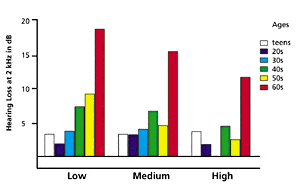
Is there a relationship between exercise and better hearing health? In plain English, Yes! |
 |
 |
 |
Creating a Team Culture of Personal Accountability |
| |
by Danita Bye |
| |
Essential tips for creating a culture of accountability within a hearing care practice. |
 |
 |
 |
Proving Adaptive Directional Technology Works: A Review of Studies |
| |
by Thomas A. Powers, PhD, and Volkmar Hamacher, PhD |
| |
A review of and commentary on four recent important studies on the subject of adaptive directionality and dual- and three-microphone hearing instruments. |
 |
 |
 |
Clinical Experience Using a Hearing Aid for TMJ-Related Fitting Problems |
| |
by C. Mike Hall, MA |
| |
A new hearing instrument style may provide benefits for patients who have trouble with their hearing aids retaining an adequate seal in the ear canal. |
 |
 |
 |
Maximizing the Voice-to-Noise Ratio (VNR) via Voice Priority Processing |
| |
by Mark C. Flynn, PhD |
| |
The new digital aid uses parallel processing, adaptive directionality with separate polar patterns for frequency bands, as well as noise management and 8 channels of compression. |
 |
|
 |
 |
 |
 |
 |

 |
| Departments |
 |

|
LOOKING FOR EXPERT ADVICE?
|
 |
|
|
|