Measuring the Occlusion Effect in a Deep-Fitting Hearing Device
A multi-site field study uses a unique occlusion effect measurement procedure to assess how a deep-fitted hearing device can reduce or eliminate occlusion.
Read More
A multi-site field study uses a unique occlusion effect measurement procedure to assess how a deep-fitted hearing device can reduce or eliminate occlusion.
Read More
Designing a hearing aid for a child with severe-to-profound hearing loss involves coupling advanced technological developments with the unique needs of children.
Read MorePerspectives from 15 companies in the hearing industry on what happened during 2004 and what might be expected in 2005.
Read More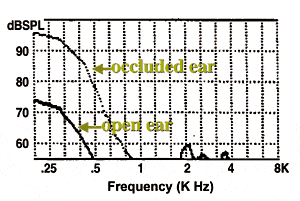
A modulated sinusoid that is 1-2 seconds in duration—when coupled with sufficiently long and randomly spaced interstimulus intervals—is sufficient to achieve reliable aided sound-field threshold results in most non-linear hearing aids. Here’s how to measure ASFTs in your practice.
Read MoreA study using computer-simulated scenarios that assessed consumers’ willingness to pay (WTP) for four advanced features suggests that feedback cancellation and directional microphones were valued more than expansion and noise management. For individuals with no hearing aid experience, WTP values systematically decreased as the hearing aid size increased.
Read More