March 2006


Features


On Music and Hearing Loss
  by Marshall Chasin, AuD
  An introduction by this month’s guest-editor, and his thoughts on music induced hearing loss, why it differs from noise induced hearing loss, and what might be expected in the future of this exciting area.
Hearing Aids for Musicians
  by Marshall Chasin, AuD
  Understanding and managing the four physical differences between speech and music allows the hearing care professional to approximate the correct electroacoustic parameters and enhance the enjoyment of listening to music.
Room Acoustics and Modifications for Performing Artists
  by Bill Gastmeier, MASc, PEng
  The design of music rehearsal spaces, practice/teaching rooms, and performance venues shouldconsider the acoustical and safety requirements of performers, instructors, and the audience.
The Medical Aspects of Noise Induced Otologic Damage in Musicians
  by Kenneth Einhorn, MD
  Studies show that musicians routinely face sound pressure levels (SPLs) in potentially hazardous ranges, extending up to 120-130 dBA only 3 feet from the speaker in amplified rock/pop bands, 83-112 dBA on stage in various orchestras, and 80-101 dBA on stage in jazz, blues, and country and western bands.
Hearing Conservation in Schools of Music: The UNT Model
  by Kris Chesky, PhD
  The UNT model is designed to provide students with knowledge about retaining their musicians’ ears for their careers and their quality of life. The National Association of Schools of Music (NASM) has reviewed the program and an outline is being prepared for national dissemination.
Hearing Protection for Musicians
  by Patty Niquette, MA
  Musicians need to hear well, and safely, when they play. Standard industrial-type hearing protectors muffle sound and frequently provide too much attenuation and occlusion to be acceptable for musicians. This article describes the selection of high-fidelity earplugs for musicians.
Please Welcome On Stage...Personal In-the-Ear Monitoring
  by Michael Santucci, MS
  Personal monitoring has revolutionized onstage sound reinforcement. The development of personal monitors was driven by the need to provide an onstage listening experience that surpassed the limitations of traditional floor monitor systems, and it has the dual ability to protect the performers’ hearing. Here’s a brief tutorial on these systems.
“Portable” Music and Its Risk to Hearing Health
  by Brian J. Fligor, ScD
  As hearing care experts and “hearing loss preventionists,” it is our responsibility to consider critically the level of risk and educate our patients and the public appropriately about the use of personal music players.
Perceptual Considerations in Designing and Fitting Hearing Aids for Music
  by Frank A. Russo, PhD
  A selective overview of perceptual dimensions contributing to music experience that have implications for the fitting of hearing aids, as well as possible treatment and research of hearing loss.
Audio Players and Cochlear Implants
  by Edie Gibson, AuD
  Cochlear implant users can listen to MP3 and CD players via several options, including audio headphones, direct patch cables, or FM systems.
Digital Noise Reduction: Yes, There Is Research Supporting Its Effectiveness
  by Pamela Burton, MA, Carolyn Smaka, AuD, and Thomas A. Powers, PhD
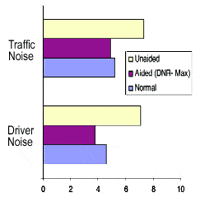
  A review of four different research studies that show outcomes favoring Digital Noise Reduction (DNR). As we move toward evidence-based practice in the selection and fitting of hearing instruments, studies such as these will lead the way in showing that DNR is an effective treatment strategy in the provision of amplification.
What Outsiders Tell Us About the Hearing Industry
  by Brent Edwards, PhD
  By continuing to develop advanced technology, promoting advances to those outside our industry, supporting evidence-based practice and data-driven development—and acknowledging the success that we are achieving in our industry—we will be poised to be one of the most successful fields to work in among all of the medical device industries.
A Comparison of Decision-Making Processes in Directional Systems
  by Mark C. Flynn, PhD
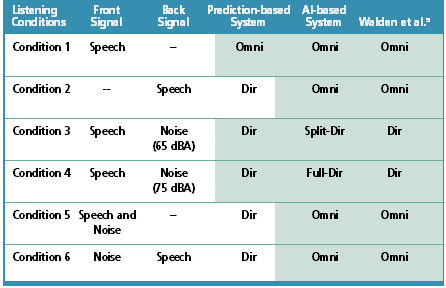
  A study that analyzes the decision-making of prediction-based directional systems versus that of parallel-processing-based systems.
Resolving a Root Cause of Failure to Fit: Re-examining the Ear Canal
  by Max Stanley Chartrand and Glenys Anne Chartrand
  Frequent complaints of earmold discomfort, non-acoustic occlusion, sensations of fullness, and chronic itching while wearing hearing aids still continue to drive at least some of the failure-to-fit rate for dispensing professionals.
HIA: The Time is NOW for the Hearing Aid Tax Credit Bill
  The annual Hearing Industries Association (HIA) meeting was primarily focused on the enactment of the Hearing Aid Tax Credit Assistance Act. There has never been a better time than 2006 to pass this important piece of legislation.
BHI’s Reorganization Produces Results: Institute Produces a Variety of Tools for Professionals, Consumers, and Industry
  The Better Healing Institute (BHI) has produced a wide range of materials in the last 2 years, including useful consumer literature offerings, consumer demographics and data, Web pages, and now a PBS mini-documentary.


Departments

Staff Standpoint
News
Associations in Action
Industry Insider
Product Showcase
Information Please
Industry Personalities
Calendar
Classifieds

MEDIA CENTER

Interactive Media
Resources
Classifieds
Calendar
Consumer Resources
Media Kit
Advertiser Index
EAB
Reprints
Submit an Article

ADDITIONAL ONLINE RESOURCES

Allied Healthcare
Medical Education
24X7mag
Chiropractic Products Magazine
Clinical Lab Products (CLP)
Orthodontic Products
The Hearing Industry Resource
HME Today
Rehab Management
Physical Therapy Products
Plastic Surgery Products
Imaging Economics
Medical Imaging
RT Magazine
Sleep Review
SynerMed Communications
IMED Communications
Practice Growth
Practice Builders
powered by:
Copyright © 2009 Ascend Media LLC | The Hearing Industry Resource | All Rights Reserved.
Privacy Policy | Terms of Service