Issue StoriesSecrets of the Multilayer Impression-Taking Techniqueby Chester Pirzanski Learn how to master the little known Fifield Technique to stop feedback when other impression-taking procedures fail
Leakage of sound around the otoplastic (earmold or earshell) provides unintentional, uncontrolled and variable venting in many hearing instrument fittings. This often leads to acoustic feedback. When leakage occurs, a portion of the output signal from the hearing instrument receiver radiates back to the microphone. When the portion of the output being fed back at a particular frequency equals the gain of the hearing instrument at that frequency (and is in phase with the input), audible oscillation, or feedback, occurs. Reducing the gain of the hearing instrument could eliminate the oscillation. However, inadequate sound amplification would result from this course of action.1 To prevent acoustic feedback and feedback-related sound distortion, the otoplastic needs to seal effectively with the ear canal. In practice, the effectiveness of otoplastic seal is controlled through the thickness of in-lab impression coating, commonly made of wax.2 The canal portion of the ear impression is enlarged by either dipping in melted wax, or by applying melted wax with a brush or a spatula and then smoothing the build-up over with an electric wax knife. Unfortunately, this process is carried out without checking the build-up in the clients ear to make sure that the seal is adequate and the fit is comfortable. Since each ear is different, errors in applying either too much or too little build-up, or applying it in the wrong place, have been occurring. With high-powered hearing instruments, even a slight error in the fit can result in a hearing instrument that will feedback, necessitating a remake using different waxing conditions. Multilayer Impression-Taking 1. The impression was produced in three stages; 2. The controlled build-up of canal area on the impression was carried out in the ear. This ensured that the impression conformed to the structures of the ear and the problems of discomfort associated with impression waxing were avoided; 3. The impression was built up more than once, if necessary. In this way, the impression was enlarged gradually so that the minimum build-up necessary to achieve a seal was applied; 4. The technique incorporated a test to prove that the impression was sealing the canal effectively; 5. The multilayer impression did not require any further build-up or modification by the earmold or hearing instrument manufacturer. The following is a brief description of the three stages of the technique and also a method of testing the seal. Step 1: The Primary Impression
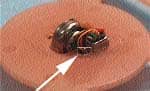
The oto-block is inserted in the ear, not deeper than the second anatomical bend of the canal. A high viscosity (heavy-bodied) silicone impression material is then mixed and syringed into the ear. When set, the finished primary impression should show the detail of the ear canal and concha, and should have the end of the tubing showing at the tip of the canal. The tubing should remain imbedded in the impression (Fig. 2a).
Step 2: Canal Build-Up þ Testing the Seal: When the impression is fitted back in the ear, an air pump and manometer (part of an acoustic impedance meter or tympanometer) are attached to the tubing protruding from the impression. The pressure is increased to a maximum of +200 daPa and maintained at that level for 5 seconds. The patient is encouraged to open and close his/her jaw to ensure that leakage does not occur during these movements. If the pressure decreases during the test, the impression requires a build-up with another layer of the soft silicone. The dispensing professional may have to repeat this build-up procedure several times, testing after each attempt, until a satisfactory seal is achieved. This part of the impression-taking procedure is considered complete only when an effective airtight seal is provided. Carrying out the procedure of the impression being first removed from and then returned to the ear for the pressure seal test is important because it breaks the seal between the impression and the ear. If not administered, most impression materials will stick to the ear tissue firmly enough to demonstrate an effective airtight seal. Step 3: Applying a "Wash" A new oto-block (Fig. 1b) tied to a thread is selected and inserted into the canal to give the desired length to the finished impression. A low viscosity (thin-bodied) silicone material is syringed into the ear canal and over the surface of the concha. The impression is then gently reseated in the ear before the material begins to set. During this process, the thin silicone is displaced from under the impression and flows up, around the sides and outward. After this silicone sets, the impression is gently removed from the ear and the impression will now have a light coating of the low viscosity material over its surface, as shown in Fig. 2c. Where the impression has been built-up and is sealing against the canal wall, the material previously used for the build-up will show through the final (outer) coating. The canal of the impression should then be trimmed to the desired length, if necessary. Instructions to the earmold lab should indicate that the impression should not be built up before being manufactured. For guidelines on selecting high, medium or low viscosity impression materials, the reader is referred to a previous article by the author.5 Study Results Macrae1, in a series of experiments conducted on a varying number of young adults, compared the effectiveness of static pressure seal in earmolds made from non-waxed multilayer impressions and from waxed standard impressions. The static pressure seal was tested as proposed by Fifield.3 For the waxed impressions, the effectiveness of earmold seal ranged from 15-65%, depending on the thickness of the impression coating. Earmolds made from non-waxed multilayer impressions provided an airtight seal 88% of the time. Even though the targeted score of 100% was not achieved, earmolds made from multilayer impressions still demonstrated superb sealing properties. Discussion It takes about an hour to obtain a multilayer impression as opposed to approximately 10-20 minutes for other techniques. Acoustic feedback does not occur in most hearing instruments manufactured by labs with reliable otoplastic work.4 In humans possessing narrow or crooked ear canals, the returning of the multilayer impression to the ear canal can be most challenging, particularly if the oto-block for the primary impression was inserted past the second anatomical bend of the canal. More importantly, there are additional methods that effectively address feedback. Unintentional sound leakage in hearing instruments usually has two different causes.5 The first is the softness of the ear tissue; the second, which is at least as common, is the increase in ear canal diameter caused by the patients downward movement of his/her jaw. If separate causes exist, it appears more practical to approach each cause individually. The ear tissue compressibility is best tested through the employment of a standard-viscosity or high-viscosity impression material. The magnitude of the ear canal widening is best illustrated on the impression by utilizing the open-jaw impression-taking technique.6 Because it is unpredictable which of these two factors will be more critical for a given patient, it is most appropriate to combine these two methods. The advantage of taking an open-jaw impression with a standard-viscosity impression material lies in the procurement of a high-quality ear imprint without increasing the time of impression making. Despite the reasons for its limited popularity, Fifields method has at least one element that appears very interesting: the static pressure-seal test used for evaluating the accuracy of the earmold seal and the risk of feedback. However, in interpreting such tests results, two factors should be considered. The first is that, if the earmold loose fit is equal to or greater than an equivalent of a 0.5 mm vent, the air pressure in the ear canal will be close to zero.7 Secondly, sound leakage around the earmold will not necessarily lead to acoustic feedback. An acoustically tight earmold is not the same as an airtight earmold.8 An air-tight earmold means a lower limiting frequency of zero. An acoustically tight earmold means a lower limiting frequency of about 50-100 Hz. Acoustic feedback in hearing aids develops well above 100 Hz, typically between 1700 and 2500 Hz.9 In other words, an airtight seal is not necessarily imperative for high-power hearing instrument fittings. Summary
References |
|
|
|
||||||||||||||||||||||
ADDITIONAL ONLINE RESOURCES |
|