Issue StoriesMultilingualism and Children with Cochlear Implantsby Ann V. Levi, MA, Jennifer Boyett-Solano, MS, Brooke Nicholson, MS, & Laurie S. Research from the House Ear Institute suggests that oral bilingual youngsters who receive cochlear implants perform similarly on speech perception tasks and make equivalent gains in language compared to their monolingual peers As state health care systems become more involved in the funding of cochlear implants (CIs), and as more children of all types of socioeconomic backgrounds and ethnicity receive them, it becomes more important to understand the effects of multilingualism on children who receive CIs. Evidence in this study disputes the hypothesis that oral children in multilingual environments are significantly more at risk than their monolingual peers for slower development of functional speech perception skills. However, this study does suggest that multilingual children in total communication (TC) environments may be at risk for slower development of these skills. Cochlear implantation has become an increasingly accepted rehabilitative option for hearing-impaired youngsters. For example, the MediCal system in California has become involved in providing funding for cochlear implants, and the number of requests for cochlear implantation from families of bilingual, and often lower socioeconomic backgrounds, has increased. Los Angeles is a city known for its cultural diversity. At the present time, the ethnic makeup of Los Angeles County is 45.56% Hispanic, 32.15% white, 12.58% Asian, 9.43% African-American and 0.28% American Indian. This cultural diversity is reflected in the House Ear Institutes (HEI) CARE Centers pediatric implant caseload. The Centers staff monitor a number of patients who are exposed to multiple languages in the home yet receive English-only instruction in school. Although bilingual classes were offered in California prior to 1998, this option is generally no longer offered for multicultural students following the adoption of Proposition 227, the English for Children initiative. Although implant centers and schools advocate the establishment of a consistent language between home and school (at least in the initial phases after implantation), it has become readily apparent that these expectations are often unrealistic. Based on the language constraints of siblings and extended family, and the ethnic composition of the surrounding community, establishing a consistent language program is problematic. Consequently, at the CARE Center, predicted outcomes for multilingual children tend to be lower than for monolingual children. Staff at the Center have hypothesized that multilingual children in oral programs may be particularly at risk for slower development of functional speech perception skills, since no common language (not even sign language) exists between the two environments. Different concerns have been raised for children in total communication (TC) programs who are obliged to become tri-lingual, since the English/Sign model of instruction often differs from the second language/Sign model in the home. A retrospective analysis was undertaken to examine the validity of this hypothesis. It was motivated by the need to provide clinicians with a counseling tool for families with multicultural backgrounds interested in cochlear implantation. Testing for Receptive and Expressive Language and Speech Perception
Measures of Receptive and Expressive Language: Subjects were evaluated for receptive and expressive language using three different tests. The Peabody Picture Vocabulary Test1 was used to measure receptive vocabulary for Standard American English. For this test, each subject selected one of four pictures illustrating a single word stimulus beginning with the phrase Show me This test was standardized on 4200 hearing children and youth, aged 2.6-18.1 years. Tests of verbal comprehension and expression included the Reynell Developmental Language Scales (RDLS)2 and the Test for Auditory Comprehension of Language (TACL).3 The receptive language portion of the Reynell test requires the subject to point to or move objects in response to questions or instructions. Expressive language is evaluated in areas of vocabulary, structure and content. This test was standardized on over 619 hearing children. The TACL measures auditory comprehension of the literal and most common meanings of word classes, comprehension of grammatical morphemes and elaborated sentence constructions. This test was standardized on 1003 normal language children aged 3.0-9.1 years. Measures of Speech Perception: Subjects were tested for speech perception using four different measures. The Test of Auditory Comprehension (TAC)4 comprises 10 sub-tests that are arranged in hierarchical order. These sub-tests evaluate a range of abilities including suprasegmental discrimination, auditory memory sequencing for up to four critical elements, auditory comprehension and auditory figure-ground abilities. This test is administered in a taped closed-set format. The Early Speech Perception Test5 was designed for profoundly hearing-impaired children with limited vocabulary and language skills. It provides closed-set picture pointing tasks. The scores from three sub-tests were used to evaluate a childs level of speech perception from 1 (no pattern perception) to 4 (consistent word identification). The Glendonald Auditory Screening Procedure (GASP)6 assesses speech comprehension using an open-set live voice presentation of 10 familiar everyday sentences. The Ling 6 Sound Test7 measures each subjects ability to detect and identify the phonemes /a/ as in art, /u/ as in who, /i/ as in ease, /m/ as in me, /s/ as in she and /s/ as in so. These phonemes are evaluated in an auditory-only format. An additional pseudo open-set task was administered, the Mr. Potato Head Task8, which uses the popular Mr. Potato Head game. This measurement uses 10 sentences requiring retention of one to two critical elements (i.e., Find his black hat or Make Mr. Potato Head go to sleep.) Instructions are given in live voice, auditory alone. Scoring is based on total correct sentences and total correct key words. Study Findings
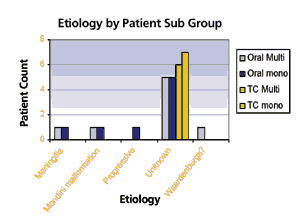
Measures of Speech Perception: To analyze results of the speech perception tests, parametric and non-parametric statistics were studied. No statistically significant difference in speech perception scores was noted between the oral groups (Figs. 4-5). However, oral children consistently outperformed the TC multilingual group. Although scores for the multilingual TC children appeared to be generally lower than for monolingual TC children, the differences were not found to be statistically significant. (Note: A complete set of data points was not available for each child.) Studies of the normal-hearing population have shown that the simultaneous bilingual acquisition process is similar to monolingual development9 and that the rate of language acquisition is not significantly different between groups. During the process of simultaneous language acquisition, normal-hearing children appear to learn to differentiate the two language systems based on the association of a specific location or specific person with one language, and another person or location with the other language.10 Studies of bilingual children with language delays offer differing conclusions as to whether or not exposure to a second language negatively affects development.11,12 There is a dearth of research studies on bilingual language acquisition in the hearing-impaired population, and even less on the language and speech perception skills of bilingual children with cochlear implants. Hodges et al.13 examined the effect of several dependent variables (length of CI use, age at surgery, device, socioeconomic status, communication mode, school setting, private therapy and bilingualism) on the speech perception performance of 40 pediatric patients with cochlear implants. The strongest correlation was found to be communication mode, whereas the variables that had the least influence on test results were age at surgery, device type and bilingualism in the home. This studys findings on speech perception and language test measures dispute the hypothesis that oral children in multilingual environments are significantly more at risk than their mono-lingual peers. Irrespective of the difference in language model exposure between oral mono-lingual and bilingual cochlear implant users, a similar learning curve was demonstrated on speech perception, receptive and expressive language measures (Figs. 4-5). It is speculated that the simultaneous language acquisition process and development of audition in oral multilingual cochlear implant users is similar to that of normally hearing multilingual children.
By contrast, multilingual children in TC environments do, in fact, appear to be at risk for slower development of functional speech perception skills (Figs. 6-9). Their comparatively poor performance could be attributed to the addition of a third language that is not consistently differentiated between persons or locations. It should be noted, however, that the average age at implantation of the multilingual total communication sample was higher than for the other three groups. Furthermore, all of the TC multilingual children were from Hispanic families. Thus, socioeconomic factors may have negatively skewed the data for this group. A larger sample size and long-term follow up is necessary in order to substantiate these suppositions. Finally, this study was confined to closed or pseudo open-set measures of speech perception, as insufficient data were available across the entire population to permit analysis of open-set performance. Continued research is necessary to examine the extent to which the level of parental and teacher proficiency in the non-native language affects performance, and to determine whether the gap between the oral and TC groups persists on open-set test measures. Conclusions Previously, the CARE Center counseled all multilingual families to adopt the language of instruction as the primary language in the home, irrespective of the parents actual proficiency in this language. For most of our bilingual families, this demand was both unrealistic and unsympathetic, given their need to find a balance between the two cultures. Results of this retrospective analysis have encouraged clinicians at the Center to adopt a more realistic and culturally sensitive approach when counseling multicultural families interested in cochlear implantation. Acknowledgements The authors would like to thank AnneMarie Cicci, Jocelyn Goubeaux, Jennifer Herbert, Suzanne Holowecky, Kathleen Lehnert, Janice Loggins, Stephanie Pogorelsky and Margaret Winter for assistance with this project. Ann V. Levi, MA, Jennifer Boyett-Solano, MS, Brooke Nicholson, MS, and Laurie S. Eisenberg, PhD, are affiliated with the Childrens Auditory Research and Evaluation (CARE) Center at the House Ear Institute, Los Angeles. Correspondence can be addressed to HR or Ann V. Levi, CARE Center, House Ear Institute, 2100 W. Third St., Los Angeles, CA 90057; email: alevi@hei.com. References |
|
|
Featured Jobs
Find a Job |
ADDITIONAL ONLINE RESOURCES |
Featured Employer
|