Issue StoriesHow Good Are Automatic Program Selection Features?by Michael Buechler, MEng A field study that compares the program choices of an automatic program selection algorithm to the selection preferences of hearing instrument wearers. Automatic program selection is a new feature of advanced programmable hearing instruments. While it is generally recognized that this type of feature would be valuable, little data exists to support how well the selections are made in comparison to the clients own program preferences. This article looks at the automatic program selection mode of one digital aid and finds that the program was deemed appropriate the majority of the time, and that the wearers used the automatic selection mode 70-75% of the time. Hearing instrument wearers are exposed to a wide variety of listening situations. Wearers often find themselves alternating between quiet and noisy environments, requiring their instruments to deal with a multitude of obstacles when processing speech. Hearing instruments are fit to an individuals hearing loss based on audiometric data such as the audiogram and loudness scaling. The required amplification for each frequency region is evaluated using a formula (e.g., DSL [i/o], NAL-RP, etc.), and a single setting is supposed to cover all listening situations. The resulting fitting is most likely a compromise; it is not the optimal setting for all listening environments and signal characteristics. Various studies1-5 show that the optimum setting of the frequency response and compression parameters depends on the background noise and characteristics of the signal, and an alternate setting to the prescribed target formula is often preferred. The aim of modern amplification technology is the improvement of speech intelligibility and comfort in any acoustic situation. In quiet surroundings, most hearing-impaired people rate speech intelligibility with hearing instruments positively. In noisy situations, however, speech intelligibility with hearing instruments is often rated negatively. The use of directional and multi-microphone technology to enhance the signal-to-noise ratio (SNR) has proven to be the most successful strategy in background noise. In digital instruments, background noise reduction algorithms can also be used to increase hearing comfort in the presence of background noise.6-8 Different listening programs can be implemented to enable many modern hearing instruments to provide appropriate signal processing for a given situation. However, with conventional multi-program hearing instruments the wearer must judge the acoustic environment and decide which program is the best for the situation and then change to that program via a switch on the instrument or a remote control. Digital hearing technology enables a running analysis of the input signal and the appropriate adaptation of the processing strategy. For example, the AutoSelect mode of Phonak Claro hearing instruments (used as the test instrument in this study) automatically switches between two programs depending on the acoustic environment, with the aim of achieving the highest possible speech intelligibility in all listening situations. For quiet environments, or when there is only background noise, the first program is activated by the automatic program selection, and for speech in background noise, the second program. In the latter, the use of adaptive directional microphone technology, noise suppression, and appropriate frequency response and compression parameters aim to improve speech intelligibility in adverse environments. The automatic program selection in the tested hearing instrument is based on an analysis originally suggested by Kates9, in which four different specifying dimensions contribute to the characterization of the input signal:
These four signal characteristics are monitored by the automatic switching mechanism, and the hearing instrument switches between the two programs when all four parameters meet the preset criteria. The aim of the implemented sound classification is to identify speech within noise from all other acoustic situations. Since the noise situations in everyday life, as well as the individual hearing needs of the wearers, are diverse (and it is impossible for hearing instruments to guess many of the individuals hearing needs), it is unrealistic to expect a programming algorithm to switch correctly in every situation. For this reason it is possible to override the automatic switch manually, with a switch on the instrument or with a remote control.
With the help of a questionnaire and subjective reports made by hearing instrument wearers, this study aimed to establish whether the automatic program switching mode of the test instrument changed between programs in the desired way and if it was judged helpful by the hearing-impaired subjects. Method During the fitting of the instruments, each subject was instructed on the differences between the two programs and the function of the AutoSelect mode. At the time of the fitting, the dispensing professionals were not aware that these people were taking part in a study. As a result, the participants were not treated or instructed any differently than other clients. The subjects had the freedom to choose the AutoSelect mode, which automatically chooses between programs, or to manually select the preferred program once they had been fit. The participants tested the hearing instruments over a period of 2-10 weeks in everyday situations. Their experiences with automatic program selection were subsequently recorded with the help of a questionnaire. In the questionnaire the subjects were asked to rate the switching mechanism of the program selection, as well as the general usefulness of the automatic program selection. For each question, answers with 5-7 scaled categories were offered (e.g., not useful, of little use, a bit useful, quite useful, very useful). For the question on suitability of the selected program, 10 specific situations were presented for rating. In addition, the subjects were allowed to provide their own comments. Results
Are you aware of program changes? Switching between programs was perceived regularly by 67% of the subjects (Fig. 1). How often individuals are in speech in noise situations will vary from person to person, and this largely explains the variability in reported awareness of program changes. The results in Fig. 1 are interpreted as an indication that most subjects could judge the frequency of switching and the moment of switching.
How do you rate the frequency of switching? The switching frequency was individually perceived quite differently (Fig. 2). For the majority, however, it was considered to be within acceptable limits. About three-quarters (74%) of all participants found the frequency exactly right, a bit too often or a bit slow. For the remaining quarter (26%) of the respondents, the frequency of switching was too seldom or too often. This indicates that the possibility of adjusting the frequency of switching would be useful sometimes to satisfy the individual preferences of the wearer.
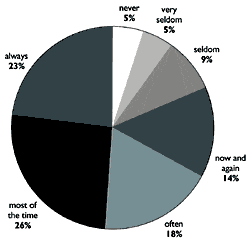
Does the instrument change programs when you expect it to? More than half (60%) of the subjects found that the instrument switched programs always, mostly or as often as expected (Fig. 3). For the rest the switching seemed more arbitrary. This may be related to the delay in the switching mechanism (the classification algorithm has to be met for at least 10 seconds in order to avoid too high a switching rate between programs), as well as to individual user differences in the expectation of program choice for certain acoustic environments (see Fig. 5).
Is the program choice suitable to the situation? The majority (79%) of subjects found that the automatically chosen program was suitable to the situation often, mostly or always (Fig. 4).
When does the program choice seem to be unsuitable? On the whole, there were three situations in which the automated system did not always comply with the wishes of the subjects (Fig. 5): Speech in noise: With speech in the presence of noise, the program choice is Program 2 with adaptive directional microphone (except for the model 22 ITCs) and noise suppression. Some subjects preferred that only the speech of the person they were looking at be amplified fully. Others found this unsatisfactory at times because they missed what other speakers in a group were saying. In this situation, however, its unlikely that even a perfect algorithm could predict the wishes of the individual wearer. Traffic noise: In background noise without speech, the directional microphone and noise suppression are usually not activated. The reason for this is that, in a traffic situation for example, important noises such as approaching vehicles usually should be perceived. The disadvantage is that also many unwanted sounds are also heard, and some wearers find this annoying. Additionally, as with speech-in-noise situations, individual preferences can differ. Music and singing: The signal identification system is currently less robust in these situations. Music is sometimes classified as speech in noise. The activation of the directional microphone and background noise suppression is not suitable when music is the signal that the wearer wishes to enjoy. A more reliable distinction between speech-in-noise and music would be desirable.
How useful is the automatic program choice? Three quarters (75%) of the test subjects found the automatic system quite useful or very useful and only 20% reported they would rather not use it (Fig. 6). Therefore the automatic program selection was found to be a valuable and desirable function. This result is consistent with the finding that the automatic program selection was usually suitable for a particular environment (see Fig. 4). Discussion With regard to the switching frequency of the automatic program selection, there were clear individual differences. For some subjects the system switched too often, for others not often enough. A fine-tuning parameter for the acoustic criteria of the program selection feature would be useful in order to better satisfy the individual preferences of hearing aid wearers. Speech in noise was a situation in which the choice of program by the automatic program selection mode often did not concur with the wishes of the test subject. Optimization of the automatic selection mode may be possible through further analysis of the acoustic parameters of these environments. The description speech-in-noise can refer, however, to a multitude of different acoustic situations, and the transition between acoustic environments is variable by nature. It is therefore difficult to delineate clear boundaries. Even a perfect classification of a given acoustic environment still does not solve the problem of individual user preferences at any given time. The suitability of a given program depends on whether the wearer is actively listening and needing high speech intelligibility from in front, or whether, for example, the wearer is also wanting good sound clarity from the sides and from behind. For example, one subject preferred the instrument not to switch in traffic noise while conversing with someone walking next to him. In this case, the reduction of sound from the sides is not suitable. The option to use the manual program override is a logical addition to the automatic program selection for these types of situations. The results of this study are based on the reports of people who were fit with instruments within the normal hearing instrument fitting procedure. The investigations were not carried out in special laboratory conditions, nor were the participants trained or instructed in any special way, and the number of subjects (22) was relatively low. However, in the authors opinion, the results reflect a reasonably accurate account of experiences with this specific automatic program selection feature in everyday practice. Other studies involving the AutoSelect feature have been conducted under controlled clinical circumstances.10,11 The participants were specially fit with Claro instruments for these studies and acclimatized in a training phase for 2-3 weeks to ensure they could distinguish reliably between the two programs. The results of the studies concur with the results presented here with respect to both the suitability of the automatic program selection and to the general usefulness of this mode. On average, the subjects reported that they had their instruments in the automatic selection mode 70-75% of the time and preferred the manual choice the rest of the time. While there are performance shortcomings in certain acoustic environments (e.g., music) and sometimes the automatically selected program is inconsistent with the wishes of individual wearers, the automatic selection feature was found to be very useful, and was perceived as beneficial by the majority of wearers.
Correspondence can be addressed to HR or Michael Buechler, Laboratory for Experimental Audiology, Dept. of Otorhinolaryngology , Head and Neck Surgery, University Hospital, CH-8091 Zurich, Switzerland; email: buechler@orl.usz.ch. References |
|
|
Featured Jobs
Find a Job |
ADDITIONAL ONLINE RESOURCES |
Featured Employer
|