Issue StoriesMarkeTrak VI: The VA and Direct Mail Sales Spark Growth in Hearing Aid Marketby Sergei Kochkin, PhD MarkeTrak VI indicates that there are now 28.6 million people reporting hearing difficulty and 22.2% of these people now use hearing aids (up from 20.4% in 1997). Binaural fittings have increased to 74.2% of all purchases, physician hearing screenings have fallen to 14%, and there are now fewer in-the-drawer aids (11.7%) than in 1997 (16.2%). The new study also indicates that VA and mail-order sales account for half of the incremental hearing instrument penetration increases over the last 3 years. This is the first segment of a multi-part publication that will cover significant trends in the hearing instruments market. Since 1989, Knowles Electronics has conducted six MarkeTrak surveys of the U.S. hearing-impaired market following the landmark 1984 Hearing Industries Association (HIA) study. Future publications in this series will revisit customer satisfaction in detail, and explore the following new MarkeTrak topics: use of ALDs; consumer uses of information in choosing a specific brand of hearing instrument; factors impacting choice of dispenser and retail outlet; suggestions to manufacturers for improving hearing instruments; perceptions of improvements in quality of life; and use of computers in hearing healthcare. In November 2000, a short screening survey was mailed to 80,000 members of the National Family Opinion (NFO) panel. The NFO panel consists of households that are balanced to the latest U.S. census information with respect to market size, age of household, size of household, and income within each of the nine census regions, as well as by family versus non-family households, state (with the exception of Hawaii and Alaska) and the nations top 25 metropolitan statistical areas. The screening survey covered three issues: This short survey helped identify 15,800 hearing-impaired individuals and also provided detailed demographics on those individuals and their households. The response rate to the screening survey was 72%. In January 2001, an extensive survey was sent to 3,000 hearing instrument owners, with tabulation of the data occurring in April 2001. The response rate for the hearing instrument owner survey was 87%. The data presented in this article refer only to households as defined by the U.S. Bureau of Census (i.e., people living in a single-family home, duplex, apartment, condominium, mobile home, etc). People living in institutions have not been surveyed; these would include residents of nursing homes, retirement homes, mental hospitals, prisons, college dormitories, and military bases. The reader should also keep in mind that the following demographics refer only to those who admit to their hearing loss. Results & Discussion Market Penetration Increases; Physician Referrals Decrease
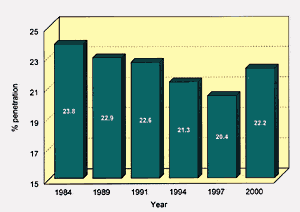
The Hearing Instrument Population: Hearing instrument penetration declined steadily between 1984 and 1997 (Fig. 1). Between 1997 and 2000, market penetration increased to 22.2%its highest rate since 1989, when MarkeTrak was established. The number of hearing instrument owners grew to 6.35 million (up 800,000) while hearing-impaired nonusers increased by 610,000 to 22.3 million people. (Reasons for this growth are explored under Distribution.) During the last three years, HIA statistics indicate that U.S. net sales of hearing instruments grew 12.6% (1998-2000 versus 1995-1996) compared to 7.6% in the previous three years (1995-1997 versus 1992-1994).1
The stellar historical growth rate for binaural hearing instrument purchases is shown in Fig. 2. Since the last MarkeTrak survey in 1997, the binaural population increased from 59.9% to 64.3% for all users, and from 74.3% to 78.7% (Table 1) for all bilateral loss consumers. The binaural purchase rate in 2000 (current period) increased to 74.2% for all users and 84.5% for bilateral loss consumers.
Fig. 3 documents the age distribution of hearing instruments in use as measured in the four previous MarkeTraks. (Authors note: A user is defined as an individual reporting he/she wears and uses his/her hearing instrument, and usage is accepted even if it is only occasional [e.g., even if less than a half-hour per day]). Use of hearing instruments that are 2 years old or less decreased slightly to 44.1% of the market. Hearing instruments greater than 9 years old increased to 15.5% of the market. Clearly there is an opportunity here to upgrade a significant portion of the market to newer technology. The average age of hearing instruments in use held steady at 3.76 years.
Physician Screening for Hearing Loss: We specifically ask individuals who received their physical exam in the last six months to indicate if their physician screened for hearing loss during the exam. Historical trends relative to this information are shown in Fig. 4 and Table 1. Physician screening has dropped to 14% for the total population. Declines are seen in every age category. This finding is puzzling given the fact that one manufacturer has distributed in excess of 30,000 physician screening kits to primary care physicians, the Better Hearing Institute (BHI) has made physician awareness of hearing loss its key market development objective, and the American Academy of Audiology (AAA) has developed a physician referral program for audiologists. In 1989-1990, HIA demonstrated that modest gains in physician awareness leading to physician screening for hearing loss was possible with a targeted media campaign. Certainly improving physician awareness of hearing loss and achieving increased referrals and endorsements remains one of the most important market development objectives for the hearing industry. Previous research has determined that consumers are five to eight times more likely to have higher purchase intents if their doctor believes they need a hearing instrument.2,3 Prices Rise; Audiologists Make Gains in Dispensing
The average price of a hearing instrument as paid out of the pocket of the consumer (includes free and third party discount) increased 35% to $1,183 (Fig. 6). In comparison, the retail price rate increases in the last two MarkeTrak surveys were 23.5% (1997) and 6.4% (1994). The price increases by style of hearing instrument were as follows: BTE 45%, ITC 31%, ITE 37%. Undoubtedly the higher prices are due to the introduction and significant penetration of digital hearing instruments in the U.S. market during the last three years.
Distribution: The dispensing role of the hearing instrument specialist continues to decline. Sixty-five percent of hearing aids were fit by audiologists in 2000, compared to 53.6% in 1997 (Fig. 7 and Table 2). In comparison, hearing instrument specialist sales declined 14.6% to 28.8% of sales in 2000. Hearing instrument fittings by medical doctors and others (e.g., mail) remain nominal. It should be noted that the distribution data represents perceptions of the consumer, who may not always be able to differentiate an audiologist from a hearing instrument specialist.
With respect to the source of distribution (Fig. 8), there are some major changes from the previous two MarkeTrak surveys. Significant increases are seen in fittings occurring in audiologist offices (47.2% in 2000 versus 41.3% in 1997) with a corresponding decrease in fittings occurring in hearing aid stores (22.2% in 2000 versus 30.5% in 1997). Veterans Administration sales increased to 8.4% (versus 4.5% in 1997), and mail-order sales increased to 3.5% (up from 0.9% in 1997), the highest it has been in history.
In Fig. 9, I have estimated the size of the hearing instrument owner population in 1997 and in 2000, based on the place where they purchased their last hearing instrument. Most notable are the significant increases in the VA population (411,000 in 2000 versus 224,000 in 1997) and mail-order sales (124,000 in 2000 versus 65,000 in 1997). Fig. 10 documents growth in each distribution source in rank order. Mail order and VA fittings increased 91% and 83% respectively. I estimate that these two sources account for one-half of the incremental hearing instrument penetration over the last three years. Without the VA and direct mail growth, market penetration would be 21.3%still lower than the industry high of 23.8% measured in 1984. Usage Increases, First-Time Users Decline and Customer Base Ages Further
Referring to Fig. 11, if hearing instruments four years of age or less (the effective life of a hearing instrument) are considered, the overall customer satisfaction rate is statistically equivalent over the last four MarkeTrak surveys, despite increases in the penetration of programmable and DSP products. Referring back to Table 3, satisfaction with new hearing instruments (e.g., less than one year old) declined to 62.9% in 2000.
Considering all hearing instrument owners, in-the-drawer hearing aids improved to 11.7% in 2000 versus 16.2% in 1997. New hearing instruments in the drawer would also appear to be improving. In 2000, 3.1% of hearing aids less than one year of age went unused, compared to 4.6% in 1997. The reader may wonder why customer satisfaction ratings are virtually unchanged given the above figures and the recent dramatic increases in programmable instruments, which are known to have higher customer satisfaction ratings. The second article in this series takes a closer look at this issue.
New Hearing Instrument Owners: First-time owners decreased in 2000 to 31.6% of sales from 39% of sales in 1997 (Fig. 12 and Table 4). By comparison, in 1989 they represented more than half of sales.
We are hypothesizing that 1989 was an unusually high year for new users and that they were probably motivated to purchase by Eddie Albert hearing aid television commercials in 1988 and 1989. The low new user rate in 1994 (29%) was most likely due to the negative publicity of the FDAs initiatives against the hearing instrument industry in the preceding years. After a decline between the years 1991 and 1997, the age of new users would appear again to be on the increase. The current new user is 68.8 years of age with an annual household income of $46,300, up from $40,100 in 1997.
Referring to Fig. 13, factors influencing new first-time owners to purchase a hearing instrument were: perception that their hearing loss was getting worse (68.5%), family members (45.2%), audiologists (40.5%, up from 26% in 1997) and ear doctors (22.1%, up from 10.8% in 1997). Notable changes are the increase in ENT and audiologist influence, as well as consumers indicating they received free hearing aids (11.6% in 2000 versus 6.9% in 1997). It would appear that family practice physician recommendations are increasing steadily (now 11.6%); but they are still below their high in 1989 (17.2%) when the HIA was advertising to physicians. With respect to media, we see small gains in the influence of newspaper ads (5.8% versus 2%) and direct mail (4.7% versus 2%).
Hearing-Impaired Population Demography: In Table 5, detailed demography is presented for the year 2000, and penetration rates are compared for the years 1984-2000. When market penetration by age (Fig. 14) is compared, it is evident that no significant gains have been made since 1989 in any age category, with the exception of perhaps the consumer aged 85+; this customer segment had temporarily stayed out of the market in 1992-1994 during the period of negative publicity associated with the FDA initiatives.
Fig. 15 documents the size of the hearing-impaired population over the last decade by age category. Most notable is the increase in the age 45-54 baby boomer segment (+2.1 million), conceivably spurred by President Clintons admission of hearing loss and his use of CIC hearing instruments in October 1997. During this same time period, the age 75+ segment grew by one million people.
When MarkeTrak VI (2000) and MarkeTrak V (1997) population figures by age segment are compared (Table 5), the largest growth took place in the following segments:
Clearly coming our way is a major wave of potential consumers in the baby boomers segment, who are both more educated and affluent than the industrys current consumer base. Unfortunately, our industry has not enjoyed any level of success in convincing this segment to purchase our products and services.
Finally, an estimate of the hearing-impaired population size by state is presented in Table 6, along with the incidence of hearing-impairment per 100 households. In terms of population sizes, the top 10 markets in rank order are: California, Texas, New York, Florida, Pennsylvania, Illinois, Ohio, Michigan, Georgia, and North Carolina.
Key Findings
Correspondence can be addressed to HR or Sergei Kochkin, PhD, Knowles Electronics, 1151 Maplewood Drive, Itasca, IL 60143; sergei.kochkin@knowlesinc.com References
|
|
|
Featured Jobs
Find a Job |
ADDITIONAL ONLINE RESOURCES |
Featured Employer
|