Issue StoriesFinally, A Solution to the Wax Problemby Sergei Kochkin, PhD In a study of more than 90,000 hearing aid users, a wax protection system was found to reduce consumer returns by up to 63% after 2 years of use. Maintenance and repair of hearing instruments continues to negatively influence customer satisfaction ratings. A previous study1 analyzing 7 million receivers found that high manufacturer usage rates of a wax protection system (70%+ of instruments) reduced receiver returns by eight-fold compared to those manufacturers not using the system. The study presented here analyzes more than 90,000 hearing instrument users and finds that this same wax protection system reduced consumer returns by up to 63% after 2 years of usage. The author concludes that it is in the best interest of the industry to incorporate wax protection systems as a standard feature on hearing instruments. In the September 2001 Hearing Review, a study1 was published analyzing the return rates of more than 7,000,000 receivers during a 3-year period for 100% of hearing instrument manufacturers worldwide. What is unique about this study is that receiver returns were analyzed relative to the extent to which manufacturers used either the Waxbuster or MicroWaxbuster active cerumen management systems. No adjustment was made for the possible fact that manufacturers could have been using alternate wax protection systems. We found that manufacturers that routinely (>70% rate) used the wax protection systems had receiver return rates 8 times lower than those that never used the system. As noted in the previous study, even though the results were astoundingly positive, it was still a correlational study. At the conclusion of that study, it was noted that it would be valuable to compare the experiences of consumers who used the wax management system versus consumers who did not. In response to this, we tracked more than 90,000 US consumers, who purchased in-the-ear hearing instruments over a 24-month period, for service and repair of their hearing instruments. This study specifically focused on the incidence of receiver replacement in the hearing instrument. The receiver is usually one of the leading casualties of cerumen build-up in the hearing instrument. It is our theory, for which support is offered in the following article, that if a cerumen management system could be found that reduced clogging of receivers, then repair rates would plummet, consumers would be more satisfied, and dispensers would experience less administrative hassle and enhanced consumer good-will, while manufacturers and component suppliers would realize significant cost savings during the warranty period of the product. The compelling evidence documented below leads us to believe that finally a solution to the cerumen problem has been found.
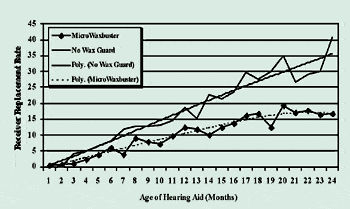
Method After the sale, a careful examination of service records was made and the following data retained: service date (if any) and the number of receivers replaced during the lifetime of the hearing instrument (which varied from 1-24 months). The number of receiver replacements over the life of the instrument ranged from 0-7. The average receiver replacement was 8.77 per 100 hearing instruments. Results Statistically, the effects of the wax management system on receiver replacement rates is highly significant when the following results are compared:
The above means that the study results could occur by chance only once in 10,000 samples of hearing instrument users. The probable impact on users, dispensers, and manufacturers is portrayed in Figure 4. Calculating the least square means across all of the 24 months2(see authors note), these 90,000+ consumers experienced a total reduction of receiver replacements ranging from 31% (ITE) to 42% (CIC). At the 24-month time frame, consumers and manufacturers can expect to see significant receiver replacement reductions over the first 2 years of hearing instrument use: 59% for CICs, 40% for ITCs, and 63% for ITEs. Summary Conceivably, consumers are more satisfied with their hearing instrument if they use the wax management system, since the frequency of difficult cleanings is reduced because the incidence of clogged receivers is lessened. In turn, perceptions of reliability and value for hearing instruments should increase, because the consumers hearing instrument is less likely to be in the shop for a receiver replacement. Finally, repair costs (actual and administrative) are curtailed, benefiting the consumer, dispenser, and manufacturer. The author contends that the evidence is compelling enough to recommend the wax management system as a standard feature on ITE hearing instruments.
References Authors Note: Least square means were computed to adjust for differences in sample sizes across styles of hearing instruments and age of instrument (1-24 months). If the ANOVA design was perfectly balanced, simple means would have sufficed. Correspondence can be addressed to HR or Sergei Kochkin, PhD, Knowles Electronics Inc, 1151 Maplewood Dr, Itasca, IL 60143; email: sergeikochkin@knowles.com. |
|
|
Featured Jobs
Find a Job |
ADDITIONAL ONLINE RESOURCES |
Featured Employer
|