Issue StoriesA Portable Classroom FM Systemby Staci Fritz A product review of Phonic Ears Toteable personal FM system, designed for classroom use by hearing-impaired children.
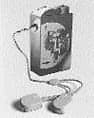
Its not something a hearing care professional notices right away upon visiting a classroom. The teacher is obviously wearing a microphone and a transmitter hooked on her belt, but you cant spot anyone with a body-worn FM system. After being there for a while, however, you notice a few desks with little black bags sitting on top. Roughly the same size as a pair of soda cans sitting side by side, the bags look a bit small and plain for lunch bags. In the mid-90s, Phonic Ear began receiving requests for tips on how to construct a personal desktop amplification unit by using a computer speaker hooked up to the Easy Listener Personal FM system. Though this type of makeshift system worked, it was more than a little unwieldy, not to mention difficult to move from place to place, and the speakers drained batteries almost as quickly as new ones could be put in. The Portable FM System What came out of the session was the Toteable sound fielda small, portable, and inconspicuous way to bring a teachers voice closer to the student who needs it. Weighing less than 2 pounds and having a height of about 5 inches, the FM system was designed to be everything envisioned by the students. A prototype was unveiled at AAA in 1998, although the product wasnt available until the fall of that year. Basically a sound field system in a small bag, Toteable raises the signal-to-noise ratio (SNR) so that the teachers voice is always audible and easy for the student to focus on. The device uses a body-worn receiver thats tucked inside the bag to transmit the teachers voice to an individual student or a small group. The student plugs either the Easy Listener PFM or Solaris PFM receiver into a jack inside the Toteable, then places the bag on their desktop. They then turn on the unit and adjust the volume to hear the teachers voice (whos wearing an Easy Listener or Solaris transmitter). The transmitter, receiver, and the speaker itself all occupy a specific place in the bag and all are recharged by plugging the wall unit charger into one clearly marked charge jack inside the bag. Uses of a Portable FM System Any situation where background noise might hinder a students ability to understand or focus on the teacher, the FM portable device is appropriate. Though it is most often used for students with mild-to-moderate hearing loss either in place of, or in addition to, personal hearing instruments, there are many other instances where a better SNR makes a difference. Children with cochlear implants benefit because the system can bring in sound from beyond the range of the microphone while also minimizing the effects of background noise. It does not require a patch cord and, since students do not plugg anything in, they can still use their ear-level microphone. Students with auditory processing disorders are often prescribed a multi-pronged approach for helping them to learn (for detailed information on this subject, see the article Gauging the efficacy of CAPD Treatment in the September 25, 2000 issue of Advance for Speech-Language Pathologists). One of the environmental modifications, aside from preferential seating, is soundfield amplification. The system is also useful for applications outside the realm of hearing-impairment. For those students with attention deficit disorders (ADD) or learning disabilities, the FM system works by keeping them focused. Since these students often have trouble attending to the desired signal (ie, the teachers presentation) if it is diluted by ambient noise, the FM system helps them ignore auditory distractions. Another area where this system has been effective is in the English as a second language realm, where studies have found that a stronger speech signal greatly helps these students in less-than-optimum listening environments. As students get older, they often refuse to wear an FM system because it singles them out. Since the Toteable is discreet, it is designed to provide a way for these children to receive the benefits of a better sound signal without looking different. It can also be shared by multiple students in a single classroom. Additionally, these types of systems are available to the whole class, so anyone can take advantage of the benefitsincluding those who have colds or ear infections. New Features The aesthetics of the system have also been updated. The case grew to house the larger speaker, the corners are now rounded, and there are clearly marked slots inside the bag for all the components. The on/off/volume control is easier to access now that its placed on the front of the bag. The Toteable is still padded, but the basic structure is now a flexible, hard-shell case with a zipper top. Subject to durability tests during manufacturing, the system withstood being dropped over 10 times from a height of 10 feet without any problems. When prescribing a desktop amplification device, the main factors a hearing care professional must consider are: the distance a child sits from the teacher; the teachers style (ie, very mobile or fixed); and the amount and intensity of background noise. Additionally, the hearing care professional needs to determine if students are currently using any other form of hearing instrument/cochlear implant or if they already use an FM system. Any child will benefit from hearing the teacher better, and this is just one more option for enhancing that signal to provide the best learning experience possible. This article was submitted to HR by Staci Fritz, copywriter at Phonic Ear, Petaluma, Calif. Correspondence can be addressed to HR or Staci Fritz, Phonic Ear, 3880 Cypress Dr, Petaluma, CA 94954-7600; email: sf@phonicear.com. |
|
|
Featured Jobs
Find a Job |
ADDITIONAL ONLINE RESOURCES |
Featured Employer
|