Issue StoriesMarkeTrak VI: Factors Impacting Consumer Choice of Dispenser & Hearing Aid Brand; Use of ALDs & Computersby Sergei Kochkin, PhD What factors are involved when a potential client is trying to choose where to seek help for his/her hearing problem? How are ALDs and computers being used by consumers? These answers and more are offered in this latest study of 3,000 hearing instrument users. MarkeTrak VI indicates that one in five (39%) consumers visit multiple offices prior to purchasing a hearing aid. The top influencing factors in choosing a dispensing office are professional staff, convenient location and hours, and price. Professional advice and positive word-of-mouth advertising dominate reasons for brand choice. Few consumers of hearing aids are interested in purchasing the aids online (3%), and less than one-third use the Internet for anything more complex than email (34%). Use of assistive listening devices (ALDs) ranges from 10%-27% of hearing aid owners, depending on ALD type. This is the fourth installment of a multi-part series covering significant trends in the hearing instrument market. Previous publications in this series covered 17-year demographic trends,1 10-year customer satisfaction trends2 and improvements sought in hearing instruments by current owners.3 The major purpose of this paper is to report on consumer factors impacting distribution and brand choice in the hearing instrument market. In addition, the following ancillary marketing topics will be covered: the extent and impact of dispenser counseling and post-fitting follow-up on customer satisfaction ratings; the number of dispensers visited and number of brands concurrently tried before their most recent hearing instrument purchase; the use of assistive listening devices (ALDs) among hearing instrument users; and the use of computers in the hearing health market. Methods As part of the extensive Knowles Electronics MarkeTrak VI survey, consumers were presented with a list of 11 factors and asked the importance of each in choosing the specific location where they purchased their current hearing instruments. In addition they were given a list of 19 sources of information which may or may not be helpful and/or reliable when choosing a specific brand of hearing instrument. For each source they were asked to indicate how helpful the source was for them in choosing the right brand of hearing instrument. The 19 factors were presented in three broad categories: 1) written material and advertising, 2) recommendations, and 3) computers. With respect to the ancillary topics covered, current hearing instrument owners were asked to indicate their usage of five assistive listening devices (yes/no scale); to rate their pre-purchase knowledge of hearing instrument technology (good/some/no knowledge) and hearing instrument styles as well as pre-purchase brand knowledge (yes/no/not sure). Consumers also indicated the amount of counseling time their dispensing professional spent with them, whether a post-fitting survey was administered, the number of brands they were sent home with by the same dispensing professional to try prior to choosing their current hearing instrument, and the number of dispensing offices visited prior to choosing their current hearing instrument brand. Choosing the Dispenser
Hearing instrument owners rated the relative importance of 11 factors in choosing their dispenser (Figure 2). Nearly eight out of 10 (77%) indicate that professionalism of the dispenser is highly important in the decision process. About six in 10 indicate that convenient location and hours, price and a free hearing screening motivated them. About half rated range of hearing instruments, physician referral and insurance coverage as key factors. Finally four in ten indicate a previous purchase motivated them and about a third indicate they chose the dispenser due to the recommendation of a friend. In Table 1, the 11 factors are presented in rank order of importance for the total hearing instrument owner population followed by segmentation results by gender, age group, income level, hearing loss level, and new versus experienced user. Significant differences within each segmentation category are presented in the right-hand column within each category. With a few minor exceptions, the rank ordering of reasons for choosing the dispenser is the same. There are a number of significant differences within each of the major segments worth mentioning (Authors Note: I will focus on factors where there is a 10% point difference in the category and the differences are statistically significant using a chi-square analysis). Females rate nearly all categories more important than males. They are more likely to be motivated by a convenient location and hours; they also would appear to be referred more by physicians. Older individuals are more likely to be motivated by free hearing screenings while younger consumers (<44 years) are more motivated by insurance coverage and a referral from a physician. Household income is highly related to importance ratings. High-income individuals ($80,000+) are more likely to put primary emphasis on the professionalism of the individual. Lower income individuals are more likely to rate convenience, price, and free hearing screenings equally (70% +). Lower income individuals tend to be more interested in a wider range of hearing instruments (eg, probably lower price hearing instruments), insurance coverage, and live demonstrations of hearing instruments. Severe and profoundly impaired consumers are more motivated by the range of hearing instruments and the fact that they previously purchased at that location. There are only minor differences between new and experienced users (eg, range of hearing instruments). Computer Use in Hearing Health Care The following general conclusions can be made by segment:
Dispenser Counseling and Post-Fitting Surveys
About six in 10 consumers indicate they received no follow-up customer satisfaction survey (Figure 4). Of those receiving a survey, about half were verbal surveys conducted in the dispensers office. Only about one in 10 consumers report they received a survey either through the mail, by computer, or over the phone. As Figures 5-7 demonstrate, the amount of counseling time and post-purchase surveys are positively correlated with improvements in overall customer service ratings. Consumers receiving no counseling time report customer satisfaction ratings at around 40% (Figure 5). This should be compared with consumers receiving two hours of counseling (mid-high 60% overall customer satisfaction ratings). After two hours of counseling, ratings fall slightly, perhaps indicative of service issues or problems in the fitting.
In Figure 6, consumers who received any form of post-fitting survey generally report a greater degree of satisfaction with their hearing instruments. In Figure 7, dispensers who administered some form of post-fitting survey received significantly higher post-purchase service ratings. Consumers, who received a formal mail, office, or phone survey gave the highest overall customer satisfaction ratings. The findings suggest that dispensing professionals can improve their ratings to the 90% level on post-purchase service by administering a survey either verbally in the office or over the phone, or via a written mail survey. Hearing Instrument Brand Choice
Brand choice for all user segments is heavily influenced by the recommendations of hearing health care professionals, the family doctor, and other hearing instrument owners. Nearly eight in 10 consumers indicated the audiologist was the most helpful source, followed by 6 out of 10 in favor of hearing instrument specialists and their family doctor. More than half indicated the recommendation of experienced hearing instrument users was helpful. Close to half indicated that consumer reports and family member recommendations were helpful, followed by a third of consumers consulting manufacturer brochures and scientific papers. Only about a quarter of consumers thought magazine articles, books on hearing instruments, and newspaper articles were helpful. About a fifth of consumers thought AARP and direct mail literature/ads were helpful, while only a small minority of consumers felt advertisements (TV, ad, radio), web sites (manufacturers and hearing instrument dispensers), and Internet chat rooms were helpful. When reviewing the rank ordering of sources by consumer segment, it is evident that, with few exceptions, all segments hold the same belief system regarding the helpfulness of these 19 sources. Females tend to stress the recommendations of audiologists, hearing instrument specialists, and family members more than males. The elderly rate most of the factors lowerespecially web sites (that is if we take a look at the proportional decline in ratings between the youngest and oldest group). Despite a heavy emphasis by the industry on direct mail, the elderly are less likely (17%) to be influenced by this source of information than younger segments of consumers (28%). The only source in which the elderly ratings exceed younger consumer ratings is AARP recommendations, and then only by a slight margin. Higher income users place more of an emphasis on the audiologist, consumer reports, and web sites than lower income users. In addition, all forms of advertising (TV, direct mail, radio, newspaper) are less influential to higher income consumers. Individuals with more severe hearing losses are more likely to be influenced by the recommendation of hearing instrument specialists and tend more to participate in Internet chat rooms. There are no meaningful significant differences between new and experienced users. Referring to Table 2, about six in 10 users indicated they had some to good knowledge of hearing instrument technology (eg, programmable, digital, styles of hearing instrument) prior to making their current purchase. The elderly, individuals with more serious hearing losses, and experienced users were more likely to possess pre-purchase technology knowledge. Only four in 10 consumers had ever heard of the brand of hearing instrument they were fit with prior to purchase.
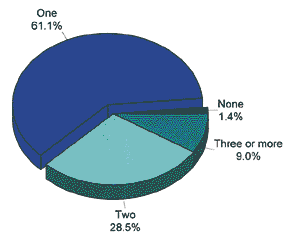
As shown in Figure 9, about nine in 10 consumers indicated they went home with only one brand of hearing instrument during the trial period. Only 9% of consumers indicated they were given two, while 2% indicated they were given three brands to try. In Table 2 are the detailed findings for all hearing instrument users, as well as recently fit consumers (within the previous 5 years). (Authors Note: The routine practice of sending a client home with more than one hearing instrument for trial has been greatly frowned upon by both the hearing industry and most professional organizations due to its inflationary effect on the return for credit rate; ultimately, it is the consumer who pays for the resulting higher-than-necessary return rates due to this practice.) The data suggests that there is a greater likelihood dispensing professionals will send consumers home with more than one brand of hearing instrument to try if the individual is an experienced user with a severe hearing loss. Use of ALDs Summary
References Correspondence can be addressed to HR or Sergei Kochkin, PhD, Knowles Electronics, 1151 Maplewood Dr., Itasca, IL 60143; email: Sergei.Kochkin@knowles.com. |
|
|
|
ADDITIONAL ONLINE RESOURCES |
Featured Employer
|