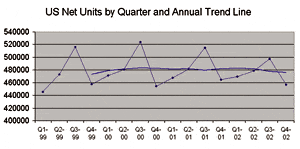
Issue StoriesWill Baby-Boomers Save a Flat Hearing Aid Market?by Henrik M. Nielsen, MA If Baby-Boomers are to significantly change the hearing industry in the short term, then the overall image of amplification products may require some tweaking to reflect the total communication needs of this younger audience Much has been said about how the Baby Boomer generation will rescue the hearing industry from its current sales doldrums. But there is little evidence to suggest that hearing-impaired Baby-Boomers will purchase hearing aids at a younger age or be more inclined to positively address their hearing impairment than the generations that precede them. Meanwhile, hearing instrument market penetration remains mired at around 22%. If Baby-Boomers are to significantly change the market in the short-term, then the products offered by the industry may have to change, placing greater emphasis on the total communication (and virtual communication) aspects that hearing care services and hearing technology can bring to the table. The US hearing instrument market continues to be flat according to the Hearing Industries Association (HIA) statistics1 (Figure 1). Market penetration continues to be low and is showing only token signs of improvement. Only 22.2% of those who have a significant hearing impairment actually own a hearing aid.2 This fact persists despite the significant improvements in hearing instrument technology which have taken place over the last 5-7 years. These improvements have resulted from a number of significant product innovations, including the introduction of advanced digital signal processing instruments, the widespread use and unique applications of directional microphone technology, and digital processing strategies that attempt to replicate and aid in cochlear processing.3
According to the annual Hearing Review Dispenser Survey,4 only 45% of patients purchasing hearing instruments in 2001 were first-time users. During the industrys growth years in the 1980s, the first-time customer rate was above 60%. This would suggest that improved technology has not increased unit sales, but only increased revenue due to the higher prices associated with advanced instruments. In addition, it appears that we, as an industry, are not doing a good job at convincing those who have admitted to a hearing loss to try our products. Baby Boomers to the Rescue? This prompts a few important questions: If the majority of people who admit to having a significant hearing problem remain in the 65+ age group, what is the outlook for the industry? Are Baby Boomers, as they grow older, any more likely to purchase hearing instruments at a younger age as compared to todays patients? Or will they come to resemble the previous (ie, WWII and so-called Eisenhower) generations relative to hearing aid purchases? What Characterizes Baby Boomers? In the years to come, there is little question that Boomers will continue to instigate changes in consumerism, retirement funding, and health care. They will live a more active life and have greater demands on quality of life issues compared to previous generations. According to a recent American Association of Retired Persons (AARP) survey,5 eight out of 10 Baby Boomers expect to work at least part time during their retirement. They will have more disposable income at retirement age compared to their parents, and only one-third of Boomers expect that they will have to scale back their spending when entering retirement.
This characterization of the Boomers holds great promise for the future of the hearing industry. The Boomers have only recently started to turn 55. According to the Census Bureaus population projections, we will see significant growth in the 65+ population group around 2012 (Figure 2). This would lead to the conclusion that increased sales as a result of the Baby Boomers will happen in that time frame. However, the gradual aging of America has seemingly had little effect on the hearing instrument population in the past two decades. In fact, over the last 20 years, there has been one predominant factor driving the sales growth of the hearing instrument market: binaural fittings. In 1983, 83% of all hearing instrument fittings were monaural, while only 27% were binaural. Today, those percentages are reversed: 29% are monaural and 71% are binaural fittings. The sad fact is that, when the numbers for first-time users and binaural/monaural fittings are extrapolated, it can be seen that there are fewer first-time users of hearing instruments today than there were 20 years ago! Unit sales increases due to an increased incidence in binaural fittings are no longer plausible; binaural fittings are now approaching a saturation point in sales (eg, somewhere between 75%-85% of fittings). Today, there are really only two factors that can drive increased sales within this decade:
Regarding the latter point, only one in five hearing-impaired individuals is wearing a hearing aid.2 This statistic hasnt changed significantly for 20 years. With regard to the first point, it has been said that Baby Boomers are less likely to accept growing old. However, as long as hearing aids are associated with aging, there are few indicators that suggest a downward age shift in hearing instrument users will occur. Can We Convince Boomers to Purchase Hearing Aids at a Younger Age? If hearing instrument technology can evolve into communication devices with multipurpose functionality, it would likely change the image of hearing instruments. This would result in a broader appeal for the target group of hearing-impaired Baby Boomers. Possible examples of this would be seamless integration with cell phones, TVs, radios, PCs, and other electronic devices. Such applications could utilize new wireless technologies, such as the Bluetooth standard. Baby Boomers are a significant opportunity for the hearing industry. To take advantage of this opportunity, the hearing industry will need to create technology that is multi-purposed, appealing to a wide variety of consumer segments. The products will also need to have high user satisfaction and deliver on performance in virtually all environments. Speech in noise is the number one area that current hearing aid users indicate a desire for improvement, according to a recent survey conducted by Sergei Kochkin.6 Addressing hearing-in-noise while transforming hearing aids into multifunctional communication devices will eliminate the age stigma associated with amplification products and create a far greater demand from consumers. The sheer number of Baby Boomers is likely to have dramatic effects on the hearing care market. However, without new products that bring about a change in the traditional perception of hearing instruments and drive consumer demand, it will be almost a decade before we see a growth in the hearing instrument market that can be truly attributed to the Baby Boomers.
Correspondence can be addressed to HR or Henrik Nielsen, MA; email: henrik@mn.rr.com. References |
|
|
Featured Jobs
Find a Job |
ADDITIONAL ONLINE RESOURCES |
Featured Employer
|