Issue StoriesMade to Order: How eTONA Will Serve You and Your Clientsby Scott Peterson Ordering hearing aids and other transactions will be radically transformed in 2003. When ordering a hearing instrument today, dispensing professionals must check off numerous items and provide information that can easily be confused or mistaken. Additionally, todays order forms require that the dispensing professional manually convert and transfer information to a sheet of paper that may already be in a NOAH-based electronic patient record. That will begin to change in 2003 with the advent of eTONA and NOAH 3. For more than two years, members of the Hearing Industries Association (HIA), along with representatives from the dispensing community and the Hearing Instruments Manufacturers Software Association (HIMSA) have been discussing ways to improve the process of fulfilling orders, returns, and repairs. The goal is to help save time and money for all individuals involved in dispensing activities. In the near future, the old ways of doing businessthrough faxing or mailing paper order forms or calling with orders and/or concerns via telephoneis expected to be replaced by electronic Transfer of NOAH Actions (eTONA). eTONA features are being integrated into NOAH 3 and will enable users to transmit orders electronically, receive electronic updates as to the status of their orders, and assist in many facets of dispensing. Goodbye Paper Order Forms Paper order forms can also be confusing because all products and options need to be listed on the same form. This can lead the dispensing professional to selecting options that may be unavailable or incompatible with a particular model or specification. For example, with all the choices presented on an order form, direct audio input (DAI) can be accidentally selected for a CIC. This will generate a customer service call to correct the problem and it may delay the order. Using a paper order form also requires that the dispensing professional manually convert and transfer information to a sheet of paper that may already be in the NOAH-based electronic patient record. The most common pieces of electronic data already in a NOAH-based record are the patients name, audiometric and other measurement data, as well as past fitting information. In an effort to help automate the ordering process, many of the hearing instrument manufacturers will begin to release ordering software modules in 2004 that are compatible with NOAH 3. These software modules will be able to automatically collect the patients name and other applicable demographic data from the NOAH database. Next, the order software module will grab the appropriate audiogram information and plot the necessary data directly onto the respective manufacturers electronic order form. The automatic configuration of the hearing instrument order will also be greatly simplified, as the order software module guides the user through all the available products and possible product optionswithout having to worry about invalid choices, incompatibility issues, etc. After the order has been configured correctly, the order software module will utilize eTONA to transmit the order to the manufacturer. What about Ear Impressions? In the meantime, manufacturers will be able to received orders electronically and double-check the order, alerting the dispensing professional to any potential problems prior to receiving the impression. When the impression arrives (usually the next day), the manufacturer will be able to electronically match it with the electronic order form and begin the manufacturing process. Currently, several manufacturers are electronically scanning the impressions in their own laboratories, and the scans are then attached to the order. eTONA will also be able to handle orders that are not tied to a specific patient record or ear impression. Order software modules will be able to generate orders for stock items such as BTEs, remote controls, batteries, and in-office repair parts like ear hooks and battery doors. Put Down Your Phone and Pick Up Your Mouse
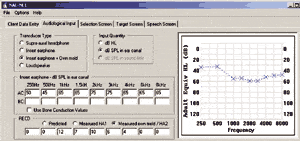
In this regard, there are some exceptional features in eTONA that will assist dispensing professionals in the real-life work environment. eTONA will provide users with a Transaction Browser (Figures 1-2) to track the status of all orders, for all manufacturers, across all the patient records in your database. The browser is designed to allow hearing care professionals to conveniently check the status of orders at the end of the day or any time, as necessary. Getting status updates is as easy as clicking on a button or allowing eTONA to automatically query each manufacturer for updates. The Transaction Browser provides two main views to help the dispensing professional determine the status of an order. The Overview screen (Figure 1) provides a quick view of orders by patient and the orders current status. The browser can also provide a detailed account of the order history (Figure 2). Using the available views, the Transaction Browser allows you to track your orders from the time the order was accepted to the time when it was shipped from the manufacturer.
Occasionally a manufacturer may have an important issue to bring to the attention of the dispensing professional about the specifics of an order. For example, the manufacturer may determine that the patients ear is too small for all the components (eg, t-coil, large battery, D-Mic, etc) that the original order calls for. When this occurs, manufacturers can send status updates and mark them as High Importance (Figure 3). The high importance message will signal eTONA to pop up a warning message that can be shown to the NOAH user that created the order and other appropriate employees within the office. The Internet, Security, and HIPAA A large concern for many dispensing professionals when using the Internet is security. In discussions with hearing care professionals, weve found that the actual transmission of product orders (ie, misuse of credit card information) is not the greatest concern; the fact is that many people routinely order books and other products/services over the Internet and this has become much more commonplace. However, hearing care professionals have voiced great concern over the security of patient data. In the past year, the industry has been hearing a lot about HIPAA privacy issues, but not much attention has been focused on the security mandates because they have yet to be formally released. However, HIMSA has paid a lot of attention to the proposed HIPAA security regulations, devising eTONA so that it will be able to securely transmit orders and receive status updates using encryptionmuch like online banking Web sites. Essentially, eTONA will encrypt product orders and status updates by completely rearranging the information with numbers and letters so that it is unreadable as the data passes between a dispensing professionals office and a manufacturer. Both eTONA and the manufacturer will retain special keys which will allow the data to be decrypted back it to an understandable format.
Summary
Correspondence can be addressed to Scott Peterson, HIMSA, 2550 University Ave. W, St., Ste. 241N, St. Paul, MN 55114; email: speterson@himsa.com. References |
|
|
|
ADDITIONAL ONLINE RESOURCES |
|