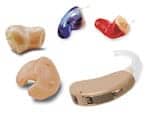
Issue StoriesA New Solution to Telephone Feedbackby Donald Hayes, PhD, and Andi VonLanthan, MS A system that detects and controls acoustic feedback in telephones and listening devices. Using the telephone is a major inconvenience for people with hearing loss. Up to three-quarters of surveyed hearing aid wearers describe their experience with the telephone as unsatisfactory, fair, or poor.1,2 In other words, most people find their hearing aids to be inconvenient and often ineffective on the telephone. Because of the importance that the telephone plays in modern life, it can be argued that a convenient hearing aid is one that improves speech perception through the telephone without complicating or impeding the normal use of that phone. Telephone & Hearing Aid Incompatibility Due to Feedback
The effects of handset-induced acoustic feedback are visible in Figure 1. Two speech recordings were made through a telephone handset as it was held by the wearer of a powerful behind-the-ear (BTE) hearing aid. The blue line shows the frequency response of the hearing aid without the presence of acoustic feedback, and the orange line shows how the frequency response changes once oscillation occurs. The oscillation generates two sharp gain spikes at approximately 2300 Hz and 4600 Hz, respectively. Note that the 40 dB spike at 4600 Hz is well beyond the 3400 Hz bandpass of the telephone handset. Controlling Telephone-Induced Feedback Multimemory hearing aids may be fitted with a special telephone program that limits amplification outside the bandpass range of the telephone handset. This method requires a multi-memory hearing aid with a selection switch, push button, or remote control to engage the telephone program. Otherwise, once the output of the aid is limited enough for telephone use, the loudness, clarity, and quality of speech for all other situations is severely compromised. Even with these compromises, telephone-induced feedback is not always eliminated using this approach.5 Furthermore, the switch must be tampered with before picking up the handset, after putting down the handset, and anytime it is inadvertently pressed by the handset while talking on the telephone. For these reasons, the most common telephone solution has been the telecoil. The hearing aid telecoil breaks up the acoustic feedback pathway by disabling the hearing aid microphone and picking up the telephone signal through magnetic induction.6 A telecoil may be used alone or with a secondary magnetic coupling device that further boosts the intensity of the signal.2 Unfortunately, since the telecoil disengages the microphone, it is impossible to hear any acoustic signals through the hearing aid without switching the microphone back on. The telecoil usually requires an additional switch on the hearing aid. Furthermore, for maximum sensitivity, it needs to be properly oriented to work with the telephone. Optimizing the telephone handset signal inadvertently reduces the sensitivity of the coil for neck loop and room induction systems.6 Modern telephonesparticularly mobile phonesare often not compatible with a telecoil, and small hearing aids, such as completely-in-the-canal (CIC) aids, have no space for the telecoil. Each of these methods can reduce or outright eliminate telephone-induced acoustic feedback. However, in the process of curtailing feedback, each of these solutions can introduce compromises that limit the convenience of telephone use. Predictably, this often leads to the least desirable solution of all: removing the hearing aid to use the telephone. Consequently, while feedback elimination has been obtained, the primary objective of convenient and effective telephone use for all hearing aid wearers has not been totally realized. A hearing aid is truly not telephone compatible until the telephone can be used normally, as if the hearing aid were not even there. Telephone Convenience in Real-Time A transparent, real-time, feedback suppression system, called ClearCall, has been developed by Unitron Hearing to make telephone use as convenient for hearing aid wearers as it is for everyone else. This new system utilizes a channel-specific feedback canceling approach that is able to detect and control acoustic feedback within 12 independent channels, adaptively and rapidly. Within every 500 Hz-wide channel, a fully independent and adaptive feedback canceling system is active. Six or more feedback peaks can be independently eliminated without affecting the output of any of the other channels. This minimizes the impact of the feedback canceling system on sound quality and speech clarity, even in the presence of multiple peaks.
The effect of the system is demonstrated in Figure 2. Both curves show the RMS average output of a hearing aid for 20 seconds of running speech through a telephone handset. ClearCall was engaged for the recording of the blue curve and disengaged for the orange curve. Figure 2 indicates that the major feedback peaks have been completely suppressed by the system. The owner of this hearing aid, who has a severe bilateral sensorineural hearing loss, has used the system for several weeks and reports clear, comfortable, and convenient listening on the telephone.
One of the most important parameters for any feedback suppressor is its activation time. Feedback canceling systems, especially currently available phase cancellers, typically require a long activation time. This can lead to initial feedback for several seconds.4 With an activation time of less than 100 ms, ClearCall controls and eliminates feedback often before audible whistling occurs. A feedback loop requires some time to build up. The longer the activation time, the stronger and louder the feedback signal. Thus, the sooner feedback can be detected and suppressed, the less buildup time there is available for the peaks to reach their maximum amplitude. A fast activation time prevents the user from experiencing feedback when using the telephone. Figure 3 demonstrates how the system can suppress significant acoustic feedback in nearly real time. For Figure 3, a telephone was placed against a hearing aid to drive it into oscillating feedback. After the hearing aid was allowed to whistle/ring for a few seconds, the feedback suppressor was engaged and the oscillations completely ceased in less than 65 milliseconds. Summary
References |
|
|
|
ADDITIONAL ONLINE RESOURCES |
|