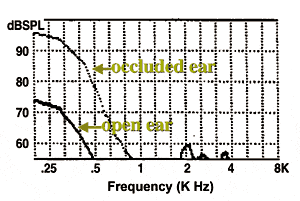
Issue StoriesA High-Definition Compression System for Open Fittingsby Jennifer Groth, MA, and Brian Dam Pedersen, MScEE A technical review of a system that utilizes 3-band compression and frequency shaping. Providing amplification to individuals with hearing loss in the high frequencies presents a challenge to hearing instrument designers. The patient with good hearing in the low frequencies requires a fitting that allows the escape of low frequency bone-conducted soundslike the wearers own voicefrom the ear canal to avoid the sensation of occlusion. In addition, the amplification system should not add noise that the wearer will be able to hear. Finally, the open nature of such a fitting means that unamplified sound will enter the ear canal directly and mix with amplified sound from the hearing instrument. Depending on the lag between the direct and amplified sound, the result can range from a slight alteration in the timbre of the incoming sound to a perception of reverberation. A hearing instrument intended for fitting high frequency hearing losses, the ReSoundAIR from GN ReSound, has been developed to effectively address these challenges. The device is fit without occluding the ear canal, and features Stabilizer feedback cancellation to extend the amount of usable gain, allowing the fitting of a large range of high frequency hearing losses. It also utilizes an innovative compression system design that provides frequency shaping flexibility with minimal internal noise and distortion. Further, the sound processing time is exceptionally low. This article describes the WarpOpen compression system for open hearing instrument fittings in ReSoundAIR hearing aids. The system consists of high-resolution frequency response shaping for soft sounds combined with a 3-band low distortion compressor, and low level expansion to ensure that no internal noise is audible. Frequency Shaping System One particular benefit of this type of filtering is that the manner in which transient sounds are processed correspond better to auditory system processing than other digital filter techniques. The WarpOpen is the first hearing aid compression system to make use of this technique. The minimum-phase FIR filter used in the system corresponds to the resolution of the Cochlea Dynamics compression system used in the GN ReSound Canta series of hearing instruments. The settings of the filter determine the precise gain for soft and moderate level inputs to the hearing instrument.
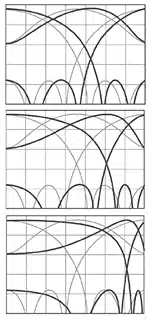
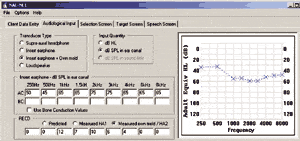
Compression Technique The WarpOpen employs a 3-band filter bank system to achieve fast-acting WDRC separately from the frequency-shaping system described above. A signal processing technique, called frequency warping, enables variable cross-over frequencies in the compressor filter bank. Depending on the desired gain settings, the cross-over frequencies are automatically adjusted to best approximate the response. Examples of how the compressors band structure changes based on the gain prescription are shown in Figure 1. The frequency warping technique is designed to offer better processing efficiency and virtually no cross-over region distortion. This means that there are no dips or bumps in the frequency response of the compression part of the system. Like the compressor used in the existing Canta series, the WarpOpen compressor is controlled by a number of gain handles for soft and loud gain. The fitter sets the gain for these inputs using a number of frequency handles as shown in Figure 2, and these settings are transformed to control the system. The crossover frequencies in the filter bank are automatically optimized so it is not necessaryor possiblefor the fitter to adjust them manually.
Placing the Compression Before the Frequency Shaping
The advantage of placing the compression part of the system in front of the frequency-shaping portion is that the estimates of the input power are thereby accurate. The drawback in performing the frequency shaping firstas done in other commercially available systems where frequency shaping and compression are implemented separatelyis contamination of the input power estimation. If the input power estimation is not accurate, the compression applied will not be based solely on the level of the input signal; rather, it will be heavily influenced by how the system is set to amplify low level sounds. This has the important implication that gain for all sound levels can be lower or higher than desired. Open Fitting Capabilities However, a low propagation delay does not guarantee optimum conditions for an open fitting. One of the potential advantages of an open fitting is improved localization ability.2,3 Therefore, it is important to ensure that interaural directional cues are not lost in the signal processing. To accomplish this, it is essential that the delay does not change over time. Traditional low-delay filter bank structures change their delay quite drastically when the compressor alters gains due to changes in input power. This phenomenon is completely avoided with the WarpOpen because of the systems choice of filter structures which has a fixed propagation delay regardless of the input level of incoming sounds. Low Noise and Distortion As a result of the design advantages described above, the compressor has very low internal noise and distortion. As a further precaution against circuit and microphone noise, a low level expansion system has been implemented in the device. This system reduces gain for very low input levels, ensures that internal noise is inaudible, and that low level environmental noise is not overamplified. Summary
References |
|
|
|
ADDITIONAL ONLINE RESOURCES |
|