Issue StoriesSolving the Occlusion Effectby Wayne J. Staab, PhD A new style of hearing instrument has been developed that consists of a separate speaker designed to fit deeply in the ear canal, and one of the reported benefits of the new device is its effectiveness in eliminating occlusion. This article reviews the new device relative to the occlusion effect. The occlusion effect is the sensation of increased loudness (sound pressure level), especially in the low frequencies, a person experiences to self-generated sounds (vocalization, chewing, swallowing, walking, and the like), when the ears are covered (occluded). The occlusion effect appears to be a consequence of the transmission of this increased signal through the normal middle ear, not appearing to be present when middle ear pathology exists. The reason for the absence of an occlusion effect in middle ear losses is the inability of the middle ear system to transmit the increased SPL to the cochlea.1 Explanations for the occlusion effect have been quite varied and a number of origins (sources) have been proposed, including: Masking Theory,2-4 Outflow Theory,5 Inertial/osseotympanic Theory,6,7 and Impedance Theory.8-10 Regardless of the origin, Feldman et al.1 offer an appropriate operational explanation when they state: ...one would be hard put to assume that the occlusion effect was not a consequence of a signal generated peripheral to the tympanic cavity and that the occlusion effect is nothing more than the transmission of some of this increased SPL through the normal air-conduction pathway.1 The occlusion effect is usually described by hearing aid wearers as it sounds like I am listening in a barrel, my voice sounds too loud, I can hear my footsteps and other body-generated sounds, etc. This is a common complaint by wearers of hearing aids when the device or earpiece in the ear canal is not properly fit. The magnitude of the increased SPL when wearing traditional instruments terminating in the cartilaginous ear canal (as measured using probe microphone procedures) is approximately 25 dB at 250 Hz, but varies by individual. The resultant increased loudness sensation, as experienced by the wearer of hearing aids, can be reduced often by use of a large vent at least 2 mm in diameter.11 However, when venting leads to feedback, an earpiece fitted deeply into the ear canalproviding full contact with the bony canal structureis the alternative option to reduce the occlusion effect.12-19
Test Instrument
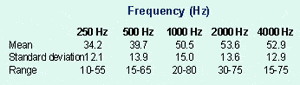
Study Methods and Results An occasional concern expressed with deeply fitting hearing aids relates to the potential insertion problems; traditional earmolds are often difficult to navigate comfortably past the bends of the ear canal. Because the PAC instrument is designed to be fitted deeply, subjects were allowed a self-practice session to learn how to insert the speaker assembly for acceptable sound quality when they spoke. Although the magnitude of the occlusion effect varied with practice of the PAC tip insertion, all subjects learned quickly to insert the earpiece to obtain the minimum occlusion effect.
Figure 3 shows the individual variability of the multiple insertion process. During this training session, which was monitored, the shallower the insertion, the greater the occlusion effect (as might be expected). For Subjects 10, 3, and 8, the shallow insertions are identified with the letter S. It is important to confirm that minimal Occlusion Effect Meter measurements relate to the approval of ones own voice (sound quality/loudness), and although not evaluated systematically, subjective reports of vocal approval were in good agreement with meter readings. The PACs insertion depth was found to be a critical factor by the subjects. Occlusion Effect and Seal Contrary to what might be expected, the best seal did not necessarily translate to the greatest reduction in the occlusion effect, nor did the poorest seal show the greatest occlusion effect. As a result, the relationship between having a good seal and maximum reduction of the occlusion effect is not clear. However, if feedback is not an issue, a good seal may be a non-issue because the designed earpiece functioned sufficiently well to reduce the occlusion effect. Still, it appears that in all cases the speaker assembly arrangement used provided an effective acoustic seal (range from 12.5 dB-30 dB). Summary While a good acoustic seal deep in the ear canal is considered essential to the reduction of the occlusion effect, the data did not show an absolute relationship between the magnitude of the seal and the magnitude of the occlusion effect reduction. The data does suggest that this style hearing aid, while developed to address a number of the continuing issues related to deep canal hearing aid technology, effectively manages at least one of the major problems wellthat of the occlusion effect. Using this new hearing aid fitting tool, dispensing professionals increase their chances to better satisfy many current hearing aid purchasers and remove a leading reason hearing aids are returned for credit by prospective, first time purchasers. Acknowledgments
References |
|
|
Featured Jobs
Find a Job |
ADDITIONAL ONLINE RESOURCES |
Featured Employer
|