Issue StoriesReducing the Negative Effects of Reverberation in Hearing Aid Processingby H. Christopher Schweitzer, PhD, and Desmond A. Smith In some cases, processing properties of AGC hearing aids may be contributing to the difficulties encountered by hearing aid wearers, says this technical report. A look at this premise and the development of an alternative processing approach to reduce reverberation is offered. Reverberation is a well-studied acoustical property that often complicates hearing aided listening. It is possible that processing properties within many nonlinear hearing aids may be contributing to the difficulties encountered by hearing aid wearers. An examination of this premise and the development of an alternative processing approach designed to mitigate many of the difficulties of reverberation are discussed in this article. The Basics of Reverberation Some of the effects of reverberation on speech identified by Assman & Summerfield1 include 1) smearing and prolonging of spectral change cues, such as formant transitions; 2) smoothing out of the waveform envelop, and 3) increase of the low-frequency energy with greater resultant masking of the higher frequencies. Final consonants are particularly susceptible to interference.2,3 Stop consonants are also vulnerable to filling in the silent gaps during stop closure. Reverberation also obscures information pertinent to rates of spectral change.4 This causes confusion between stop consonants and semi-vowels. Sussman et al.5 also noted how reverberation interferes with second formant transition perception as these parts of speech tend to persist unnaturally. Place of articulation errors are often the observed consequence of this type of interference from reverberation. Generally, the effects of reverberation on speech intelligibility are quite complex and not well described by spectral-based analysis methods such as the Articulation Index. This is partly due to the fact that, for normal-hearing listeners at least, binaural de-verberation processes come into play. On the other hand, the effect of reverberation and noise combined is considerably worse than noise alone. This is fairly well-modeled by the Articulation Index.3,6 Extensive evidence indicates that interference of echoes on target speech sounds is considerably worse for the typical hearing-impaired listener.7-9 Hence, it would be of particular importance to ensure that a hearing aids signal processing operations do not impose further complications to an already acoustically troublesome situation.
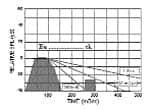
A simple illustration of one of the principles of reverberation interference on a speech sequence is shown in Figure 1. It is based on an example developed by Everett.10 A single spoken word, back, is shown with the consequence of three different reverberation times. The rising sound pressure of the [bę] component peaks about 320 milliseconds before the [k] sound which trails by about 100 milliseconds. The peak amplitude of the final [k] is 25 dB less than the [bę] in this representation. If the reverberation time of the room is about 250 milliseconds, the initial and more intense [bę] will have decayed sufficiently below the peak energy of the [k] so as not to cause masking. However, if the room reverberation time is longer, as in the lines representing decays of 500 milliseconds and 1 second, masking of the trailing final consonant is almost certainly to occur. This is a fairly simple case of aggravated forward masking. For such long reverberation times, as is often found in auditoriums and large public spaces, the bounce of reflected sound is well known to compromise speech clarity for most listeners. But what about in the softer and smaller volume acoustical conditions which more typically confront hearing aid users at home or in the office? Is reverberation a problem for hearing aids when the RT-60 is as low as the 250 millisecond line drawn in Figure 1? The answer may well depend on the particular processing properties of the hearing aid amplifiers and the prospect for complications from standing waves which are not necessarily revealed by conventional RT-60 values. Examining Reverberation Problems in AGC Processing For purposes of this investigation, a digital compression hearing aid of a two-channel design was evaluated in contrast to a new approach that specifically attempts to reduce the effects of reverberation interference in a typical living room. A development platform in use at Acoustimed (Pty) Ltd was configured to make comparisons between a hearing aid configured in a standard, commercially available, compression approach and a proprietary configuration. The standard compression set-up was configured using the FIG611 prescription for a flat hearing loss of 60 dB. For analysis purposes, the frequency response was adjusted to be flat (within 3 dB) for a 65 dB input from 100 Hz to 5 kHz. Expansion was set at 30 dB to reduce the low level ambient noise. Other details are as follows: crossover frequency was located at 1.6kHz; the low-frequency channel compression threshold (CT) was set to 40 dB, and the compression ratio (CR) was 2.5:1. In the high-frequency channel, the CT was also set at 40 dB, and the CR was 3.6:1. A fast attack and release time for both channels was enabled (32 milliseconds) for fast (transient) input signals; a slow attack and release time in both channels was enabled (256 milliseconds) for less rapid input changes. The slow release time was implemented to avoid pumping and to preserve the relative intensity of the vowels. These time constants are within the operating range of many commercial hearing aids. Samples of connected discourse were presented to the hearing aid attached to a 2cc coupler. The speaker was located at a distance of 75 cm from the hearing aid microphone, and the average speech level adjusted to 65 dB SPL. The room was a standard office with a computer fan operating. The measured ambient noise at the location of the hearing aid was 45 dBA. An alternative hearing aid design was programmed into the same hearing aid with the specific objective of reducing low-level reverberation. The basic operating properties were set to match the standard hearing aid as much as possible. However, a key difference was that the expansion properties were set to a threshold of 50 dB input level rather than the 30 dB of the more standard approach. Furthermore, the amplifier remained linear through a range of inputs that would include most speech sounds, up to 90 dB. The expansion time constants were 16 milliseconds for attack and release.
Figure 2 shows an Input/Output curve (400 Hz) for the compression hearing aid (red) and for the reverberation control hearing aid (blue). The dotted green line provides a linear reference up to 90 dB with no further output allowed. The operational differences are perhaps more clearly illustrated by the Input/Gain curve shown for the same frequency and input range in Figure 3.
A hearing aid that operates linearly through the input range of 50 dB-90 dB is noteworthy for its non-conformity to the standard assumptions and approaches that use Wide Dynamic Range Compression (WDRC). WDRC attempts to both maximize audibility and, to some extent, normalize loudness. However, the possibility for introducing greater audibility of ambient noise has encouraged the introduction of a variety of noise reduction algorithms.12 In general, these algorithms are programmed to attenuate steady-state types of noise, but may introduce artifacts themselves as the attenuation is suddenly relaxed in response to the detection of speech. Initial Trial Fittings Figure 4. Four spectrograms of a 20-second passage of a male talker (Prince Phillip). Sample A is the original studio recording. Sample B is the same passage replayed and recorded in a quiet office environment at a distance of 75 cm. Low level noise and reverberation clearly fill in the inter-syllabic spaces. Sample C is the output from the standard compression hearing aid with speaker at the same distance and level as in Sample B (average speech level was 65 dB). In this sample, the hearing aid shows some improvement of the high frequency content, but the spaces between syllables still contain considerable noise and reverberation content. Finally, Sample D shows the output for the reverberation control hearing aid for the same conditions as in Samples B and C. A considerable recovery of the inter-syllabic spaces is evident. Obviously systematic performance measures are required and such studies are underway. However, the informal clinical observations and interviews with early users suggest that the approach may provide a kind of phonemic edge enhancement13,14 which allows for greater clarity of the co-articulated speech components. This speculation relates to the considerable reduction of low-level noise, especially reverberation in typical office and living room environments. This can be seen quite clearly in the spectrographic samples of connected discourse that are shown in Figure 4. The reader is also invited to listen to the sound samples from which these spectrographs were made by visiting the Acoustimed Website at www.acoustimed.co.za/EchoStop.htm. The 20-second sample shown in Figure 4 is a passage of a studio recording of Prince Phillip, Duke of Edinburgh, in a commentary on economics. Sample A is the original; Sample B is a recording in the semi-reverberant room at a distance of 75 cm. The average speech level was adjusted to 65 dB. Noise and reverberation are clearly filling in the inter-syllabic gaps. In Sample C, the standard compression aid was presented at the same distance and level as in Sample B. The noise between the syllables is quite prominent. Finally, Sample D shows how closely the Reverberation Control hearing aid resembles the original recording, providing greater separation between syllables and clearly reducing the noise between the phonemic elements.
As a means of quantifying the extent to which the noise was reduced, a spectral analysis of the two hearing aids was conducted and referenced to the 45 dB room noise. This is shown in Figure 5 where the 0 dB reference line is the noise at the coupler microphone without any hearing aid and the coupler removed.
More on Room Acoustics
This is in marked contrast to Figure 7 where a 200 Hz puretone burst was used. In this case, the contribution of standing waves contributed to increase the reverberation time on the order of over 2.5 times. Here, the greatest amplitude of the sound at the microphone is occurring after the signal has desisted! The best estimate of the time it takes for this tone burst to decay by 60 dB is over 900 milliseconds. Similar analysis of the word back clearly showed a tendency for much longer effective reverberation time than the nominal, and more standardized, RT60 assigned to the room. This is presumably attributable to the tonal property of the voiced portions of the word and the presence of standing wave complications. Summary and Discussion Reverberation is also apparently more daunting than simple analysis seems to suggest. Even within relatively common-sized rooms, acoustics are likely to be a complicating factor that reduce speech clarity in an otherwise appropriately prescribed amplification scheme. This might relate to why many hearing aid wearers report superior TV listening in their living rooms with directly coupled audio listening devices than with their own advanced digital hearing aids. The approach detailed in this report involves altering the input/output properties of a digital 2-channel hearing aid platform to provide substantially more expansion than is commonly used, and a linear operating mode through the speech frequencies. Acoustical analysis of the standard compression approach and reverberation control method indicates a 50% reduction in reverberation and a nearly 20 dB reduction in ambient noise. Initial fittings with this design have been highly favorable in terms of consumer acceptance. The approach has a serendipitous and significant reduction in the tendency for acoustic feedback, since gain is reduced during low input intervals. Hence, larger vents can be used in the fittings.
References |
|
|
|
ADDITIONAL ONLINE RESOURCES |
|