Issue StoriesSudden Hearing Loss: Unique Challenges and Opportunitiesby Maurice H. Miller, PhD, guest editor An introduction to the topic of sudden sensorineural hearing loss (SSNHL), and a look at the issues and articles discussed in this special edition of The Hearing Review. This special issue is dedicated to our esteemed colleague Michael K. Wynne, PhD (1954-2003)
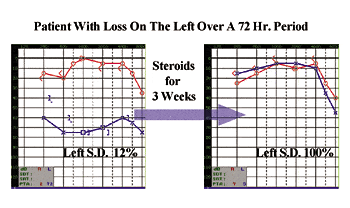
Despite its identification over a century ago, sudden sensorineural hearing loss (SSNHL) remains a persistent clinical enigma, both as to its diagnosis and its management. Unlike the majority of hearing losses in adults which are slowly and stealthily progressive, SSNHL is a frightening and mysterious event because of its sudden, typically unannounced appearance. In this context, we refer to a unilateral sensorineural hearing loss which may range from a mild hearing loss to a profound hearing loss over at least 3 contiguous frequencies occurring in 3 days or less as sudden deafness (SD).1 Often it is noted by the patient upon arising in the morning, making the exact time of its occurrence uncertain. Idiopathic SSNHL A variety of treatable causes of SD are discussed in the articles by Drs. Fayad & De La Cruz (pages 20-23) and Drs. Wazen & Ghossaini (pages 38-41). Identification and management of these conditions are essential. A detailed history by knowledgeable and experienced specialists and appropriate audiological, laboratory, and radiological procedures may be necessary to establish the diagnosis and to map the course of treatment. These cases of SD should not be classified as idiopathic since their etiology can be established. When such conditions are determined and appropriate treatment is carried out, a large number of patients remain who have a sudden hearing loss correctly considered idiopathic and are frequently considered of viral or vascular etiology. Treatment decisions are difficult to make in such cases and present a conundrum to practitioner and patient. To Treat or Not to Treat? I often ask my students, If you developed a unilateral sudden sensory hearing loss, what would you do? And, if you believe in management by specialists (as I do), how would you negotiate your way through the managed (mismanaged?) system of health care to get to specialists familiar with your condition? Any physician can write a prescription for cortico-steroids, but this author believes this is not the way to go unless justified by thorough evaluation of the condition to identify treatable cases of SSNHL in which a specific etiology can be established. Knowledgable otologists and audiologists should manage patients with these conditions. Drs. Halpin & Rauch (pages 32-35) report on a recent study conducted by Chen, Halpin & Rauch4 involving a control group of 52 patients with ISSNHL who declined treatment or had medical contraindications to use of steroid therapy. In 60% of 266 steroid-treated patients, there was an average improvement of 29 dB for frequencies of 500 Hz, 1000 Hz, 2000 Hz, and 4000 Hz. This was a better outcome than seen in the 52 untreated cases where a spontaneous improvement averaging 11 dB was found. The study, based upon a 10-year retrospective analysis, appears to argue strongly in favor of steroid treatment for patients with ISSNHL. Of this I am certain: All hearing care professionals need to know more about ISSHL. There are some otherwise excellent texts in audiology where the topic is not even indexed. Most of the literature on the subject appears in otologic and other medical texts. And yet, many SD patients first appear in the office of an audiologist or an hearing instrument specialist. SD: Rehabilitative Aspects Dr. Schein and I discuss the rehabilitative aspects of SD management (pages 42-43) and, here again, counseling is of pivotal importance. Clearly, medical/surgical treatment to restore hearing is not indicated in many cases. For such patients, aural rehabilitation is essential and tends not to be given serious and sufficient consideration in much of the literature. Miller & Schein5 regard rehabilitation planning and execution as the immediate responsibility to the decision to adopt the label ISSNHL. We hope you enjoy and find professionally valuable this special edition of HR on the topic of sudden hearing loss. References Correspondence can be addressed to Maurice H. Miller, PhD, Department of Speech-Language Pathology and Audiology, New York University, 719 Broadway, New York, NY 10003; fax: (718) 793-4645. |
|
|
Featured Jobs
Find a Job |
ADDITIONAL ONLINE RESOURCES |
Featured Employer
|