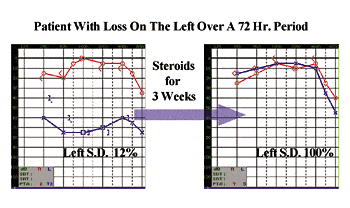
Issue StoriesEtiologies and Treatment Options for Sudden Sensorineural Hearing Lossby Jose N. Fayad, MD, and Antonio De La Cruz, MD Sudden hearing loss is a common medical emergency, with 5 to 20 individuals per 100,000 population per year experiencing SSNHL. Two otologists from the House Ear Institute explain the causes and treatment strategies for sudden hearing loss. Sudden hearing loss is a common condition. Fortunately, it is usually unilateral. By definition, sudden hearing loss is a decrease in hearing that occurs over a short period of time from a few hours to a few days. Etiology and management of this entity have been the subject of much debate over the years. The estimated incidence in the US of sudden sensorineural hearing loss (SSNHL) ranges from 5 to 20 individuals per 100,000 population per year. Prevalence, Natural History, Prognosis The most common presentation is of a patient who notices a unilateral hearing loss on awakening. In others, hearing loss is sudden and stable. Occasionally, patients will notice a fluctuating hearing loss. Tinnitus is usually present in the ear and sometimes precedes the onset of hearing loss. Aural fullness can be present. Up to 40% of the patients complain of dizziness, vertigo, disequilibrium, and imbalance. Four different variables appear to affect the prognosis of idiopathic sudden sensorineural hearing loss: 1) the severity of the loss; 2) the association with vertigo; 3) the age of the patient; and 4) the audiogram shape. Upsloping and mid-frequency losses recover more frequently than downsloping and flat losses. The worst prognostic factors include a more severe hearing loss, the presence of vertigo, reduced speech discrimination, and an age of more than 40 years. Most of the recoveries occur in the first 2 weeks after the onset of hearing loss. The longer the loss persists, the worse the prognosis for recovery. Without any treatment between 30% and 65% will experience partial or complete recovery. Etiology of SSNHL: Infectious Disorders Meningitis. Meningitis is a common etiology of acquired severe-to-profound sensorineural hearing loss. Rare cases of idiopathic sensorineural hearing loss may be caused by subclinical meningoencephalitis. Syphilis. The incidence of syphilis in patients with ISSNHL is 2%. Hearing loss may be associated with vestibular symptoms. It may cause a unilateral or bilateral sensorineural hearing loss. It can also result in the reactivation of syphilis in patients with HIV (human immunodeficiency virus) infection. Acquired immune deficiency syndrome. HIV is not a common cause of ISSNHL, but it has been documented as such in rare instances in the literature. Some of these cases may be the result of reactivation of latent syphilis or cytomegalovirus (CMV) infection. Neoplasms Meningioma, cholesteatoma, hemangioma, arachnoid cyst, metastatic lesions, and skull base tumors that erode into the inner ear can present with ISSNHL. Trauma and Other Causes Perilymphatic fistula. Perilymphatic fistula may be accompanied by sudden or fluctuating sensorineural hearing loss and varying degrees of vestibular symptoms. There is no reliable test to diagnose such a fistula. Intracochlear membrane breaks. Membrane breaks have been documented pathologically in patients with endolymphatic hydrops and have been proposed as an etiology for sensorineural hearing loss. Experts are divided as to whether 1 or 2 membrane breaks are the cause of ISSNHL. Pharmarcologic toxicity. Insecticides such as melathion and methoxychlor have been associated with bilateral sensorineural hearing loss. Prescription drugs can cause a relatively sudden onset of sensorineural hearing loss. The list is very long, and includes Interferon. More recently, abuse of certain painkillers has been incriminated as a cause of rapidly progressive SNHL. The link between hearing loss and high doses of painkillers like Vicodin, Lorcet, and OxyContin was not well-known. Chronic abuse of these medications may cause sudden hearing loss. Immunologic disorders. A subset of sensorineural hearing loss cases is caused by inner ear autoimmunity disorders (AIED). Well known autoimmune diseases have been associated with sensorineural hearing loss. These conditions include Cogans syndrome, systemic lupus, erythematosis, temporal arteritis, and polyarteritis nodosa. AIED can result in a rapidly progressive hearing loss and subsequent hearing loss if left untreated. Therapy that targets the immune system is considered standard treatment for AIED. High-dose Prednisone is known to reverse hearing loss and maintain hearing, but usually cannot be tolerated for long periods of time. Prednisone in combination with other drugs has been used as an approach to long-term management of hearing loss due to AIED. Cytotoxic drugs were initially considered, but since these agents can have serious side affects, long-term risks are unacceptable, especially in the younger population. Methotrexate has been investigated as a possible drug for the maintenance of long-term hearing in these patients. Methotrexate offers the advantage of being safer and better tolerated than cytotoxic drugs. Unfortunately, a recent, randomized, controlled clinical trial demonstrated that Methotrexate is no more affective than placebo in maintaining hearing improvement in patients with AIED who had initially benefited from high-dose corticosteroids. The results of this study clearly underscore the need for more effective and less toxic therapy for AIED. Vascular disorders. Sudden hearing loss can occur with occlusion of the cochlear blood supply. Vascular occlusion is thought to be the etiology of ISSNHL in a certain number of patients. Arguments against the circulatory etiology include a high incidence of spontaneous recovery, significant incidence in young patients, lack of an apparent increased incidence in diabetics, the fact that the hearing loss frequently is limited to just a few frequencies, and the fact that most patients do not have vertigo. Temporal bone studies have not found evidence of vascular occlusion in cases of ISSNHL. The role of vascular occlusion versus viral infection in these idiopathic cases has been the subject of extensive debate. Migraine, hemoglobin sickle cell disease, microglobulinemia, hypercoagulability disorders, and rare cases of thromboangeitis obliterans have been associated with SSNHL. Cerebellar infarctions may mimic labyrinthine lesions. Cardiopulmonary bypass, transplant surgery, and non-cardiac surgery have also been associated with an increased risk of SSNHL. Sudden sensorineural hearing loss was also reported after spinal manipulation with probable injury to the vertebral basilar arterial system. There was no significant difference in the audiologic pattern between diabetic and non-diabetic ISSNHL patients. Wilson and others found that diabetic ISSNHL patients were less likely to recover hearing at higher frequencies. Developmental abnormalities. Inner ear malformations, especially large vestibular aqueduct syndrome is associated with sensorineural hearing loss, which frequently occurs in a progressive fashion associated with minor head trauma. Idiopathic disorders. Menieres disease, multiple sclerosis, sarcoidosis, psychogenic disorders can be the source of SNHL. Treatment of SSNHL Steroids are the most widely accepted treatment option for ISSNHL. In our clinic, we use a taper of Prednisone over 2 weeks. We start with 60 mg orally, once a day in the morning for 9 days, and then taper over the following 5 days. Vasodilators and other medications have also been used extensively in the treatment of sensorineural hearing loss. The list includes intravenous Histamine effusion, oral Papaverine, or oral Nicotinic Acid, Carbogen, low molecular weight Dextran, Manitol, Pentoxifylline, and Heparin. The literature on the previously mentioned agents have shown poor to mixed results. In our clinic, we use vitamins of the lipoflovanoid group, vitamins B and C complex (LBC), Niacin, and Pavabid. Because of the evidence for a viral etiology, treatment with oral and antiviral medications, such as Acyclovir or Famvir, has been used. Clinical studies supporting the efficacy of any of these treatments is yet to be established. Famvir (500 mg by mouth, 3 times daily for 10 days) or Acyclovir (800 mg 5 times daily for 10 days) has been employed. A low salt diet (1.5 grams to 2 grams) is recommended with a hydrochlorothiazide diuretic and potassium supplements if we suspect endolymphatic hydrops. Middle ear infusion of steroids is also gaining popularity (see the article by Halpin & Rauch in this issue of HR). Treatment Options Conclusion
Suggested Reading Correspondence can be addressed to HR or Antonio De La Cruz, MD, 2100 West Third Street, Los Angeles, CA 90057; email: adelacruz@hei.org or jfayad@hei.org. |
|
|
Featured Jobs
Find a Job |
ADDITIONAL ONLINE RESOURCES |
Featured Employer
|