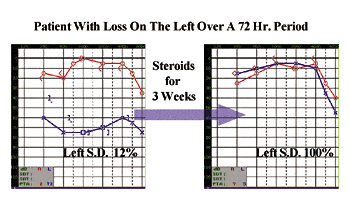
Issue StoriesRehabilitative Aspects of ISSNHLby Maurice H. Miller, PhD, and Jerome D. Schein, PhD Amplification and bone conduction options for those with idiopathic sudden sensorineural hearing loss (ISSNHL), and why counseling is the key to success. Appropriate audiologic rehabilitation for the patient with Idiopathic Sudden Sensorineural Hearing Loss (ISSNHL) should be introduced when spontaneous recovery of hearing has not occurred or a favorable response to medication appears unlikely. The rehabilitation course should be agreed upon by the patient, the otologist, and the audiologist working together. Multiple rehabilitation optionsincluding fully digital amplification systems and bone-anchored hearing aids (BAHA) are now available to these patients, and they should be presented in counseling sessions in which the patients concerns can be addressed realistically and empathetically. The patient sustained an ISSNHL in her left ear 2 months ago. Under otologic-audiologic evaluation, treatable conditions such as perilymph fistula, blood disorders, and acoustic tumors were eliminated. The condition has been ascribed to vascular or viral etiology, and a short period of systemic steroids was recommended, resulting in no change in the patients hearing. The otologic-audiologic team now decides to consider amplification and a joint conference with the patient is conducted. The patient raises two questions:
Many patients may resist suggestions that they try a hearing aid because, to them, it means they will not recover their hearing. This attitude needs to be respected and considered by the hearing care clinician. The use of a hearing aid will not affect the course of auditory recovery, but will facilitate improved performance in a variety of listening situations. The electro-acoustic characteristics of the hearing aid can be adjusted if hearing improves, and its use can be discontinued if hearing returns to normal. When to amplify depends upon a number of factors which need to be considered (eg, patient attitude and resistance, economic factors, etc). Uppermost should be the possibility for delayed spontaneous recovery which will not be affected by use or non-use of amplification. A delay of 60-90 days is certainly justified by the odds favoring the return of normal- to near-normal hearing during this period. Even postponing for a longer period might be indicated, although the handicap imposed by ISSNHL and its effects on the ability to function in challenging listening situations needs to be considered and addressed. When the normal- or better-hearing ear is exposed to environmental noise, the ability to communicate is seriously compromised. These patients are functioning, in effect, with a significant bilateral hearing loss under such conditions. Choices need to be made among the following:
Amplification Options Until fairly recently, people with unilateral hearing losses were either not fitted with hearing aids or given a trial with a CROS hearing aid which often proved unsuccessful. In a CROS fitting, components are mounted at each ear so that sound is transferred from one side of the head to the other. In the classic CROS fitting, the microphone is mounted on the the poorer (or no) hearing ear. The output of the microphone is fed to the amplifier and receiver which are mounted on the opposite side of the head. Signals reaching the side of the poorer ear are amplified and heard in the better ear. An open earmold is used on the better-hearing ear so unamplified sound is also allowed to enter directly to the better ear. If the signal comes from one side and the interfering noise from the other, a superior signal-to-noise ratio (SNR) should occur, contributing to improved ability to understand speech in challenging listening situations.1 Feedback is reduced by the separation of the microphone and receiver. Despite the advantages of CROS amplification, it has been rejected by many who try it. One disadvantage is that a connectionusually a cable run along the eyeglass frame or around the back of the headmust connect the two sides. This is unacceptable cosmetically to many people. Wireless transmission is an alternative, but many patients prefer to live with their monaural hearing loss than to accept the amount of hardware required in such a fitting. Some patients find any component of a hearing aid system in their better ear unacceptable even when open earmolds and shells are used. Bone-Stimulation Considerations The use of transcranial ITE CROS cochlear stimulation in transcranial routing of signals by placing a hearing aid in a deaf ear was introduced in the late-1980s. Transcranial stimulation was a concept proposed by Sullivan5 in 1988. The transcranial CROS hearing aid transmits a signal from one side of the head to the other using bone conducted sound. This system is applicable to people with profound-to-total sensorineural hearing loss. The hearing aid, often of the ITE variety, is placed in the non-functioning ear. Vibrations induced on the side of the dead ear are coupled through the bones of the head to the opposite, normal-functioning cochlea. CROS or BAHA? If there has been no recovery of hearing after a period of 2-3 months, the otologist and audiologist should discuss transcranial implantation in the affected ear with the patient. The hearing care professional needs to emphasize that the possibility for return of hearing still exists and, while the suggested procedure should facilitate improved communication in a variety of listening situations, the procedure will not reduce or negate the potential for recovery. The BAHA can be deactivated should return of hearing occur. Prior to the introduction of the transcranial BAHA implant, patients with severe, profound, or total unilateral hearing loss were either left unaided or fitted with a CROS. Not to rehabilitate a patient who has a significant unilateral hearing loss denies the importance of binaural hearing in real-life situations. In general, patient satisfaction with CROS has proved unfavorable. Some patients who tried CROS systems during the trial period decided not to purchase them. In a multi-institutional study by Wazen et al.6 comparing the transcranial implantation of the deaf ear with CROS amplification, patients reported a significant improvement in speech intelligibility in noise and generally greater benefit from BAHA compared to CROS aids. There was a significant favorable impact on quality of life and no major complications were reported. Improvement in word recognition was measured with the Hearing-in-Noise Test (HINT) and greater subjective improvement was evaluated with the Abbreviated Profile of Hearing Aid Benefit (APHAB) questionnaire and the Single-Sided Deafness (SSD) questionnaire. Wazen and colleagues conclude that CROS versus BAHA performance indicated that BAHA was perceived as the more effective rehabilitative modality compared with the unaided function. (See article by Wazen & Ghossaini in this issue for more details on transcranial implantation.) In 2000, Vaneecloo et al.7 reported success with 2 patients with SSD implanted with BAHA. In a larger study of 29 patients, Vaneecloo et al.8 reported good patient satisfaction with BAHA in the deaf ear. In 2003, Niparko et al.9 reported a comparative trial of BAHA and CROS amplification on a subgroup of patients with unilateral deafness. The authors observed that subjects experienced an expanded sound-field with BAHA amplification and strongly preferred this to CROS. BAHA produced significantly better speech recognition in noise under most conditions. It also facilitated better speech recognition than CROS both in quiet and in a composite of noise conditions. Clearly, transcranial BAHA is an important addition to the clinicians armamentarium in the rehabilitation of patients with SSD resulting from ISSNHL. Conclusion
References Correspondence can be addressed to Maurice H. Miller, PhD, Department of Speech-Language Pathology and Audiology, New York University, 719 Broadway, New York, NY 10003; fax: (718) 793-4645. |
|
|
Featured Jobs
Find a Job |
ADDITIONAL ONLINE RESOURCES |
Featured Employer
|