Issue StoriesA New Method for the Collection of AEPsby Isaac Kurtz, MHSc, PEng, and Yuri Sokolov, PhD, MBA A new system for measuring auditory evoked potentials designed to reduce artifact noise by eliminating and shortening wires, while measuring real-time electrode impedance mismatch. A new method and system for the collection of Auditory Evoked Potentials (AEPs), called the Vivosonic Amplitrode, uses amplification of AEP signals right at the electrode site. The conductive portion, or lead wire, between the electrodes and the amplifier is absent or extremely short. This significantly reduces non-physiologic noise introduced into the signal detected by the amplifier. The amplifier is thus designed to amplify a signal with a much higher signal-to-noise ratio (SNR) compared to conventional electrode-to-lead wire-to-amplifier arrangements. Additional benefit is much smaller size and easier handling of the AEP device. EP Wires, SNR, and Noise To collect AEPs, electrodes are applied to the skin on the scalp and connected to a preamplifier, band-pass filters, analog-to-digital converter, and a signal-processing and user-interface device, typically a computer.3 The conductive pads of the electrodes are connected to the preamplifier through a lead wire, with a length of typically around 1m and a cable, usually about 1-2.5 m long. The amplifier amplifies the difference in electric potentials between a signal electrode and a reference electrode, both of which are affixed to the subject. Unfortunately, this arrangement of the electrode, lead wire, and amplifier has significant shortcomings. AEPs are very small in amplitudeoften in the millivolt, microvolt, or even nanovolt range in the case of Auditory Steady State Response (ASSR).1,2,3,4 As a result, AEPs are easily drowned out or lost due to noise from the electrical potentials generated by physiologic noise and non-physiologic noise (eg, radio-frequency broadcasts, high-voltage equipment, stimulus artifact radiation, and 50/60 Hz power line radiation).5 This noise occurs due to time-varying and time-invariant electromagnetic fields that may be present in a test environment where the electrode-lead wire-amplifier arrangement is employed. Time-varying electromagnetic fields are inductively and capacitively coupled to the lead wire that carries the signal from the electrode to the amplifier. Consequently, electromagnetic fields introduce noise into the lead wire that can be detected and amplified by the amplifier. A second significant source of noise is motion artifacts: noise induced in the lead wire as it moves through a static (i.e., time-invariant) electromagnetic field. To address this problem, efforts have been made to shorten the lead wire in an attempt to reduce this noise.3,5 However, it is often impractical in many applications to conduct testing on a subject with a wire that is less than about 1 m long to the amplifier. Another shortcoming with conventional AEP systems is the difficulty in determining whether the electrodes have been properly attached or affixed to the subject. Proper attachment, as typically indicated by low electrical impedance between the electrodes, is important for the recorded signal-to-noise ratio. As a result, significant care needs to be taken by the clinician to properly attach these electrodes and then carefully monitor any measured potential to judge if the measurements are indicative of improper electrode attachment. If a clinician or other operator believes that one or more electrodes is improperly attached to the subject, a time-consuming review of each electrode is necessary. To overcome this problem, most clinical AEP systems include impedance detection, a means for automatically detecting if an electrode is poorly connected with the skin of a subject. Such an impedance-detection system, however, requires additional circuitry and the introduction of another electrical current. This current and corresponding circuitry represents a further potential source of noise when detecting AEP signals. Moreover, the impedance is measured prior to testing, but there is no way to monitor impedance during the AEP test. Therefore, it can be seen that lead wires and cables introduce additional noise and affect AEP recording. From the clinical practitioners perspective, these elements are also cumbersome and sometimes a nuisance, especially if the subject is an infant or small child. Accordingly, a method for the collection of electrical potentials which addresses, at least in part, some of the above-noted shortcomings is desired. New AEP Measurement Method and System
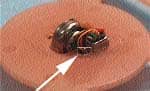
The Amplitrode implements an integrated amplifier which clips directly onto a conventional snap-type electrode (Figure 1). Due to the extremely short connection between the electrodes and the amplifier, significantly less noise is introduced into the signal detected by the amplifier. The amplifier is designed to amplify a signal with a higher SNR as compared to the conventional electrode to lead-wire to amplifier arrangements. In addition to amplifying the EP signal, the amplitrode produces an offset voltage which is proportional to the difference in impedance between the signal and reference electrodes. This measurement occurs in real-time during EP testing, which allows the system to monitor the integrity of the electrode connections and notify the clinician of a faulty connection during testing. The polarity or phase of the offset signal is used to determine which electrode contact is faulty. The system, therefore, is designed to reduce the cost, size, complexity, and total noise compared to conventional EP systems. The whole amplifier is less than the size of a quarter. Clinical Benefits Additionally, the authors believe that the ongoing measurement of electrode impedance mismatch offered by this system is more clinically meaningful and efficient than the conventional impedance check. Measured in real time, it provides the clinician with ongoing valuable information on the test conditions. The small size of the Amplitrode makes it exceptionally easy to use. Additionally, the chances of incorrectly placing the electrodes are dramatically reduced.
References |
|
|
|
ADDITIONAL ONLINE RESOURCES |
|