Issue StoriesFitting and Evaluating a Hearing Aid for Recipients of a Unilateral Cochlear Implant: The NAL Approachby Teresa YC Ching, PhD; Paula Incerti, MAud; Mandy Hill, DipAuD; and Jane Brew, MAud Part 2. Bimodal hearing should be standard for most cochlear implant users Unless there is a clear indication that bimodal device use is counter-productive, bimodal stimulation should be the standard practice for clinical management of children and adults who receive unilateral cochlear implants and who have functional residual hearing in the non-implanted ear. Part 2 of this two-part article summarizes empirical evidence on the binaural benefits derived from wearing a hearing aid with a cochlear implant (bimodal hearing devices). Editors Note: Part 1 of this article, which appeared in last months HR, described the NAL protocol for fitting a hearing aid on the opposite ear of a cochlear implant. A person who has severe to profound hearing loss in both ears but wears a cochlear implant in only one ear may experience considerable hearing deficits in localization and speech intelligibility. The ability to localize sounds is highly dependent on being able to perceive sounds in both ears. When low frequencies are clearly audible in both ears, the brain can make use of the differences in time and intensity of sounds reaching the two ears to locate where a sound comes from on the horizontal plane. When sounds are inaudible in one ear, localization becomes very difficult.1,2 Reduced localization may lead to reduced safety, and difficulties in social functioning when understanding speech is reliant on lipreading. Further, listening with two ears enables a person to understand more when speech occurs in background noise. This is because binaural processes related to head diffraction, binaural squelch, and binaural redundancy facilitate speech perception.3 Due to the physical size of the head, a sound on the right side of the head will reach the right ear a bit sooner than it will reach the left ear. It will also be slightly louder in the right than in the left ear. This head diffraction effect will enhance speech intelligibility in noise when speech and noise come from different sides of the head, because the brain can selectively attend to the ear with a better signal-to-noise ratio (SNR) for understanding speech. Even when the same signal and noise reach both ears, the brain can combine both inputs to produce more salient central representations of the speech signal (binaural redundancy) than if only input from one ear is available. The brain can also make use of the inter-aural time differences to partially reduce the deleterious effect of noise (binaural squelch). For unilateral cochlear implant users who have residual hearing in the non-implanted ear, it is possible to provide binaural hearing by fitting a hearing aid to that ear. Increasing evidence points to the binaural benefits that are possible with the use of bimodal hearing devices, including improved speech intelligibility, better sound localization, and functional improvements in real-life environments. This article examines this research and discusses clinical issues related to bimodal device use. Speech Intelligibility
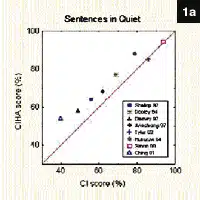
Binaural Redundancy. When speech and noise were presented from the same loudspeaker positioned at a fixed distance in front of the subject, the SNR is similar at both ears. In this test situation, binaural/bimodal hearing is still superior to monaural hearing with cochlear implant alone (CI), as long as the hearing aid causes speech in any frequency range to be audible. Figures 1a-b summarize the sentence perception data reported in previous literature for adults4-11 and for children.12-14 Results from listening in quiet (Figure 1a) and in noise (Figure 1b) are shown, with averaged results from each study represented by a data point. Greater binaural/bimodal advantage is evident for speech perception in noise than in quiet. Head Diffraction. The effect of head diffraction has been measured by presenting speech and noise from spatially separated sources in two studies for adult listeners8,10 and one study for child listeners.14 Data on the mean cochlear implant (CI) and cochlear implant and hearing aid (CIHA) scores reported in these studies are shown in Figure 1c, with each data point representing averaged results from one study. Both adults and children understood sentences better in noise when using CIHA compared to CI alone. These results were obtained when speech was presented nearer to the hearing aid side, and noise was presented nearer to the cochlear implant side. The hearing aid would, of course, not lead to any benefit (or may even be detrimental to speech perception), if speech were to come from the side nearer the cochlear implant and noise from the side nearer the hearing aid.8 Access to head diffraction differences is possible only if the hearing aid causes the mid- or high-frequency components of speech to be clearly audible. It follows that benefits due to head diffraction effects may be compromised when the residual hearing in the ear aided with a hearing aid is limited to very low frequencies, and when the hearing aid fitting does not provide adequate audibility at frequencies where there is functional hearing. The speech results from both adults and children shown in Figure 1 support the fitting of a hearing aid to the non-implanted ear of unilateral cochlear implant recipients when there is functional residual hearing in that ear. Binaural Squelch. People who use current bimodal hearing devices are not able to make use of binaural squelch to enhance speech perception in noise. This is supported by direct research into the ability of hearing-impaired listeners to make use of inter-aural time delay for perceiving sentences in speech-shaped noise.15 The study concluded that normal-hearing listeners and moderately hearing-impaired listeners using bilateral hearing aids perceived sentences better when the noise was delayed in one ear relative to the other than when it was not delayed; however, the same was not observed for listeners with more severe hearing losses, irrespective of whether they used bilateral hearing aids or bimodal hearing devices. This finding is consistent with a previous study on hearing-impaired listeners showing that the ability to use inter-aural time differences decreases as hearing loss increases, and that masking release is negligible for hearing losses exceeding 50 dB HL.16 Even if users of bimodal hearing devices have moderate degrees of hearing loss in the non-implanted ear, their access to binaural squelch will be limited by the extent to which the cochlear implant preserves fine timing information. Localization Advantages
Figure 2 shows mean results summarized from the three studies on children and one study on adults that reported root mean square (rms) localization errors. (Note: Tyler et al.8 reports a percentage-correct score rather than rms error for 3 adults tested using an array of two loudspeakers.) The data on adults were drawn from Ching et al.10 in which an array of 11 loudspeakers (a 180° arc, with loudspeakers at 18° apart) were used and pink noise pulses were presented at 65 dB SPL from one of the loudspeakers at random. The subjects responded by identifying the loudspeaker from which the noise was emitted. Data from two of the studies on children used the same test method,13,17 and data from one study14 was based on an array of 5 loudspeakers at 30° apart. Performance was scored as rms error between the source and the response loudspeakers, expressed as degrees. These empirical results show that binaural interaction occurs with an implant and a hearing aid, and that both children and adults are able to make use of bimodal hearing to improve their localization ability compared to the use of a cochlear implant alone. Functional Performance in Everyday Life
Table 1. Summary of subjective comments of adults and children on the use of a cochlear implant with a hearing aid, compared to a cochlear implant alone.
Four studies have used structured interviews based on questionnaires to solicit the information in a systematic way. The advantage in everyday life was quantified by comparing questionnaire scores between the CIHA and the CI conditions, based on real-life experiences over a period of 1 week for each condition. Figure 3 summarizes the data from adults10 and children,13,14,17 with the mean result from each study represented by a data point. Functional performance is better with CIHA than with CI alone, both for adults and for children. In order to find out whether the children and adults who were fitted with a hearing aid due to their participation in a research study were wearing a hearing aid with a cochlear implant a year afterwards, we mailed out a questionnaire to all local participants (18 adults and 13 children) and conducted a telephone interview based on the questionnaire. The questionnaire included four questions on usage (How often did the subject use a cochlear implant and a hearing aid? A cochlear implant alone? Which was the preferred amplification mode? How much was the preferred mode better than the alternative mode?); and 12 questions on preferences in a range of specific situations (talking to family/friends in quiet; in transport; in noise; recognizing someone calling from behind and/or at a distance; watching TV or movie; and listening to music; localizing sounds; detecting/ recognizing sounds in the environment. For children, communication in the classroom and in the playground were included). Of the 18 adults, 14 (78%) continued to use a hearing aid with an implant for at least 30 hours a week, two did not wear a hearing aid and were considering a second implant, and two had subsequently received a second cochlear implant. Of the 13 children, 10 (77%) continued to use a hearing aid with a cochlear implant. One child ceased wearing a hearing aid with a cochlear implant some time after her participation in the study, despite her indication that using bimodal hearing devices was a lot better than using a cochlear implant alone. This child was referred to her audiologist for follow-up counselling and management. One adolescent has not continued to wear a hearing aid now that he relies on his FM system that works with his implant only. One adolescent replied by mail because he could not communicate effectively over the phone. He uses a hearing aid alone, and doesnt use his cochlear implant with his hearing aid because it aggravates the noise problem he encounters in his work environment.
Four adults and the parents of 12 children completed the entire questionnaire on rating the relative efficacy of bimodal hearing devices in a range of situations. Figure 4 shows the overall preference in relation to the preference averaged across specific situations. All except two children rated CIHA to be better than CI overall, and that rating was consistent with the ratings based on a range of situations in real life. The situations in which a hearing aid complements a cochlear implant most effectively for children are talking to the teacher and to classmates in the classroom; talking to friends on the playground; recognizing the caller when he or she called from behind; communicating with family or friends in a bus/train/car; and localizing sounds. One child commented especially on being able to hear better with both devices during dancing classes, and another commented on being able to hear the radio better when he used both devices. All four of the adults who completed the questionnaire said that they continued to wear a hearing aid with a cochlear implant. Not only did they confirm that there were small improvements in understanding speech when talking to family and friends in quiet and in noise and watching a movie or TV, but they also attested to the greater benefits associated with listening to music; localizing sounds; recognizing sounds and voices in the environment; and recognizing who called when someone called from a distance and/or from behind. The adults also explained that they selectively used bimodal hearing devices in certain situations, but a cochlear implant alone in some other situations. For instance, one adult commented that she would turn her hearing aid off in noisy social situations when she wanted to listen to the friend on the side nearer her cochlear implant. Another commented that he would not wear his hearing aid when he rode his motorcycle so as to reduce wind noise. These results from the follow-up study, albeit from a very small sample, confirmed the contribution of a contralateral hearing aid to a unilateral cochlear implant in some everyday life situations, but also revealed that individual management strategies are required to encourage the effective use of binaural amplification, especially for children. Clinical Issues For children, clinicians customarily discouraged hearing aid use after implantation.12 Fortunately, this practice is changing as an increasing number of children who receive unilateral cochlear implants have functional residual hearing in the non-implanted ear, and evidence is accumulating to indicate that the contralateral hearing aid complements the cochlear implant. Although there is no systematic data on the role of counseling, experience in practical management of children at the Sydney Cochlear Implant Centre supports the value of counseling for parents, teachers, and children (if applicable), and the implementation of individual management strategies in facilitating the use of a hearing aid with a cochlear implant for children.20 Hearing aid fitting and fine-tuning. We recommend selecting a hearing aid using the NAL-RP prescription, in keeping with the empirical evidence showing that the prescription is appropriate on average (see Part 1 of this article in the July HR)21 Individual fine-tuning can be carried out 2-4 weeks after fitting using a systematic procedure to check that the hearing aid frequency response is best for speech intelligibility, and that the gain for low-level inputs and high-level inputs (or compression ratio) of the hearing aid provide a loudness sensation that is similar to that provided by the cochlear implant (ie, NAL approach described in Part 1). If an individual requires modifications in frequency response and/or gain, the procedure gives clear indications of how changes need to be made. Balancing the loudness between ears is essential for listening comfort, and could make the difference of a child using a hearing aid or not. FM system. When a binaural FM system with independently adjustable gain for each ear is fitted to a child user of bimodal hearing devices, the child would not be expected to gain any advantages from head diffraction or binaural squelch in those circumstances where the FM system is actually used. However, the child would be able to derive the advantage arising from binaural redundancy. Auditory experience. A clinical question remained as to whether one should fit a hearing aid to a child or adult who did not continue to wear a hearing aid after receiving a unilateral cochlear implant for some years. Previous evidence on bimodal hearing benefits have mostly been based on results from subjects that habitually used a hearing aid with a cochlear implant, with some suggestion that people who did not habitually use bimodal hearing derived less benefit.7 In contrast, recent research that compared the performance of adults and children who habitually wore a hearing aid with a cochlear implant to those who did not10,14 provide evidence that binaural benefits are possible for both groups of subjects after a short period of familiarization with the two devices. The results clearly indicated that both groups derived binaural benefits from bimodal hearing compared to using a cochlear implant alone. We therefore recommend fitting a hearing aid to the non-implanted ear of children or adults who discontinued hearing-aid use after implantation and who have functional residual hearing in that ear. Fine-tuning of the hearing aid can be carried out after about 4 weeks of familiarization with the use of a cochlear implant with a hearing aid.21 Possible disadvantages. Notwithstanding the accumulating evidence in support of the use of bimodal hearing devices, there may be some people who have deficits in binaural processing such that better performance is obtained with a unilateral device than with bilateral devices (indeed, this phenomenon has been observed for hearing aid wearers22). Evidence for withdrawing hearing aid amplification for a unilateral cochlear implant recipient would include consistent and prolonged rejection of the hearing aid after the clinician has made every effort to fine-tune the fitting, as well as poorer speech test results when using bimodal hearing than when using a cochlear implant alone. For young children, parental reports based on systematic evaluation showing that the child functions better with a cochlear implant alone than with both devices during trial periods of a few days with the implant alone would also constitute evidence for withdrawal of the hearing aid. Bimodal Hearing Should Be Standard for Most CI Users Unless there is a clear indication that bimodal device use is counter-productive, bimodal stimulation should be the standard practice for clinical management of children and adults who receive a unilateral cochlear implant and who have functional residual hearing in the non-implanted ear.
Correspondence can be addressed to HR or Teresa YC Ching, PhD, National Acoustic Laboratories, 126 Greville St, Chatswood, NSW 2067, Australia; email: Teresa.Ching@nal.gov.au. References |
|
|
Featured Jobs
Find a Job |
ADDITIONAL ONLINE RESOURCES |
Featured Employer
|