Issue StoriesNews
Extreme Makeover Focuses on Hearing Loss for Second Time
HITEC Group International, Burr Ridge, Ill, was asked to be part of Extreme Makeover: Home Edition (EMHE) for a show that aired on October 24. In that show, the EMHE team spent 7 days transforming the Detroit home of a deaf couple and their childrenone of whom is a blind and autistic 12-year old boy, and the other who is a 14-year-old boy who has learned to help both parents and younger brotherwith high-tech communication and safety devices. As the 14-year-old enters high school and plans to enter college, he expresses concerns about how the family will cope with phone calls and other verbal communications (the family relies on American Sign Language and does not communicate verbally). The EMHE segment represented a virtual showcase for assistive device technology, providing viewers with a look at many advanced technology products that assist people with hearing and communication problems. This presents us with a great opportunity to use our knowledge and expertise and to find innovative ways in which to deal with this familys special needs in order to make a difference in their life, says HITEC Vice-president Michelle Ahlman. In January 2004, Extreme Makeover (the original people edition) aired a segment that featured Cynthia Lunceford, a hearing-impaired mother of three who has a congenital hearing loss. She was successfully fitted with a pair of Widex Diva hearing aids, resulting in a dramatically improved quality of life. The segment generated a large amount of press attention for the hearing industry, with the gregarious Lunceford going on to do a number of special appearances on the Larry King Show, Fox News, and Inside Edition, as well as other radio and television shows (for more information, see HR News, February 2004, p 74, and July 2004, p 10).
Governor Schwarzenegger Says Hasta La Vista to Hearing Aid Bill While, on the surface, the bill looked like a good idea, several in the hearing industry expressed reservations about it. If the bill had been passed, insurance companies would have had sole discretion as to which hearing aids would be available to program participants and how they would be purchased. This type of system is of increasing concern to hearing care professionals. The Hearing Industries Assn (HIA) and several professional and consumer organizations have expressed reservations about programs that limit patient access to technology or provider choice, as well as programs that have the potential to result in a closed provider network that could limit access to advanced hearing aid technologies. HIA recently drafted a white paper entitled Addressing the Societal Costs of Hearing Loss and Issues in Third Party Reimbursement that has been endorsed by AAA, AG Bell, ASHA, DRF, IHS, and SHHH. In contrast to closed provider programs, the overwhelming hope by the above organizations is that the Hearing Aid Assistance Tax Credit Act (HR 3101 and SB 2055) will continue to gain the support of Congress and be passed into law. HIA and coalition partners have garnered 10 new co-sponsors for HR 3103, bringing the total list of co-sponsors to an impressive level of 64. HIA and its allies continued to meet with Congressional staff members until the November election, and it is hoped that the bills will be reintroduced when the next Congress convenes in January 2005.
Widex Aids Continue to Draw Media Attention
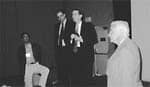
Guitar legend Les Paul has also become a proud and happy wearer of Senso Diva hearing instruments, according to Widex. Paul is a world-renowned guitarist who has performed with a whos-who list of contemporary stars like Eric Clapton. However, he is probably best known and loved by musicians around the world for his dedication to music and his innovative ideas in guitar/electronic designs. The Les Paul Guitar is considered a classic instrument among musicians, borne from Pauls painstaking attention to detail in music technology. Paul was introduced to Diva hearing aids by an audiologist who heard him perform in concert. Dissatisfied with his older hearing aids, Paul now speaks highly of his new aids during his concert performances, and he continues to do a wonderful job of publicly raising awareness about hearing loss. Recently, he and his wife paid a visit to Widex to personally thank the technicians who have helped him open up a new world of sound. He also saw some of the dramatic changes that have impacted the way hearing aids are made, including Widexs CAMISHA Laser-Fit technology. Interton and Sonovation Announce Strategic Partnership We are very excited by this new venture, says Interton President and CEO Stephan Sagolla. While the hearing industry was generally stagnate, we have been growing steadily over the last few years. Now, to fuel our future growth, Interton must strengthen its position as a provider of advanced hearing technology...Sonovations technologies are appealing to the industrys mainstream, and with our quality manufacturing, innovative hardware design, and worldwide distribution, we are in a position to offer cutting edge technologies in a broad product line. Interton and Sonovation have great synergy, said Sonovation CEO Barak Dar. We have a track record of innovation and engineering breakthroughs, but as a small company, we have always struggled with product packaging, marketing, and international distribution. Interton is a perfect partner...This partnership produced immediate results. Intertons sleek looking, European-designed Nano instruments are based on open-platform DSP, which enable us to run our proprietary digital frequency compression and directional microphone algorithms. Both companies announced a future focus on wireless technology for hearing-impaired individuals, and Sagolla was nominated to AVRs board of directors. We are surrounded by small portable devices such as PDAs and cell phones, and everything is now wireless. There is no reason why we cannot bring some of these benefits to the hearing impaired, says Sagolla. Dar concurs: We developed the first ear-level wireless system, Extend-Ear, over 12 years ago, and we were probably too early for the market. Now, with Interton, I feel confident that together we will offer very exciting products that will better the lives of people with hearing loss. New Study Indicates that Half of Baby Boomers Have Hearing Loss The survey, conducted by Prince Market Research, an independent research company and a member of the Council of American Survey Research Organizations, is reportedly one of few studies of its kind in the last decade. It looked at the occurrence, cause, and impact of hearing loss on people ages 40 to 59 (born between 1945 and 1964). Not only did the study find that half of those surveyed said they had difficulty hearing at times, it also revealed that most people experiencing hearing loss are not seeking help to remedy their hearing issues. Only 1 in 3 individuals (34%) surveyed had gotten their hearing tested, and the majority of Boomers who report hearing loss blame it on exposure to noise. This study indicates that Baby Boomers are losing their hearing at a more rapid pace than past generations, says Michael Glasscock, MD, Founder of The EAR Foundation. Whether because of apprehension or denial, Boomers are not seeking the help they need to alleviate the affects of hearing loss. Hearing loss is a serious yet often overlooked issue, and this study will help bring it into the national spotlight so we can help this generation take the next steps on the road to better hearing. The study reports that more than half (51%) of individuals who reported hearing problems attributed their hearing loss to noise pollution, either on the job or during recreational activities. Slightly more than one-third (37%) reported that their hearing loss was due to aging, while only 18% said their hearing loss was due to a medical condition. Baby Boomers are the first generation of rock and roll, says Glasscock. They have a very active lifestyle and they are used to getting what they want, from careers to family to recreation. This lifestyle lends itself to experiencing an increased amount of noise and that is why we believe Boomers have encountered more noise pollution than any other generation. The study revealed that difficulty hearing can often create obstacles in a persons life at home, in the workplace, or in social situations. Almost half (46%) of the individuals who reported having some difficulty hearing said they were most affected by the loss at home, and 44% said that hearing loss caused problems for them in social situations. More than one-third (35%) said they have difficulty hearing and understanding telephone conversations, 24% said their hearing loss made them feel misunderstood, and 9% said they felt isolated. Admitting a problem doesnt necessarily translate to finding a solution. Most of the individuals in the study who said they had difficulty hearing were doing little to find appropriate care or products to alleviate their hearing issues. Only 1 in 8 (15%) individuals had been medically diagnosed with hearing loss, and about half (52%) of these individuals had received this diagnosis within the last 10 years. About 1 in 3 (34%) had received a hearing test. Although the survey shows that a large majority of the individuals who reported having difficulty hearing are not actually seeking treatment, it did find that most Baby Boomers are well-informed in general about products that can improve hearing. Almost all (97%) of the respondents said they were aware of hearing aids. Almost 80% were aware of amplified telephones, which boost high-frequency sounds often missed during telephone conversations. The vast majority of survey respondents expressed a willingness to purchase hearing-related products, with 62% saying they would buy a product for up to $100, and 23% saying they would spend more, if necessary, for a hearing solution. Baby Boomers need to take advantage of both audiology testing and the wealth of products for better hearing that are available to them, says Clarity President Carsten Trads. There is no need for either Boomers or their loved ones to literally suffer in silence. We urge anyone who thinks they may be experiencing hearing loss to contact an audiologist, and seek information about the many convenient and economical devicesfrom hearing aids to amplified telephones to assistive listening technologyon the market today. The studys research methodology was designed to ensure that the results are accurate within a margin of error of ±5% at a 95% confidence level. To access the full report, visit: www.clarityproducts.com/boomer Natus Purchases Fischer-Zoth Under the terms of the acquisition, Natus will retain Fischer-Zoths operations near Munich, as well as its existing sales channels. Fischer-Zoth Co-Founder Peter Zoth will continue to serve as that companys managing director. The company currently has 20 employees and recorded revenues of about $3.1 million in 2003. We believe Fischer-Zoths complementary products will round out our hearing screening product portfolio and give Natus a stronger European presence, says Natus President and CEO Jim Hawkins. Fischer-Zoth has built a growing, profitable operation with strong margins and a reputation for producing high-quality products. Natus has become the world leader in newborn hearing screening through our proprietary AABR® technology. Now we can build on this position by bringing the Fischer-Zoth products into the pediatric and diagnostics markets. Fischer-Zoth develops and manufactures products for the detection and diagnosis of hearing disorders, distributing its products in more than 40 countries. As a developer of proprietary, patented signal-processing software, the company has sold more than 3,500 OAE devices worldwide. |
|
|
Featured Jobs
Find a Job |
ADDITIONAL ONLINE RESOURCES |
Featured Employer
|