Issue StoriesAdaptive Directional Microphone Technology and Hearing Aids: Theoretical and Clinical Implicationsby David A. Fabry, PhD A look at the four common types of directional hearing aid systems, and a perspective on how they might be used to maximize customer satisfaction. Directional microphone technology is not new. In fact, directional microphones were first used 60 years ago to help prevent acoustic feedback in public address systems and suppress noise at sporting events, and directional microphones in hearing aids have been available in the United States since the early-1970s.1 In 1984, Hawkins & Yacullo2 reported a 3-4 dB signal-to-noise ratio (SNR) advantage with directional microphone hearing aids in hard-of-hearing listeners (compared with omni-directional microphone hearing aid performance), and Dillon & Macrae3 also reported a similar benefit in that year. Abundant evidence suggests that hearing aid users frequently report that satisfaction decreases as background noise increases.4 It is therefore somewhat surprising that directional microphone usage in hearing aids remained low until the mid-1990s, when most directional systems offered the ability to switch between the omnidirectional and directional modes, and the FDA began to require substantiation for speech-in-noise claims made by manufacturers. Valente et al.5 were among the first to report benefit for subjects wearing behind-the-ear (BTE) directional microphone hearing aids in a randomized, controlled study, and as a result, Phonak received FDA approval for the claim of improved speech recognition in noise.6 Directional microphone use did not increase appreciably in the US, however, until they were adapted for use with in-the-ear (ITE) hearing aids.
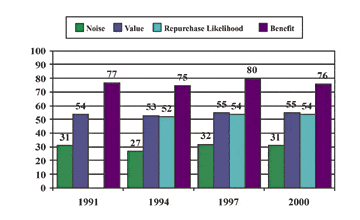
Today, it is estimated that 36% of all hearing aids incorporate directional technology.7 Although several indices related to customer satisfaction remained largely static from 1991-2000 (Figure 1),8 directional hearing systems have been shown to make a large difference in improving those factors that have the greatest impact on customer satisfaction scores (Figure 2).9
Directional Systems
Fixed directional systems. These devices use a fixed polar pattern that is either activated all the time or manually engaged via a program switch or remote control. The pattern may be cardioid, supercardioid, hypercardioid, or bi-directional (di-pole) in nature (Figure 3), but the pattern does not change in different listening environments.
Figure 4 shows the results of comparisons between omni- and directional microphone results for a system with a cardioid polar pattern which provided much better front-back performance than when the noise sources were located laterally. Depending on the spatial location of speech and noise and the test materials and conditions used in a study, SNR benefits may range from 3-10 dB when compared to omni-directional microphone hearing instruments.10
For some fixed directional microphones, various polar patterns may be configured and stored in different hearing aid memories, but the fundamental nature remains the same: the polar pattern does not change as a function of changes in the spatial separation between speech and noise, and the benefit provided by a fixed directional microphone system will be therefore be better in some noisy situations than in others. Automatically activated fixed directional systems. These instruments are similar to the fixed directional microphone, in that they also employ a stationary polar pattern, but they may automatically engage the directional microphone when background noise is present. Although different polar patterns may be configured in different hearing aid programs, this selection is typically made by the practitioner at the time that hearing instruments are programmed or the system loses its automatic functionality. As a result, the primary advantage to the end-user over directional microphones is related to ease of use, as performance will be similar to that achieved with directional microphones with the same polar pattern. Automatically activated adaptive directionality systems. These devices are similar to automatically activated directional microphones, in that they turn the directional microphone on and off when needed, but they may also change polar patterns in response to spatially dynamic listening environments (ie, noise sources that are moving relative to the listener, as in Figure 5) by altering the internal time delay between the microphones.
Practically speaking, these systems may change polar patterns independent of frequency (broadband) or alter polar patterns in multiple frequency regions (Multi-band, Figure 6). Multi-band adaptive systems provide additional advantages when several noise sources (or jammers) are spatially and spectrally distinct from the primary talker. For the broad-band system, only the most intense noise source is suppressed; for the 20-band system, the loudest source in each channel is reduced. That is, if one jammer is a human voice located at 135° azimuth, and another is a microwave oven located at 180°, the polar patterns may be different for the different frequency regions that correspond to the primary energy peak at each azimuth. If signals overlap in channel (ie, lower graph in Figure 6), only the loudest source is suppressed. Consequently, more channels provide better resolution for isolating and suppressing noise sources that differ spectrally and spatially.
Preliminary data from seven subjects showed that speech recognition in noise was improved with a new 20-band adaptive directional microphone (Phonak Savia) versus a broadband adaptive system (Phonak Claro/Perseo) when tested in the listening environment depicted in Figure 7. Under these conditions, which placed a low-pass filtered noise at 180° azimuth and high-pass filtered noise at 90° and 270°, the average directional benefit from the multi-band and broad-band systems was 7.7 dB and 5.8 dB SNR, respectively (Figure 8). Although additional data are needed, the results provide encouraging evidence for the use of multi-band adaptive directional microphones in specific listening environments where multiple independent noise sources are present that differ in their spectral characteristics from each other.
Manual/Adaptive directionality systems. These systems are similar to adaptive directional microphones, but may offer manual selection of the adaptive directional characteristics for specific listening environments. For example, some hearing instruments (eg, Phonak Savia) may alternately allow selection of either fixed directional or frequency-specific adaptive directional microphone settings within the same device. These settings may be automatically or manually selected by the hearing aid user in different listening situations. This additional flexibility may provide additional advantages in the event that an individual patient might occasionally prefer a fixed directional setting over multi-band frequency adaptive settings. Limitations of Directional Systems Another potential issue with automatic and adaptive directional systems is synchronization of program and volume control settings between the left and right ears. Also at issue is whether microphone mode (eg, omni versus directional) should always be coordinated between ears for optimal speech recognition and sound quality. For example, in an automobile, the driver is usually confronted with noise on the left side (directional microphone settings would be preferable here) but may wish to converse with his/her passenger on the right side (here a directional microphone suppressing sounds laterally would be a disadvantage). In such a situation, a purposeful de-synchronization will be advantageous, as long as it does not impact speech recognition and/or sound quality. A recent study by Payne & Lutman13 evaluated speech recognition thresholds (SRT) in noise by hearing aid users that used matched binaural conditions for omni, fixed-and broad-band adaptive (adapt) directional microphones, versus mismatched conditions where an omnidirectional hearing aid was paired with an adaptive broadband directional microphone system. Results (Figure 9) indicate that, although the adapt/adapt condition provided the best performance, the mismatched condition did not degrade performance, and provided comparable sound quality in all listening conditions (noise from the front, back, sides, and asymmetric L>R and R>L). The clinical implications are that, for asymmetric environmental noise conditions, it may be preferable not to synchronize microphone mode across ears for directional microphone systems. Given that 77% of all US hearing aid fittings are binaural,7 this topic has the potential to impact many hearing aid users.
Finally, it should be recognized that directional microphonesdespite their newfound popularitymay not be for everyone. For example, the audiogram alone does not provide a good indication of the degree to which individual hearing aid patients have difficulty listening in background noise. Several researchers, including Mead Killion who is a strong advocate of directional microphone use,14 have suggested that speech recognition in noise measures, such as the QuickSIN15 or Hearing in Noise Test,16 may be useful for determining an individual patients SNR deficit for speech. Table 2 illustrates how SNR loss for speech may, in turn, be used to develop candidacy guidelines for benefit from directional microphones and FM technology. The COSI17 or APHAB18 also provide useful subjective indications regarding patient expectations for benefit from amplification. The bottom line is that there are numerous technology solutions that may be used with hearing aids to enhance or preserve SNR, but the most important clinical issue is the appropriate selection and application of that technology to individual patients.
Conclusions Matching patient needs and expectations to selected technology is a critical factor related to success with directional microphones; assessing SNR loss and measuring subjective patient needs (eg, COSI, APHAB) are useful tools to assist with this process.
Correspondence can be addressed to HR or David Fabry, PhD, Phonak LLC, 4520 Weaver Parkway, Warrenville, IL 60555; email: Dave.Fabry@phonak.com. References |
|
|
|
ADDITIONAL ONLINE RESOURCES |
|