Issue StoriesAssociations in Action
Coral Gables, Fla Approximately 75 industry leaders and guests convened at the 2005 Hearing Industries Association (HIA) Annual Meeting in early-March which had as its primary focus the hearing aid tax credit and communicating with consumers.
The HIA membership endorsed a strategic plan developed by the HIA Board of Directors that commits the organization to actions that will benefit consumers and support dispensing professionals. Passage of the Hearing Aid Tax Credit Assistance Act (HR 414, see March 2005 HR News, p 94), development of a series of industry white papers, and maximization of hearing aid technology through training are key elements of the three-year plan, as well as supporting initiatives of the Better Hearing Institute (BHI).
But HIA Outgoing Chairman Jerry Ruzicka minced few words: this years number-one initiative is to gain support for the tax credit among members of Congressparticularly the Senate and members of special committees. The HIA Board outlined action steps and developed a member resource kit to encourage grassroots support of the tax credit legislation by manufacturers and allied organizations. According to HIA Executive Director Carole Rogin, HIAs goal is to welcome every member of our association to Washington, DC for Hearing on the Hill on May 18th, and to set up meetings for them with elected officials with whom they have already visited at home...Our dispensing and consumer allies are doing an excellent job at the grassroots level and, although there are relatively few companies, we employ thousands of people and that translates into votes.
The BHI also presented an ambitious plan for the year to HIA members, launcing a new Web site (www.betterhearing.org) and its comprehensive new consumer communication program (see February HR, p 16). BHI Executive Director Sergei Kochkin outlined consumer communications projects to be tackled with the assistance of the Institutes new public relations firm, Strategy XXI, New York City, as well as a range of special projects for which BHI will seek special funding. Kochkin announced at the meeting that MarkeTrak VII, funded for BHI by Knowles Electronics Inc, would be issued in the near future. Other initiatives included a PR and marketing communications program, the enlistment of celebrities who have overcome hearing loss (BHI is actively seeking celebrity spokespersons), and several new outreach programs that target such entities as pharmacies and places of worship (Kochkin says that 86% of hearing aid wearers believe that its important to hear better in church).
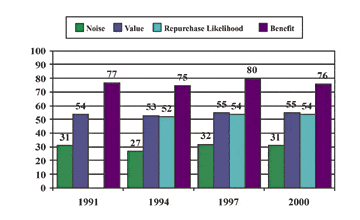
Tax Credit Bill and Positioning Hearing Care for Baby Boomers An informal Hearing Aid Tax Credit Coalition composed of the major hearing industry organizations, including HIA, American Academy of Audiology (AAA), American Speech-Language Hearing Association (ASHA), International Hearing Society (IHS), Deaf and Hard of Hearing Alliance (DHHA), and Self Help for Hard of Hearing People (SHHH)has been setting up meetings with both House and Senate offices to gain support for the new bill. Currently, the coalitions main focus has been gaining Senate support for the issue as Senator Norm Coleman (R-MN) prepares to reintroduce a companion bill later this spring. An additional boost to the legislation may come as both AAA and SHHH host their annual conventions in Washington, DC. A marketing consultant, Don Neal, of Marsh Affinity Group Services, Washington, DC, presented ideas on repositioning hearing health care products in anticipation of the Baby Boomer generation. Most Baby Boomers believe that old age starts at 79, says Neal. But actuarial tables tell us that men die at 78. His point: our audience is changing and they do not think of themselves as old. There is a great need to disconnect hearing aids and age, Neal contends. Without this, its hard to believe that there can be geometric growth...for the industry. He also endorsed the concept of changing the industry relative to positioning. Neal says that the industry should take care to consider all the facets of a consumers purchasing life cycle, including awareness of hearing loss, interest in gathering information, consideration of the supplied data, purchase and trial of the product, and repurchase of hearing aids. [You need to] define and agree on what value is defined as by the consumer, says Neal. Elections and Awards
Carole Rogin, who continues as chief staff executive, was honored by HIA at the meeting for her 25 years of service to the Association. HIA and the hearing industry has been a cornerstone of my career, says Rogin. It has been, and continues to be, a very meaningful and wonderful aspect of my life. HIA also awarded its Volunteerism Award to Jerry Ruzicka, chairman of HIA, and president of Starkey Laboratories, for his leadership in building a political action component for HIA and his vision in crafting a strategic plan for the Association over the past 3 years. Ruzicka was also honored at the meeting as the outgoing HIA Chairman. This years guests included Jesper Mailind, chairman of the European Hearing Instruments Manufacturers Assn (EHIMA) and CEO of GN ReSound; Brad Stach, president of AAA; Harlan Cato and Cindy Helms, president and executive director of the IHS; Larry Higdon, Vic Gladstone, and Roberta Aungst, executives of ASHA; and Craig Johnson, president of the Academy of Dispensing Audiologists (ADA). New corporate representatives at this years meeting included Robert Tong of AMI Semiconductor Canada Co (formerly the DSPfactory) and Susan Whichard, InSound Medical Inc. |
|
|
|
ADDITIONAL ONLINE RESOURCES |
|