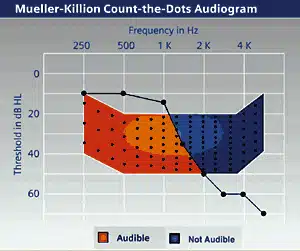
Issue StoriesWireless Technology in an Open-Ear Solutionby Pamela Burton, MA, and Thomas A. Powers, PhD A new hearing instrument in which electronic information is shared between two hearing aids in a binaural fitting has now also employed an open-fitting solution. The majority of hearing-impaired individuals exhibit a loss that is predominantly high frequency in nature. In some cases, hearing loss in the higher frequencies (eg, above 1500 Hz) can be quite severe, while hearing thresholds in the lower frequencies (eg, 1000 Hz and below) may remain normal, or near normal. Even though these individuals have normal hearing for a large portion of the speech signal, because of the importance of high-frequency speech cues they can have significant communication problems, especially with understanding speech in the presence of background noise. High frequency hearing loss is progressively becoming a primary motivator for individuals to seek assistance. Until recently, completely effective solutions were not available for most patients. A fitting solution for these patients has recently been introduced by Siemens Hearing Instruments. ACURIS Life is a hearing instrument endowed with a multitude of features to enhance effectiveness and meet the criteria necessary for open fitting products. These requirements are: Provide Adequate High-Frequency Amplification
Of course, providing a large amount of gain in the high frequencies often leads to acoustic feedback. To accomplish high frequency amplification for this type of patient, therefore, it is necessary to utilize a hearing instrument that has many discrete, highly adjustable channels of gain, and a fast-acting feedback reduction system. Acuris Life has 16 channels of gain adjustment, which allow for precise shaping of the response, depending on the audiogram configuration and requirements. Avoid Amplification Where Hearing is Normal Avoid Loudness Discomfort To address the variable dynamic range issue, Acuris Life utilizes the 16 independent channels of frequency shaping and AGCi, with adjustable kneepoints and ratios to accommodate a wide variety of hearing losses. This product also provides the option of selecting short or long compression time constants in four programmable regions, so that speech signals can be optimized for both the large and small dynamic range regions. Another important compression feature is the 16-channel AGCo system. Using this technology, the output for louder sounds is not unnecessarily capped in channels where the kneepoint has not been reached, as it would be in a single-channel system. This results in expanded headroom, increasing the utilization of the patients residual dynamic range while maintaining the output below the patients loudness discomfort. Avoid Acoustic Feedback An Open algorithm was designed specifically for these fittings to incorporate correction factors for changes in RECD that naturally occur with instruments that have this type of design. This fitting algorithm results in gain and output that couples with the patients residual open-ear acoustics to provide not only necessary audibility, but an amplified signal that is rated highly for quality and pleasantness. Along with this algorithm for FirstFit success, open instruments also must employ an effective feedback cancellation algorithm. The adaptive feedback cancellation system in the new device is designed to solve the problems often encountered with open fittings. A high-speed phase-cancellation system is utilized to address feedback occurrence. This system employs extremely fast adaptation to changes in the feedback path, with maximum energy efficiency (less than 50 uA current consumption). A detector specifically designed for analysis of feedback allows the system to determine the source of feedback (internal or external), and avoids inappropriate cancellation of environmental tonal signals, such as microwave beeps, music, etc. The feedback cancellation design does not require any optimization procedure with the instrument in the ear in order to pre-set any cancellation filter, as some other systems do. The cancellation system is adaptive and does not have any impact on gain or frequency response of the hearing instrument, thereby maintaining sound quality and intelligibility.2 Avoid Occlusion Effect When the ear canal is open, the majority of this increased energy escapes, and we judge our voice as sounding normal. If we plug the ear canal with an earmold or a custom hearing instrument, the energy can no longer escapethis results in increased pressure placed on the eardrum, and what we then hear is a more hollow sound to our voice. This is called the occlusion effect. It can increase the low-frequency components of speech by 20 dB or more, and most hearing instrument users find it annoying, sometimes to the extent that they will no longer wear their hearing instruments, or will only use one. It is difficult to eliminate the occlusion effect with simple venting. It is often not possible to make a vent large enough to leak out all the sound, especially for energy at 500 Hz and above. To eliminate the occlusion effect, therefore, it is necessary to use a specially designed earmold. For the effective release of low-frequency sounds, this earmold must be used with the appropriate adaptive feedback control (see discussion in previous section). Acuris Life is designed without a conventional earhook; instead, there is a small adaptor connected to an extremely thin tube, called LifeTube. The LifeTube is connected to a non-occluding tip to be placed in the ear canal, called LifeTip. These components allow the fitting to remain open and comfortable, and minimize or eliminate the occurrence of the occlusion effect. LifeTubes and LifeTips are available in a variety of sizes and are provided initially to each hearing care professional fitting the product in the Life Fitting Set (composed of a supply of 6 sizes of pre-formed LifeTubes, 2 sizes of LifeTips, and additional tools and accessories for fitting the hearing instrument).
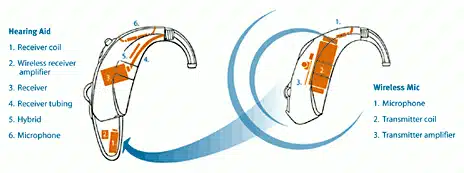
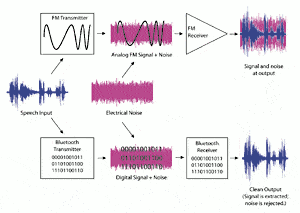
Cosmetically Acceptable Binaural Hearing At the core of all Acuris products is e2e wireless synchronization, which allows the benefits of the products core technology to be harmonized in two hearing instruments working together as one system. The wireless technology allows communication and synchronization of selected core digital signal processing features in Acuris Life. This is especially important for individuals with high frequency hearing loss, as they often lead active lifestyles and need to minimize the need for making hearing instrument adjustments. Since there are no controls on the new instrument, the wireless function allows the use of an optional ePocket remote control, which adds volume control and program selection functionality, when desired. The ePocket is a bi-directional remote control that allows not only user control for volume and memory, but data readout of current volume level, memory setting, and battery status for both instruments simultaneously. The wireless technology also enables the binaural instruments to function as one comprehensive system by exerting control over Binaural Precision Environmental Classification and Binaural Digital Speech and Noise Management.2,4 Preliminary Research Findings
Figures 3-4 show that patients reported a comfortable, natural sound following FirstFit with the Open algorithm. The majority of these patients also indicated that the new instrument was more comfortable and natural sounding in comparison to the alternative open product. Notice that, in Figure 3, for the new device, the 25th-75th quartiles are tightly clustered around the mean rating, which is close to the desired comfortable descriptor. For the alternative open product, there is a wider range of responses, with the mean response skewed toward the too sharp continuum.
Similarly, in Figure 4, the 25th-75th quartiles for the new product are tightly clustered around the mean rating (approximately 9.0), while the responses for the alternative open product exhibit a wider range of responses, with the mean response at approximately 8.2. The High Speed Feedback Cancellation system was evaluated after First Fit during the same study. Initially, subjects were asked to judge the presence of feedback in the laboratory, after the fitting of the instruments. As shown in Figure 5, patients fitted with the new system did not experience feedback (mean rating of almost 10.0). The alternative open product exhibited feedback in a significant number of cases, with a range of responses and a mean response of approximately 8.0.
Finally, in a field trial, the subjects were asked to rate the occurrence of feedback in everyday listening situations. As shown in Figure 6, subjects wearing the new open-ear system rarely or never experienced feedback in these situations, with the 25th-75th quartiles tightly clustered between 9.8 and 10.0. For the alternative open product, the range of responses was wider and the mean response was approximately 8.2.
Summary
References |
|
|
Featured Jobs
Find a Job |
ADDITIONAL ONLINE RESOURCES |
Featured Employer
|