Issue StoriesMarkeTrak VII: Hearing Loss Population Tops 31 Millionby Sergei Kochkin, PhD The hearing loss population has grown to 31.5 million people and will top 40 million within one generation. Overall customer satisfaction with new hearing instruments is 77%placing hearing aids in the top-third of products and services in the United States. This is the first segment of a multi-part publication that will cover significant trends in the hearing loss population. Since 1989, Knowles Electronics has conducted six MarkeTrak surveys of the US hearing loss population following the landmark 1984 Hearing Industries Association (HIA) study. Beginning with this report, MarkeTrak is conducted and published by the Better Hearing Institute through the continued generosity and sponsorship of Knowles Electronics as a public service to the hearing care industry. Future publications in this series over the next year will consist of the following:
In November 2004, a short screening survey was mailed to 80,000 members of the National Family Opinion (NFO) panel. The NFO panel consists of households that are balanced to the latest US census information with respect to market size, age of household, size of household, and income within each of the nine census regions, as well as by family versus non-family households, state (with the exception of Hawaii and Alaska) and the nations top-25 metropolitan statistical areas. The screening survey covered only three issues: 1) physician screening for hearing loss; 2) whether the household had a person with a hearing difficulty in one or both ears without the use of a hearing aid; 3) whether the household had a person who was the owner of a hearing instrument. This short survey helped identify 15,947 people with hearing loss and also provided detailed demographics on those individuals and their households. The response rate to the screening survey was 66%. In January 2005, an extensive survey was sent to 3,000 random hearing instrument owners and 3,000 random people with hearing loss who have not yet adopted hearing instruments. The response rates for the detailed surveys were 75% and 77%, respectively. The data presented in this article refer only to households as defined by the US Bureau of Censusthat is, people living in a single-family home, duplex, apartment, condominium, mobile home, etc. People living in institutions have not been surveyed; these would include residents of nursing homes, retirement homes, mental hospitals, prisons, college dormitories, and the military. The reader should also keep in mind that the demographics to follow refer only to those who admit to their hearing loss. MarkeTrak Results and Discussion User and Non-User Populations and
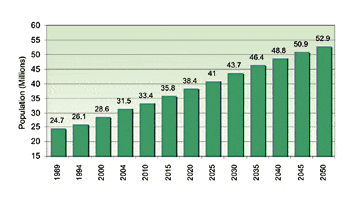
In addition, hearing loss population projections through the year 2050 are shown in Figure 1. The projections are derived by applying MarkeTrak hearing loss incidences by age against US Bureau of Census population projections by age.1 Within a generation, we can expect the hearing loss population to grow by one-third and top 40 million people.
The Hearing Instrument Population (Table 1). Hearing instrument adoption rates declined steadily between 1984 and 1997 (Figure 2), decreasing from 23.8% to 20.4%. Starting in 2000 the hearing instrument adoption rate rebounded and increased to 23.5% in 2004its highest level since 1984. Figure 3 shows that active hearing instrument users grew to 6.2 million (up 600,000) while people with a hearing loss without amplification increased by 1.8 million to 24.1 million people.
The stellar historical growth rate for binaural hearing instrument purchases is shown in Figure 4. Since our last survey, the binaural population increased from 64.3% to 69.6% for all users and from 78.7% to 82.3% (see Table 1) for all bilateral loss consumers. The binaural purchase rate in 2004 held steady at 74.1% for all users and 85.9% for bilateral loss consumers.
Physician Screening for Hearing Loss (Table 1). We specifically asked individuals who received their physical exam in the last 6 months to indicate if their physician or nurse screened for hearing loss during the exam. The historical trends are shown in Figure 5. Physician screening has dropped to 12.9% for the total population. Declines are seen in every age category with the exception of young adults. This finding correlates with a recent publication that indicated 11.8% of primary care physicians screen for hearing loss during annual physical exams.2
Previously, we have shown the use of the Better Hearing Institute (BHI) Physician Referral Program, which did not provide a method for hearing loss screening, resulted in modest increases in referrals for hearing health solutions.3 Increasing physician referrals purely through educational material is a difficult task. The BHI and allied hearing healthcare organizations will need to find other methods for motivating physicians to take a more active interest in hearing as part of a total wellness program for their patients. Future initiatives which might increase physician screenings include:
Hearing Instrument Pricing & Distribution
Referring to Figure 7, the average price of a hearing instrument as paid out of the pocket of the consumer (includes free and third-party discounted, direct mail, but excludes VA fittings) increased 7.3% to $1,369. The price changes by style of hearing instrument were as follows: BTE (14.6%), ITC (-5.1%), ITE (19.1%). The price increases for BTEs and ITEs are probably due to the greater likelihood that they may have additional features such as volume controls, remote controls, multiple microphones, telecoils, or FM attachments.
Distribution (Table 2). The dispensing role of the audiologist appears to have declined in 2004 as perceived by the consumer of hearing instruments. Sixty-five percent of hearing instruments were fit by audiologists in 2000, compared to 55% in 2004 (Figure 8). In comparison, hearing instrument specialist fittings increased 7.1% to 35.9% of sales in 2004. Hearing instrument fittings by medical doctors remain insignificant. It should be understood that the distribution data represents perceptions of the consumer, who may not always be able to differentiate an audiologist from a hearing instrument/aid specialist.
With respect to where the hearing instrument was fit, referring to Table 2 (which is summarized in Figure 9), there are some major changes over the previous MarkeTrak survey. To more accurately reflect the dynamics of the hearing instrument industry in the consumers eye, the term hearing aid store was changed to hearing aid specialist office in the 2004 MarkeTrak survey. This terminology change resulted in significant decreases in perceived fittings in audiologist offices (47.2% in 2000 to 24.9% in 2004) with a corresponding increase in fittings occurring in hearing aid specialist offices (22.2% in 2000 versus 37% in 2004). Veterans Administration fittings increased to 14.9% (versus 8.4% in 2000), physicians offices increased to 8.6% (versus 7.1% in 2000), while mail order sales increased to 5.4% (versus 3.5% in 2000)the highest it has been in history.
In Figure 10, we have estimated the size of the total hearing instrument owner population as of 2004 based on the place where the consumers purchased their last hearing instrument. This data was generated using historical MarkeTrak data. The total hearing instrument user population is 7.38 million people. The top-three sources relative to the current hearing instruments in the field are hearing instrument specialist offices (2.77 million people) making up 37.5% of all fittings, audiologist offices (2.04 million people) making up 27.6% of all fittings, and VA hospitals making up 10.6% of all fittings. Most notable are the significant increases in the VA population (784,000 in 2004 versus 411,000 in 2000, a 91% increase) and mail order sales (221,000 in 2004 versus 124,000 in 2000, a 78% increase). The top-three locations where a hearing instrument was fitted by an audiologist were: audiologist offices (45.1%), VA hospitals (18.3%), and hearing aid specialist offices (15.9%). Thus, nearly 4 in 5 (79.3%) of all fittings by audiologists were performed in these three settings. The top-three locations where a hearing instrument was fitted by hearing aid specialists were: hearing aid specialist offices (73.7%), audiologist offices (5.7%), and ear doctor offices (4.9%). Likewise, slightly more than 4 in 5 (84.3%) of hearing aid/instrument specialist fittings were performed in these three settings.
Customer Satisfaction and Usage Trends
Referring to Figure 11, if we consider hearing instruments 4 years of age or less (the effective life of a hearing instrument), the overall customer satisfaction rating is 73.1%; the dissatisfied rating remained virtually the same despite the change in scaling. Customer satisfaction with new hearing instruments less than or equal to one year is 77.5% (Figure 12) which puts it in the top-third of products and services in the United States.5 When considering the large percentage of new digital (eg, programmable) directional hearing instruments available, the 77.5% customer satisfaction rating is consistent with a previous historical MarkeTrak analysis6 that showed programmable directional aids had an 81% satisfaction rating and programmable omni-directional aids had a 72% rating. Wearing and Age of Instrument Trends. Hearing instrument owners who do not use their hearing instruments increased to 1.2 million. (Authors Note: A user is defined as an individual reporting they wear and use their hearing instrument. Usage is accepted even if it is only occasionaleven if less than a half-hour per day). Part of this is due to the fact that 36% of the hearing instruments owned are 5 years or older; nearly 6 out of 10 hearing instruments in the drawer are at least 5 years old. The average age of hearing instruments increased from 3.8 in 2000 to 4.5 in 2004. Figure 13 documents the age distribution of hearing instruments (including hearing instruments in the drawer) as measured in the five previous MarkeTraks. Hearing instruments, which are 2 years old or less decreased slightly to 41.7% of the market. Hearing instruments greater than 9 years old are now 12.6% of the market. The second publication in this series will report detailed customer satisfaction ratings.
First-Time Users
After a decline between the years 1991 and 1997, the age of new users would appear again to be on the increase. The current new user is 69.7 years of age (Figure 15) with an annual household income of $55,800 (Figure 16) up from $46,300 in 2000. Adjusting for the consumer price index (in 1989 US$), household income of new purchasers has increased by $5,000 since 2000.
Factors influencing new first-time owners to purchase a hearing instrument in 2004 were:
Safety concerns, asked for the first time, influenced 5.8% of new users. No aided-awareness marketing or public education influence garnered more than 5% of mentions; factors influencing new users less than 2% are: magazine ads, Internet, celebrity public service announcement, radio ad, and telemarketing call. Referring back to the trends in Table 4, the reader will notice that marketing or public education-oriented initiatives have been historically as high as follows: newspaper ad (5.8% in 2000), hearing loss literature (10.5% in 1989), direct mail (4.7% in 2000), TV advertisement (6.5% in 1989), magazine ad (5% in 1997), celebrity public service announcement (3.3% in 1989) and radio advertisement (8.5% in 1994).
Demographics of the Hearing Loss Population In the second part of Table 5 the demography is broken down and expressed as percentages for both the hearing instrument owner and non-owner populations. Among the interesting items are:
The third part of Table 5 expresses the hearing loss population in thousands of people. The modal hearing loss population can be described as: male, ages 55-64, with household incomes over $60,000 (mean=$54,400, median=$41,300), with some high school education, full-time employed, living in metropolitan areas greater than 2 million people in the role as an older parent.
Figure 17 shows the age disparity between hearing instrument owners and non-owners while Figure 18 documents hearing instrument adoption rates by age. The adoption rate for those over age 85 is 60.6%, ages 75-84 is 44.1%, and ages 65-74 is 31.3%. Clearly, it is more difficult to get younger people who have hearing impairment to purchase a hearing instrument. Additionally, the adoption rate among children (younger than 18) is only 12.5%. Future publications will explore this issue further controlling for subjective measures of hearing loss. The most notable increases in hearing instrument population size since 2000 are as follows:
Key Findings
Acknowledgements
Correspondence can be addressed to HR or Sergei Kochkin, PhD, Better Hearing Institute, Ste 420, 515 King St, Alexandria, VA 22314 skochkin@betterhearing.org. References |
|
|
ADDITIONAL ONLINE RESOURCES |
Featured Employer
|