Issue StoriesWhat the Heck is Bionic with ADRO?by Todd Fortune, PhD A new hearing instrument uses Adaptive Dynamic Range Optimization (ADRO) as an alternative to compression, with the goal increasing/reducing gain only when needed. In recent years, the hearing healthcare field has witnessed phenomenal advances in technology that have the potential to improve the quality of life for many people with impaired hearing. Features such as adaptive directional microphones, sophisticated feedback management systems, and a variety of new wireless applications add flexibility and value to products on the marketand this trend will continue. These new features certainly contribute to fitting success, but working at the core of all these advances in the vast majority of hearing aids today lies a method of signal processing that has been around for many years... Compression In the hearing industry, the tendency has been for new products to be more complicated rather than less complicated, increasing the risk of problems that could affect the success of the fitting, despite the bells and whistles afforded by the technology. Increasingly, the question being asked is why is compression my only alternative? In fact, compression is not the only alternative. Several years ago, Dynamic Hearing introduced a method of signal processing known as Adaptive Dynamic Range Optimization, or ADROŽ. ADRO was designed for use in cochlear implants,1-3 and is currently in commercial use in the Sprint and Nucleus Freedom processors by Cochlear Corp. Based in part on the success of ADRO in cochlear implants, ADRO processing has recently been incorporated into a digital hearing aid known as the Interton BIONIC. As a hearing aid, Bionic broadens considerably the potential population of ADRO users, and it also raises a variety of questions from those who might wish to fit the technology to their patients. The purpose of this article is to describe what the new system does, how it is used, and how it provides an alternative to compression. A Simpler Method to Achieve Accepted Fitting Goals
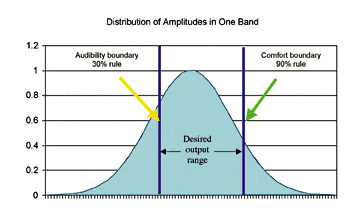
Whats so different about it? Unlike compression, which continuously adjusts gain using fixed input/output rules, Bionic first determines whether gain needs to be adjusted based on a statistical sampling of the aided listening environment (Figure 1). The device creates and monitors a distribution of amplified sound levels, comparing this distribution against a desired output range. The shaded bell-shaped curve in Figure 1 represents a sampling distribution of many output levels gathered over a few seconds. In real time this distribution will change shape and will shift to the right or to the left as the listening environment becomes louder or softer. Superimposed on this moving distribution are two stationary output level boundaries: one defined by an Audibility criterion, the other by a Comfort criterion. Together, these two criteria/boundaries form the desired output range. Each boundary has a percentage associated with it (Audibility=30%, Comfort=90%) that serves as a rule that governs the systems behavior. These rules specify that 90% of all output levels must fall below the Comfort criterion and that no more than 30% of all output levels can fall below the Audibility criterion (a criterion that represents soft but audible, not absolute threshold). As the distribution of sound levels moves higher (to the right in Figure 1), a point will be reached where more than 10% of all sounds exceed the Comfort criterion. This represents a rule violation and triggers a response to reduce gain. As the distribution of sound levels moves lower, a point will be reached where more than 30% of all sounds falls below the Audibility criterion. This represents another rule violation and triggers a response to increase gain. The rate of gain adjustments occurs at either 3 dB/sec or 6 dB/sec, depending on the needs and preferences of the listener. Figure 1 illustrates the processing in a single channel, but this method of signal analysis and processing takes place in each of 32 channels. Unlike many advanced digital instruments, this hearing instrument is quite elegant in its simplicity. This gives it numerous advantages for both the dispensing professional and the wearer.
But isnt this just slow acting AGC? No. One way to describe this system is to say that it only responds when it needs to. Thus, the best way to show this is to compare input/output (I/O) characteristics between compression and Bionic (Figure 2). Figure 2a shows a typical input/output function for a WDRC circuit. This example shows a linear segment, a compression kneepoint, and a region of 2:1 compression. This function describes how this circuit will behave at all times. While parameters such as the CR and TK can be adjusted, the aid will always abide by the fixed I/O function; as input levels vary, gain will be continuously adjusted in order to keep the output at the level defined by the I/O curve. Bionic is different. Its input/output characteristics are better described as a range rather than a function. Figure 2b illustrates this effect. The data point at the lower left indicates 30 dB of gain for a low-level input. As input level increases, 30 dB of gain is maintained until the output level approaches 90 dB SPL, the level defined as the Comfort boundary in this example. As the Comfort boundary is approached, the curve bends (ie, there is a reduction in gain). At the highest input level, gain has been reduced to 20 dB. If the input level now begins to decrease, a very different pattern emerges. Rather than following the original trajectory back downward (as would be the case with compression), Bionic maintains gain at 20 dB as the input and output levels fall. As the input level continues to decrease, the curve eventually changes slope againin this case due to a violation of an Audibility boundarywhich requires that gain be increased again. Note that, at any given input level, the aid can have more than one gain. For example, at an input level of 55 dB, this aid can have either 20 dB or 30 dB of gain, depending on the preceding acoustic conditions that have been statistically monitored by the system over time. Can you clarify that? The best way to describe the system is to say that it provides nonlinear amplification when either rule is violated, and linear amplification whenever both rules are satisfied. It is only when the desired output range is violated at either boundary at any frequency that the hearing instrument responds by adjusting gain. This behavior is what makes this system different from compression. The main advantage is that it allows natural variations in loudness to occur. Unlike compression, which constantly adjusts gainthereby minimizing loudness variationsthe new instrument functions as a linear amplifier as long as both rules are satisfied; there is no perceptual need to behave otherwise. In any given channel, loudness will vary with input level as long as the desired output range is maintained. Depending on the acoustic characteristics of the listening environment and the desired output range across frequency, it is entirely possible that some Bionic channels will be operating at fixed gain while numerous others will be actively adjusting gain. The system is clearly nonlinear, but only when it needs to be in order to satisfy the perceptual needs of the listener.
OK. So where do these Comfort and Audibility boundaries come from? Each channel of the hearing instrument has a desired output range defined by Audibility and Comfort boundaries. These boundaries are created from seven in-situ measures of loudness that are obtained during the fitting process (Figure 3). Narrow-band noise bursts at various center frequencies are presented to the listener through the aid, and the listener is asked to judge them for loudness. Noise levels are adjusted as needed until Most Comfortable Loudness (MCL) is achieved at all frequencies. The process normally takes about 5 minutes per ear to complete.
Once established, these levels are used to calculate Comfort and Audibility curves that represent the desired output range across frequency (Figure 4). These levels are also used to define a maximum output level curve that serves to prevent loudness discomfort for brief, impulse-type sounds and also a maximum gain curve. Once the desired output range is defined, the systems rules take effect and gain will be adjusted as needed as the distribution of sound levels vary within each channel. Ive seen loudness scaling before. Whats the big deal? Perhaps the most refreshing aspect of this system is that it is fit without using CRs, TKs, or attack/release times. Instead, the in-situ testing creates the boundaries that represent the desired output range, shown as green (Comfort) and yellow (Audibility) curves on the fitting screen (Figure 4). While fine tuning is generally minimal, the dispensing professional has direct control over each of the four fitting parameters (Maximum Output Level [MOL], Maximum Gain, and the Comfort and Audibility boundaries), and the method for adjusting these curves is quite intuitive. To fine tune, the dispensing professional simply determines what type of sound (low, moderate, or high level) is causing difficulty for the listener; this determines which curve (Audibility, Comfort, or MOL, respectively) needs to be adjusted. For example, if during a fine-tuning session it is learned that soft speech is too soft, all or part of the Audibility boundary, at times combined with maximum gain, can be raised to make it louder (Figure 5a). If conversational speech is too soft, the Comfort boundary can be raised (Figure 5b). If occlusion (ie, a moderately loud low-frequency sound) is the problem, the low-frequency portion of the Comfort boundary, perhaps combined with the MOL curve, can be lowered (Figure 5c). Finally, if loud impulse-type sounds are too loud, the MOL may be reduced (Figure 5d).
All adjustments can be made across as wide or as narrow a frequency region as necessary. This process is further simplified using an automated problem-solving tool called Dr. Fit. Further refinements can be made at specific frequencies as appropriatebut there are no CRs, TKs, or time constants to deal with. The entire process is designed to be simple and more intuitive than compression-based fitting methods. The one parameter that will be new to most dispensers is the Slew rate, which determines how quickly gain is adjusted whenever a rule is violated. In most cases the slew rate will be 3 dB/sec, meaning that once a rule is violated gain will be adjusted at 3 dB per second until the rule is again satisfied. When necessary, a 6 dB/sec slew rate can also be programmed to the device. These gain adjustments are intentionally slow, since the MOL curve always serves to prevent sudden loud sounds from causing discomfort. Research on the System Studies are currently underway using ADRO processing in an implant and a hearing aid simultaneously in the same user, research that could have implications for future product development. Research to date clearly indicates that ADRO provides benefit to hearing-impaired listeners. Summary
References |
|
|
Featured Jobs
Find a Job |
ADDITIONAL ONLINE RESOURCES |
Featured Employer
|