Issue StoriesThe Stacked ABR: An Alternative Screening Tool for Small Acoustic Tumorsby Manuel Don, PhD A brief review of the rationale, methodology, and the clinical application of the Stacked ABR. A more reliable method for detecting acoustic tumors Authors Note: The goal of this article is to review briefly the rationale, methodology, and the clinical application of the Stacked ABR. For more detailed literature on the Stacked ABR, please see the references at the conclusion of this article.1-5 Click-evoked ABRs have long been used for evaluation of peripheral auditory function and continue to play an important role in evaluating infants and children. An important application of ABRs in adults since the mid-1970s (eg, see Selters & Brackmann6) was for corroborating the diagnosis of an acoustic tumor (vestibular Schwannoma). Two standard ABR measuresthe interaural wave V delay or IT5 delay and the I-V delaywere used. While these measures have shown excellent sensitivity for mid- and large-sized tumors, Eggermont et al7 claimed that small (<1 cm) tumors would often not be detected. This poor sensitivity for small tumors was eventually confirmed in a series of publication during the 1990s, and several of these studies concluded that the use of ABRs to detect acoustic tumors should be abandoned (see review in Don et al2). Thus, many clinical practices have abandoned the use of ABRs and simply order an MRI with contrast to rule out a tumor. In essence, MRIs are being used as a screening tool because of the failure of standard ABR tests to detect small tumors. However, as my colleagues and I have argued,2-5 there are situations both in the United States and throughout the world where the availability, cost, and comfort of MRI testing are problematic. Thus, it would be of clinical value to have available an ABR test to screen for small tumors. Revisiting the Usefulness of ABR Screening for Acoustic Tumors 1) High frequency fibers dominate the latency measure. The Stacked ABR Methodology
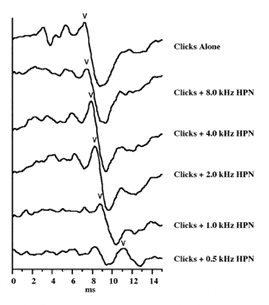
In Figure 1, the top trace represents the response to 60 dB nHL clicks presented alone. The succeeding five traces represent the responses to the clicks presented with ipsilateral masking pink noise high-pass filtered at 8 kHz, 4 kHz, 2 kHz, 1 kHz, and 0.5 kHz. The level of the pink noise before high-pass filtering is just sufficient to mask the response to the clicks. Thus, this series shows the progressive masking of the cochlea to click stimulation. One can observe that, with each lowering of the cutoff frequency of the high-pass masking noise, the latency of wave V of the ABR is progressively delayed. This indicates that the response is progressively dominated from the lower unmasked frequency region and the delay is related to the traveling wave delay down the cochlea.
Figure 2 shows the procedure used to obtain the derived-band ABRs.8 The top trace is again the response to the clicks presented alone. The next five traces result from the successive subtraction of the high-pass responses. These resultant derived-band responses represent synchronous activity initiated from successive octave-wide regions across the cochlea with the theoretical center frequency noted beside each of the derived-bands (eg, 11.3 kHz, 5.7 kHz, 2.8 kHz, 1.4 kHz, and 0.7 kHz). It can also be seen that the latency of the response to the clicks alone is determined by the responses from the highest frequency regions. If each of the derived band waveforms were added together, the sum would be essentially look like the response to the clicks presented alone. Additionally, by adding the waveforms together, much of the activity from the lower frequency regions of the cochlea will not be seen due to phase cancellation from the higher bands. Therefore, for standard ABR measures, a prolongation of the latency of wave V of the ABR to clicks presented alone will occur only if the tumor affects the high-frequency fibers. In a significant number of small tumors cases, it appears that the high-frequency fibers are not sufficiently compromised such that there is little change in the wave V latency.
To overcome this insensitivity, the Stacked ABR is formed as shown in Figure 3. The Stacked ABR is formed by shifting and aligning the wave V peaks of the derived-band responses shown in Figure 2 (stacking the waveforms), and then adding the waveforms together. In essence, this results in a waveform, the Stacked ABR (last large trace), in which the responses are synchronized across the cochlea. By aligning the wave V of the derived-band ABRs, the phase cancellation of lower frequency activity is eliminated. Thus, the Stacked ABR amplitude is composed of activity from all frequency regions of the cochlea, not just the high frequencies. Therefore, any reduction of neural activity due to a tumor, even a small tumor, will result in a reduction of the Stacked ABR amplitude. Figure 4 shows the Stacked ABRs from a patient with a 0.5 cm acoustic tumor. The left panel shows the Stacked ABR from the non-tumor side and the right panel shows the Stacked ABR from the tumor side. The Stacked ABR has been reduced by over 50% by this small tumor. Effectiveness as a Clinical Tool
The Stacked ABR measure appears to have sufficient sensitivity and specificity to warrant its use as an initial screening tool. That is, it is sensitive enough to ensure that nearly all patients with tumors are identified and sent for conclusive MRI testing, and specific enough to significantly reduce the number of non-tumor patients sent for imaging. Therefore, the Stacked ABR is a sensitive, widely-available, cost-effective, and comfortable tool for screening small acoustic tumors.
Correspondence can be addressed to Manuel Don, PhD, House Ear Institute, 2100 W Third St, Los Angeles, CA 90057; email: mdon@hei.org. References |
|
|
Featured Jobs
Find a Job |
ADDITIONAL ONLINE RESOURCES |
Featured Employer
|