Issue StoriesHow Hearing Aid Access May Be Improved Using Ultrawideband Technologyby Francis Beecher A fun look into the crystal ball for the ultimate wireless hearing system
Ultrawideband (UWB) radio is a personal area network (PAN) technology designed to replace cables with short-range wireless connections.2-4 UWB has been described by some as Bluetooth on steroids because of the rate at which it can move data and the higher bandwidth needed to support multimedia data streams at very low power levels. As several authors in HR have recently pointed out,5-6 Bluetooth technologya close cousin to UWB radiohas already made its way into the hearing healthcare field in the form of personal communication devices, diagnostic equipment, and computer software applications. Bluetooth is not currently employed within hearing instruments, but similar (FSK modulation) technology is installed in a current hearing aid7 and there are almost certainly more to come. While Bluetooth will not be discussed in this article, it is possible that it represents a bridge between the more traditional transmission technologies discussed in this article and the nascent UWB (or possibly other) transmission systems. The US Navy currently employs hand-held UWB walkie-talkies aboard their ships. These new Navy communication devices demonstrate nicely the many advantages of UWB radio. Shipboard use exposes the UWB communication devices to the severest forms of radio interference caused by intense radar signals and many other forms of electromagnetic interference (EMI) found onboard military vessels. Shipboard intelligibility of communications is of the highest importance for the Navy, and if music transmission were the concern, UWB radio would equal or exceed the quality of FM radio. UWB and Current Transmission Technologies Why fit the Navys walkie talkie into a hearing aids? Compare ultrawideband radio with currently used coupling and radio transmission systems: AM radio. AM radio is rarely used in hearing aid circuitry, but it has been used successfully for the contralateral routing of signals in CROS and BiCROS hearing aids. AM signals are extremely sensitive to electromagnetic interference caused by light dimmers, computer displays, neon signs, etc. Additionally, AM signal quality is poor compared to FM radio. FM radio. FM radio transmission has been successfully used in hearing aids for many years. Typically, it is employed in schoolrooms to assist hard-of-hearing students. The teacher, equipped with a microphone and an FM transmitter, has a very effective group hearing aid system. It offers a high-quality signal that is free of electrical interference, and it is frequently used in group hearing aid systems installed in many churches and auditoriums. Several of the FM school system manufacturers successfully adapted FM receivers into hearing aids. A successor to one of the school system companies developed a system for connecting hearing aids to home TVs, radios, and telephones; upon answering a telephone call, TV sound is automatically turned off. Unfortunately, the cost of this home system with hearing aids and a special hand-held microphone is prohibitively expensive for most consumers. FM radio has not been universally installed in most hearing aids because of cost and the physical size of the FM units. Telecoil coupling. Telecoils are not standard equipment in most hearing aids, but several experts have made a good case that they should be.8 Telecoils usually have to be specified at the time of purchase. Telecoil use is most often relegated to hearing aid users having a moderate-to-severe hearing loss who accept larger (eg, BTE) hearing aids. The annual HR Dispenser Survey suggests that fewer than 39% of the hearing aids in use are telecoil equipped.9 Despite its usefulness, there are some significant limitations to telecoils. Effective inductive (magnetic) coupling from a telephone receiver to the telecoil of a hearing aid is usually limited to one or two inches. Large area inductive (loop type) group hearing aid systems require the installation of multiple inductive wire loops placed under the carpeting of a room or in the ceiling of a desired communication area. Additionally, telecoil coupling is limited to a single audio channel. Stereo music cannot be transmitted by telecoil coupling since only one channel is available. Finally, telecoil-equipped hearing aids are subject to electromagnetic interference caused by neon signs, light dimmers, and the sparking commutators of electric motors. Ultrawideband Advantages Power consumption. UWB radio offers short-range communication that uses 1/1000 of the power required for equivalent conventional transmission methods. Low battery power consumption is a prerequisite for hearing aid use.
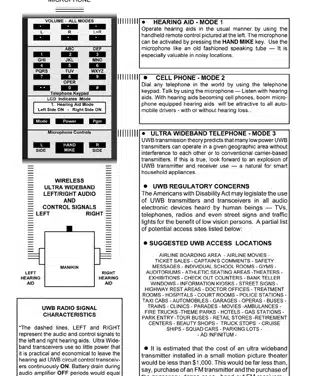
Multiplex audio and RC circuits. UWB radio transmits and receives simultaneous left and right ear audio signals. Hearing aid volume controlsleft and right earcould be remotely controlled by the hearing aid user. All of the hearing aid binaural controls could be located on a wrist band or mounted on the panel of hand-held microphone (Figure 1). Power on/off and all other switching functions could be remotely controlled without having to reach to ear level. The UWB radio signal could also support in-situ fitting and adjustment by the dispensing professional. Interference. UWB proponents claim that UWB, by its very nature, cannot possibly interfere with other communication systems such as aircraft radio. Conversely, conventional radio transmission cannot interfere with UWB. Electromagnetic interference (EMI) is not a factor, as demonstrated by the Navy. Audio quality. The audio signal of UWB radio is flawless and interference free. Telecoil coupling hearing aid use has an abysmal record of poor quality and zero interference rejection. FM radio, noted for its interference-free quality sound, would appear equal to UWB radio. However, the physical size of FM transmitters and receivers limits current hearing aid use. Zero spectrum use. UWB proponents claim that UWB radio uses zero spectrum in the sense of carrier-based conventional radio transmission systems. Spectrum capacity and assignment will not limit the number UWB transmitters operating simultaneously in a small geographic area. Conventional radio systems, such as AM and FM, require strict spectrum assignment that effectively limits the number of transmitters within a given frequency range and geographic area. Current regulations. Current FCC regulation limits UWB radio transmission to 10 meters. With full authorization, expected coverage will be as needed or authorized. It is expected that the FCC will extend UWB transmissions up to the line of sight or more. Group Hearing Aid Systems: History and Appraisal Persons with normal or near-normal hearing understand one-to-one conversation surprisingly well in a multitalker noise environment, as found in a busy restaurant. The human brain miraculously filters out much of the interfering multitalker background noise. A person whose hearing deteriorates in one ear is subjected to a dramatic demonstration on the efficacy of our noise cancelling brain: hearing loss results in an immediate measurable loss of word discrimination. Discrimination, however, can be improved substantially by standing closer to the sound source or by extending a hand-held hearing aid microphone close to the sound source. Many public gatherings, be it a classroom, church or sports arena, use a Public Address (PA) system to better convey speech or music to an audience. PA system microphones are usually placed close to the sound source (eg, goose-neck podium microphones are often only 6 inches from an announcers mouth). In this way, the signal-to-noise ratio (SNR) benefit is passed on directly to any group hearing aid system connected to the PA system. With inherent reverberation and background noise found in auditoriums, loudspeaker reinforcement may be of little value to many hearing aid users. How much better it would be if the hard-of-hearing person could effectively place his/her hearing aid microphone 6 inches away from a lecturers mouth? Poor room acoustics would no longer degrade word discrimination. Group hearing aid systems duplicate this close proximity to the speakers mouth. The first group hearing aid system became possible by induction coupling of a telephone signal to a hearing aid. Most persons with a mild-to-moderate hearing loss can satisfactorily use a telephone in the usual manner. Persons with a moderate-to-severe loss, however, often depend on special amplified telephones or the use of telecoil coupling to a telephone. Hearing aid scientist Samuel Lybarger observed that most telephones radiate an electromagnetic voice signal from their earphone. Lybarger made use of this latent voice signal by inductively coupling it to a receiving coil that he placed in a hearing aid a coil that we now call a telecoil or a T coil. People with a moderate-to-severe hearing loss benefit most by telecoil use. For many people in this loss category, telecoil use is an absolute necessity for their successful telephone communication. Hearing Aid Compatibility with Telephones An outraged David and Reba Saks founded the Organization for Use of the Telephone (OUT), a group of nationwide hearing aid users dedicated to making telephones compatible with hearing aids. Saks and OUT members who could no longer use their telecoils with the new magnetically shielded telephones lobbied both halls of Congress to pass the Hearing Aid Compatibility Act. With its passage in 1988, the Act ensured that all new landline telephones sold or manufactured in the US are hearing aid compatible. (The author did his share of pacing the halls of Congress for this Act.) More recently, the FCC has determined that cellphone manufacturers should also make their devices compatible with hearing instruments. Land-Line Telephone & Group Hearing Aid Systems Telecoil coupling technology. Present-day land-line telephones transmit sound to hearing aids via a transmitting coil that sends an electromagnetic signal to a similar coil, the telecoil, as used in many hearing aids. Critique: The combination of the transmitting coil and the receiving telecoil is essentially a very inefficient air-core audio transformer. The transfer product is not spectrally uniform and the quality of the transferred signal is poor. Additionally, should the telephone be operated next to a light dimmer or a high-voltage neon sign, its telecoil can pick up a loud staccato of electromagnetic interference. Telecoil inductive loop systems. As discussed previously, Lybargers telecoil coupling method has been expanded to cover larger areas, such as school rooms, churches, and auditoriums. This is achieved by connecting the output of a microphone-equipped PA amplifier to continuous loops of copper wire installed under the carpeting or in the ceiling of auditoriums or conference centers. Telecoil-equipped hearing aid users can then be seated anyplace in the auditorium and still advantageously pick up the speakers voice as if they are seated directly in front of the podium. If the hard-of-hearing person did not have a telecoil equipped hearing aid, a pocket-sized magnetic receiver equipped with earphones can be supplied or purchased. Critique: First, as pointed out previously,8 it should be made clear that these systems may be the best available technology. However, the cost of installing an inductive loop system under carpeting or above the ceiling has often prevented its use in many venues. Large-area loop systems and telecoil-equipped hearing aids are still subject to interference (EMI) and to the telecoils inherent poor transmission quality. Less expensive and easier-to-install FM and infrared (IR) group hearing systems became the popular choice for most auditoriums, churches, and school rooms. The receiving units (about the size of a pocket radio) are usually handed out by an usher along with earphones. An inductive neck loop or a silhouette coupler is frequently available to persons having a telecoil-equipped hearing aid. Infrared (IR) light systems. Modulated IR light is transmitted to pocket-sized IR receivers that convert or detect the invisible light into an audio signal. Critique: These systems are mostly ineffective in daylight or extremely bright artificial light. Real-time captioning. Real-time captioning is produced by having a skilled typist or stenotype operator type ongoing speech information into a computer that immediately projects the printed version on a large screen. Critique. Though very effective, the cost of real-time captioning prohibits its use for most public assemblies. Additionally, captioning trades good vision (eg, reading) for hearing loss. FM systems. The signal picked up by the PA system microphone is broadcast by frequency modulation (FM) to hard-of-hearing people. A special pocket sized FM radio receiver (purchased or furnished) receives the FM group hearing aid broadcast by use of an earphone or by inductive coupling to the hearing aid using a neck loop or a silhouette. Critique. FM radio transmits group hearing aid audio signals with clarity and fidelity that needs no improvement. With the exception of the telecoil, all of the group hearing aid systems described above require the issuance or purchase of a pocket radio-like receiver that, with extra effort, couples or connects to ones hearing aid. Any improvement over current FM radio, in my opinion, would have to be in the fields of its power consumption, circuitry size, and antenna length. Optimally, what is needed is a single module, and possibly a single chip sizepreferably much smaller than the plug-in transmitters and receivers currently used in many FM-equipped hearing aids. FM radio is limited to transmitting audio signals only; it has not been used to control or adjust the fitting of hearing aids. Does Our Future Include UWB? As previously mentioned, the US Navy is already using UWB radio transceivers (walkie talkies) for shipboard communication. Imagine, if you will, the advantage for hearing an important speech in a large group without having to fumble with an issued pocket radio-like group system. Instead, your hearing aid would have a built-in UWB radio receiver that would directly connect you to the microphone used by an artist or a lecturer. What better front-row center seat can you ask for? Since UWB transmission is still several years in the offing, let us postulate that UWB radio has arrived in full purport. FCC has now fully licensed UWB radio and Congress has mandated that many public venues (eg, telephones, TVs, radios, schools, theaters and lecture halls, etc) be equipped with UWB transmitters that can be accessed by entering a simple telephone-like number. Hearing aid users would be furnished with cellphones that connect wirelessly to their UWB-equipped hearing aids. The cellphone would double by being the wireless ears and keypad for connecting their hearing aids to selected UWB transmitter sources, such as a motion picture sound track or the microphone of a lecturing professor. The obvious current parallel to this technology is the telecoil-equipped hearing aid8; however, for reasons stated above, UWB appears to have clear advantages over this system. The Need for Increased Access with Hearing Aids With the success of UWB radio-equipped hearing aids for telephone usage, Congress could pass another act requiring all TVs manufactured after a certain date to be outfitted with UWB radio transmitters similar to the UWB radio transmitters used in telephones. This Act would emulate The Television Decoder Act of 1990, an act requiring all new TVs with screens 13-inches or larger to be equipped with a built-in captioning decoder. Captioning that utilized set-top decoders was already in successful use during the 1980s. Millions of captioning TVs, using 50-cents worth of extra parts, have since been produced. With acceptance of UWB-equipped hearing aids, telecoils would no longer be required or necessary. Current hearing aid usage places volume controls and switches at ear level. If you need to change the volume or turn a hearing aid on/off, you have to reach to your left ear, right ear, or both ears. I predict that, with UWB-equipped hearing aids, you will remotely control hearing aid volume by using your wristwatch-like or cellphone keypad. Recently, hearing aid users and hearing aid manufacturers have been successful in calling for interference-free hearing aid use with cellphonesproof positive that Congress and the FCC listen to their constituents if an important problem is posed. This bodes well for the advent of UWB communication. Conceivably, increased hearing aid access can also benefit persons with low vision by the use of talking signs and destination-announcing mass transit. With more and more persons putting earphones to their ears for entertainment and cellphone connection, hearing aid companies may find a vast new market: people with normal hearing and people with low vision.
Correspondence can be addressed to Francis Beecher, 930 N Tamiami Trail, Ste 421, Sarasota, FL 34236; email: fbeecher@comcast.net. References |
|
|
Featured Jobs
Find a Job |
ADDITIONAL ONLINE RESOURCES |
Featured Employer
|