Issue StoriesHearing Loss and Its Impact on Household Income: A special report on new data generated by the Better Hearing InstituteUntreated hearing loss negatively impacts household income by up to $12,000 per year, depending on the degree of hearing loss, and may cost over $100 billion in lost income annually. Editors Note: The information found in this article is adapted with permission from the study, The Impact of Untreated Hearing Loss on Household Income, by Sergei Kochkin, PhD, of the Better Hearing Institute, Alexandria, Va. The bad news is thattreated or untreatedpeople will pay for their hearing loss. The good news is that those who take positive action and seek treatment via amplification will ultimately save themselves, on average, thousands of dollars in lost wages and future income. This is the conclusion of a recent study conducted by the Better Hearing Institute (BHI). Surveying more than 40,000 households utilizing the National Family Opinion (NFO) panel, hearing loss was shown to negatively impact household income by up to $12,000 per year, depending on the degree of an individuals hearing loss. However, the use of hearing instruments was shown to mitigate the effects of hearing loss by 50%. For Americas 24 million hearing-impaired who do not use hearing instruments, the impact of untreated hearing loss is quantified to be $122 billion annually in lost wages. At a 15% tax bracket, the cost to the federal government could be well in excess of $18 billion in unrealized taxes. Scope of Hearing Loss There is an extensive body of research concerning the impact of hearing loss on quality of life.2-3 When we talk of quality of life, healthy hearing per se is not just to enhance aesthetic pleasure of acoustic sounds in a persons environment; indeed, hearing loss has been shown to negatively impact nearly every dimension of the human experience including:
In a recent review of the literature,4 Bridget Shield, PhD, professor of acoustics at London South Bank University, has shown that hearing loss is related to unemployment and underemployment. However, the majority of research clearly has focused primarily on people with severe to profound hearing loss. The literature, however, is less clear on the impact of lower levels of hearing loss and how they impact effectiveness in the workforce. Some recent studies indicate that minimal hearing loss is detrimental to the learning of language skills among children.5 In addition, while the link between hearing loss and employment has been established by Shield,4 for those receiving treatment for hearing loss, it is difficult discerning whether or not such treatment is associated with improvements in their economic prosperity. The purpose of this paper is to quantify the relationship between treated and untreated hearing loss and income. Study Method The screening survey covered only three issues:
This short survey helped identify close to 16,000 people with hearing loss and also provided detailed demographics on those individuals and their households. The response rate to the screening survey was 66%, and this information was reported in the July 2005 The Hearing Review (the first publication in this series).1 In January 2005, an extensive survey was sent to 3000 random hearing instrument owners and 3000 random people with hearing loss who have not yet adopted hearing instruments. The response rates for the detailed surveys were 75% and 77%, respectively. The data presented in this article refer only to households as defined by the US Bureau of Census; that is, people living in a single-family home, duplex, apartment, condominium, mobile home, etc. People living in institutions have not been surveyed (eg, residents of nursing homes, retirement homes, mental hospitals, prisons, college dormitories, and the military). Detailed demographics of the hearing instrument owner population are documented in the first publication (see July 2005 HR),1 so they will not be repeated here. Hearing instrument owners responded to a 7-page survey consisting of 188 questions or response scales in the following areas: hearing instrument owner demography, hearing loss measures, product features, customer satisfaction and usage, future behavior, factors influencing hearing instrument adoption, and perceptions of hearing care providers. Non-owners also responded to a 7-page survey covering non-owner demography, hearing loss measures, visitation with hearing health professionals and medical profession, reasons for non-adoption of hearing instruments, and future plans. Sample Selection. From the screening phase, close to 16,000 people with hearing loss were identified. Excluding children and people in the household who were not the head of household or spouse of the head of household, the following sample sizes were achieved for this study:
Other Possible Variables in Income Analysis
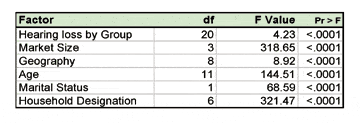
All demographic variables were included in the model since they were significantly correlated with group membership. Education was not included in the model since there were no significant differences in educational level as measured in years between the three groups. The average year of schooling attained by group was as follows: normal hearing group (12.75 years), unaided group (12.66 years), aided group (12.61 years). Results
Cost to individuals/households. The least square means (adjusting for the variables in Table 2) for the 10 hearing loss groups and the single normal-hearing group are plotted in Figure 1. The linear model expressing the relationship between hearing loss and income is approximately $53,200 - $1,180 (ie, any given decile minus $1,180) for every 10% increase in hearing impaired as measured in this study. In other words, individuals with the most serious hearing loss (Decile 10) could be expected to earn $12,000 less per year than an individual with a mild (Decile 1) hearing loss.
Does the use of hearing instruments mitigate the impact of hearing loss on income? Figure 2 plots the least square salary profiles for the hearing-impaired individuals who use hearing instruments and for those who do not. (These salaries are again adjusted for the demographic variables listed in Table 2.)
The linear model of unaided household income (ie, involving subjects with hearing loss who do not use hearing aids) equals $53,500-$2,250 (for every decile of hearing loss). In contrast, the linear model aided household income (ie, involving subjects using hearing aids) equals $54,100-$1,130 (for every decile of hearing loss). While it is important to note that both treated and untreated hearing loss groups show deterioration of income as their hearing loss worsens, the income decline is cut in half for hearing aid owners. For example, the difference between Decile 1 (mild) and Decile 10 (profound) incomes as shown in the model in Figure 2 is as follows:
Finally the difference between the unaided and aided linear models is shown in Figure 3 where the impact of non-treatment for hearing loss ranges from $1,700 to $11,700 per year depending on the severity of hearing loss. (Authors Note: For sensitivity purposes we may not want to accept the difference at Decile 1 because the least square means are virtually identical for the lowest 10% of the hearing loss population before linear smoothing.) After Decile 1, the treated and untreated profiles diverge at the rate of approximately $1,000 for every 10% increase in hearing loss.
Cost to Society. As shown in Table 3, the cost to society could be significant, since untreated hearing loss results in underachievement on the job. Currently 24.08 million people with admitted hearing loss do not use hearing aids in the United States. If we segment the non-owner population into hearing loss decile groups, it can be seen that the non-owner hearing loss is significantly lower than the hearing aid owner population hearing loss. For example 18.1% of non-owners are in the lower 10% of hearing loss in America. Now if we cross multiply population size by income differential we can arrive at:
The estimated cost in lost earnings due to untreated hearing loss is $122 billion while the cost to society in terms of unrealized federal taxes is $18 billion. For sensitivity analysis one can assume no impact on the bottom 50% of the population with hearing loss. No matter what cut-off is accepted, the impact on household income and unrealized Federal taxes will be significant. Conclusions Most hearing care professionals are aware of individuals who delayed hearing loss treatment well past their working lives due to fear of stigmatization on the job. This author is personally aware of a CEO who indicated that he had delayed treatment for his hearing loss due to vanity until he made a critical error which personally caused him to lose a $1 million contract. We have also talked with individuals who suffered needlessly during their school years with hidden hearing loss. Unfortunately, untreated hearing loss is not hidden, for it results in underachievement for nearly all who delay treatment while they are in the prime of their life. The tragedy is that untreated hearing loss impacts the individual and his/her family for life in the form of lost wages, lost promotions, lost opportunities, and unrealized dreamsnot to mention lower income in their retirement. As Helen Keller said, When you lose your vision, you lose contact with things. When you lose your hearing, you lose contact with people.
Acknowledgement Correspondence can be addressed to HR or Sergei Kochkin, PhD, Better Hearing Institute, Ste 420, 515 King St, Alexandria, VA 22314; email: skochkin@betterhearing.org. References |
|
|
ADDITIONAL ONLINE RESOURCES |
Featured Employer
|