Issue StoriesA Small Change in Verification: A Compact Live Speech REM Systemby Gay Hosking Poe, MA, and Terry Ross Although there is ample evidence that clinicians should be performing REM on all their patients, the test is not universally used in the verification/fitting process. Live speech REM is designed to provide an efficient way to administer this testing and obtain more useful information. Recent evidence1-4 points to a resurgence in real ear measurements (REMs) as the premier verification tool in the hearing instrument fitting process. However, REM testing is not without its challenges. The HR Dispenser Survey5 indicates that, although 67% of all dispensing offices report having REM testing equipment, only 26% routinely perform REMs during hearing instrument fittings. Similarly, this years HJ/AO survey reported that 21.5% of practices always or nearly always conduct real-ear probe-mic measurements, while another 12.2% say they conduct the test most of the time.6 This suggests that, although there is ample evidence that clinicians should be performing REM on all their patients, the test is not universally viewed as a vital part of the verification/fitting processor is not being conducted due to time constraints and/or the amount of information that can be drawn from the test results. With a recent product introduction, REM Speech developed by MedRx, it is now easier than ever to make these useful measurements using the most valuable input signallive speechto verify amplification. Essentially, the system is designed to establish the patients hearing levels (HLs) and uncomfortable listening levels (UCLs), then sets the target area for amplification within these parameters. The dispensing professional then measures the hearing instrument output using the REM probe mic while speaking to the patient. Likewise, the clinician can use soft, comfortable, and loud speech to map hearing aid performance in the ear at different levels. Within minutes, these essential measurements are performed using REM Speech. In addition, the outcome is easy to interpret by both the operator and patient. The authors believe that Live Speech REMs are, and will remain, the most important protocol required to ensure successful hearing instrument fittings. A Small Solution for a Large Fitting Problem Industry support for the REM is surging. As reported in a recent article by David Hawkins and Jodi Cook: if you want to know what the actual hearing aid is doing on the patient who is going to wear it, you need to make a validation measurement in-situ 1 Auto-fit programs recommended by device manufacturers are inherently inaccurate1-4 since they cannot take into account all of the physical and anatomical differences between individuals. Best-fit models from the hearing instrument manufacturers are unlikely to succeed in a large percentage of cases; these models can only utilize averages, rather than the actual in-situ fitting of the individual patient. In many cases, the starting points are more likely to provide the patient with an unsatisfactory first impression of amplification. REM Speech is designed to reduce the probability of a poor first-fit by utilizing the patients own anatomy, and the specific hearing device and coupling to verify amplification.
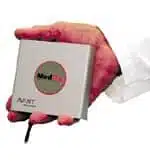
The most obvious feature of REM Speech is its size at only about 4 x 4 x 1or about the size of a mans wallet (Figure 1). Its tiny footprint allows for discreet placement in virtually any office setting, and the convenience of portability if desired. The system is computer-driven and receives its power from the USB port on a computer. There is no external power supply requirement. In addition, REM Speech conveniently provides lighted cues on the top of the device for the dispensing professional, indicating which ear is being tested with a lighted display (eg, illuminating red for right ear and blue for left ear testing). The system provides both right and left probe microphones, eliminating the need to switch probes from side to side, and it comes with its own speaker system and USB cable to the computer. How the System Works
The focus of this review is Live Speech Mapping. A critical factor in successful hearing instrument fittings is the patients understanding of the process. The system addresses this concern with careful attention to how information is displayed for both the patient and the clinician. For Live Speech Mapping, the audiogram is displayed in dB SPL, so that soft sounds are at the bottom of the display and loud sounds are at the top. When the real ear probe is measuring sound in the ear, a real-time response is plotted to the SPL graph. In this way, it is easy for a patient, third party (eg, spouse, daughter, etc), or dispensing professional to see when speech is audible, comfortable, and loud, in relation to the patients hearing thresholds and discrete frequency UCLs. Figure 2 shows the audiogram data and displays the Live Speech curve for aided and unaided responses.
The target rangethe area between threshold and UCL across the frequency rangeis the focus of Live Speech Mapping. The Speech Map is designed to ensure that soft speech is audible, moderate-level speech is comfortable, and loud speech never exceeds UCLs (Figure 3).
Real time Live Speech Mapping provides an extremely easy and valid method to verify a hearing instrument fitting while simultaneously programming the device. The fitting process is achieved by presenting the live speech map on-top of the manufacturer hearing aid fitting program within NOAH (Figure 4). Once the LSM probe is activated to take measurements, the dispensing professional can then make adjustments to all of the hearing aid performance parameters to ensure there is enough gain for soft and moderate sounds, and sufficient compression is applied to loud sounds. This procedure is performed in real time in cooperation with the patient. (For a complete review of the fitting procedure, see Ross and Smith.7)
Summary
References |
|
|
ADDITIONAL ONLINE RESOURCES |
Featured Employer
|