Issue StoriesDoes the In-Office Electronic Scanning of Impressions Really Change Everything?by William Lesiecki, MA Although the in-office scanning of ear impressions is still a new concept, it will soon become common practice. And with it, much of the dispensing process will change for the better. The October 2002 Hearing Review article, Shell Technology: The Shape of Things to Come in E-Business,1 hailed the beginning of the Laser Manufacturing Era in the hearing industry. The article described the technology that was pioneered by Siemens, in partnership with Phonak, to scan ear impressions and subsequently manufacture custom hearing instrument shells through the laser sintering process. At that time, Siemens was the first manufacturer to make hearing instruments commercially available via the LasR process. In less than three years, all six of the Big 6 hearing instrument manufacturers (GN ReSound, Oticon, Phonak, Siemens, Starkey, and Widex) now utilize some form of this technology in their manufacturing.2 As these manufacturers are responsible for 90% of the hearing instruments sold in the world, this means that scanning ear impressions and using rapid prototyping to build hearing instrument shells is now an accepted process, and its use is growing. This article will examine the ramifications of this change in the manufacturing process, with particular emphasis on the Siemens iScan system, and what the Laser Manufacturing Era means for the hearing care field. Virtual Integration Is Happening Today In the hearing industry, virtual integration is achieved by linking the hearing care professional and the hearing instrument manufacturer by means of real-time access to data. This includes information for ordering, as well as for all other aspects of managing the business between these two entities. The Chain Still Has Its Weak Link Since the publication of the first article1 on this subject in 2002, at least one feasibility study has been performed at Siemens Hearing Instruments utilizing computer assisted tomography (CT) scan technology (the study was displayed by Siemens at the American Academy of Audiology 2003 and 2004 conferences). This study suggests that the data necessary to manufacture an acceptably fitting hearing instrument shell can be obtained without ever taking a physical ear impression. In other words, it is feasible to build hearing instruments from ear scanswithout any physical ear impression ever being made. It should be noted that this was only a feasibility study, providing a foundation on which to build; the study did not recommend that we send hearing instrument candidates for CT scans instead of ear impressions! A commercially viable direct ear-scanning system likely remains a long time, and many research dollars, away. However, the positive outcome of this feasibility study bodes well for the future of direct ear scanning. The 2002 article closed with the suggestion that there could be interim steps before direct ear scanning is widespread clinical practice. One such step would be scanning ear impressions at the point where they are taken (eg, in the hearing care professionals office). The professional subsequently would attach the scans to an electronic order, transmitting it via Internet to the manufacturer. By doing this, many of the factors that are responsible for the ear impression being the weak link are mitigated. For example, the need to ship the ear impressions to the manufacturer is eliminated, and along with it, the vast majority of handling problems related to the impression. Currently, the quality and successful fit of the resulting shell/earmold still depends on the impression-taking skill of the dispensing professional. As Pirzanski & Berge4 point out, digital shell manufacturing holds great promise for improving the fitting process. However, at least until we progress to direct ear-scanning technology, the success of impression-scanning technology still relies on the many factors inherent in the impression-taking process: asymmetrical ears, the dynamic ear canal, and current impression-taking techniques. In-office Impression Scanning Is Now a Reality As exciting as many people find the concept of in-office impression scanning, perhaps even more exciting is the overall virtual integration now available as a result. iScan demanded the need for the development of a complete electronic information exchange between the hearing care professional and manufacturer: no paperwork exchanged, no impression shippedjust electronic data exchange. But virtual integration is much more than electronic ordering; it also requires that the manufacturer have systems in place enabling the manufacture of custom hearing instruments or BTE earmolds without the physical ear impression. Take a moment to consider what this really means: a technician creating a custom hearing instrument without ever having a physical ear impression in hand! So, how does this change everything? If you have ever visited a hearing instrument manufacturing lab, you know that, for the last 35 years, building custom hearing instrument shells is almost as much an art form as it is a skill. Shells require highly skilled technicians to perform a lot of by hand preparation of the ear impression before its transformation into a shell. After this detailing is completed, a cast (often referred to as the investment) is made of the impression. As the shell is being built, the cast is used for quality control purposes to see how it fits in this replica of the ear. So, relative to a scanned ear impression, no physical ear impression required means no impression to wax or trim which means no cast is needed. So how do you know if the shell is going to fit? Understanding this process helps to demonstrate the fact that there is no longer a paper order form needed. And what about things like marking the ear impression with a SharpieŽ to show where the canal should be cut, or where there is a bump to be eliminated or left alone? How will that be accomplished? And what about all those notes written by the dispensing professional on the order form to try and explain what is really required for an order? What do you do if you want to discuss the impressionparticularly when youre not sending in the impression? So this does change everything! Once you start to see the big picture, it is easy to comprehend that digital impressions do in fact change everything. Using an impression scanner, e-ordering, and linking to the manufacturerall electronicallyfor just about everything that you do is a fundamental change in the entire process. This will perhaps be as big an impact on the industry as was the introduction of digitally programmable hearing instruments or the use of real-ear measurements. But is changing everything good news? In this particular case, the answer is Absolutely yes. The end benefit is a better and more expedient process, one that gives hearing care professionals greater control and empowers them to operate their practices at higher levels of efficiency. It is a benefit worthy of being called a paradigm shift. There are also benefits for the manufacturer. For example, the elimination of in-bound shipping costs and delays associated with the handling of impressions will create substantial savings. This win-win situation for the professional and manufacturer becomes a win-win-win situation because the benefits also extend to the patients. They receive better-fitting hearing instruments with a faster delivery time. The remainder of this article will focus on iScan and the supporting structures around it. For the purposes of this description, the process will be divided into three steps: 1) scanning the impression; 2) creating and sending the order; and 3) manufacturing the hearing instrument.
In-office Impression Scanning
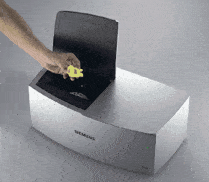
The hearing care professional places the impression into iScan and clicks Start. There is no special preparation of the impression necessary, although it is suggested to remove the otoblock first. The only requirement is that silicone impression material must be used (most colors are acceptable). The iScan device operates on approximately the same PC platform required to run NOAH 3 and/or a fitting module such as Siemens CONNEXX. The recommended operating system for the PC is Microsoft Windows XP-Pro. Hard-disk storage capacity is not an issue for todays typical PC platform. iScan files saved to the hard drive are relatively small, on the order of 300 KB each, so even a relatively small 1 GB hard drive would allow storage of thousands of files. Hi-speed, broadband Internet access is recommended for sending the files. Creating and Sending the Electronic Order HIMSAs eTONA (Electronic Transfer Of NOAH Actions) module is a new version of NOAH 3 that will allow hearing care professionals and manufacturers to exchange the data necessary for electronic ordering.5 eTONA is not an order form itself; it is just a platform that allows the manufacturer to use an electronic order form by configuring it with data supplied from NOAH 3 (eg, the manufacturer creates the fields used within the electronic order form). eTONA also provides functionality for communication about the order between the professional and manufacturer (eg, for order status updates). For a more comprehensive discussion of eTONA, see Ingraos article5 in the August 2005 edition of HR, visit www.himsa.com, or contact a hearing instrument manufacturer.
To utilize the scan data from iScan, Internet access and access to an electronic order form are required. Using mySiemens, the eOrdering process is straightforward (Figure 4): 1) Scan the impression as described above, saving the file using the patients name. Order validation. Premium digital hearing instruments have many options, and in some cases, this can complicate the conventional ordering process. Look at any companys order form, and you will find a long list of options from which to choose. Therein lies the problem: There are so many choices that often one selected feature contradicts another. A simple example of this is to select raised VC, but not select volume control in the appropriate place. This example is actually a common type of problem for manufacturersorder forms that contain simple mistakes or contradictory selections. In these cases, the order becomes a kick-out, meaning that it does not pass to the next manufacturing stage because the dispensing professional must be contacted to clarify the desired options. A kick-out delays the manufacture of the instrument, and thus the delivery time to the patient. The term 100% order validation means that, as the electronic order form is completed, it is reviewed to ensure that each selection is valid for manufacturing (eg, the instrument can actually be built). In the virtual e-ordering world, it is possible to provide 100% validation of the order before it is sent to the manufacturer. This is accomplished by software designed to inspect each parameter selected and ensure that it is compatible not only with the model and type of hearing instrument selected, but also with all the other choices made by the dispensing professional. An analysis of kick-out rate was performed at Siemens on a large sample of paper orders versus electronic orders. It was found that the kick-out rate dropped from about 12% to 2% due to the validation procedure utilized on the e-orders. This means that approximately 80% fewer calls had to be made to professionals to clarify orders. This is a direct savings of time and effort for both the manufacturer and the professional, and there is a direct correlation to faster turn-around time. Virtual manufacturing. Once the iScan-based order is at the manufacturing plant, it enters a virtual manufacturing process, resulting in a finished hearing instrument.
The first step of this process is to e-detail the impression scan. Instead of the technician following the traditional methods of prepping the physical impression by trimming, waxing, hole filling, etc, the technician utilizes sophisticated CAD-type software to electronically detail the impression (Figure 5a). What was once being done by hand is now done within the virtual world of the PC. This yields many advantages. For example, if a mistake is made and too much of the canal is trimmed, the technician simply clicks the undo button, rather than telling customer care to contact the professional and ask for a new impression. After e-detailing, the order is moved to the materialize stage. At this stage, the hearing instrument is designed, the components are virtually placed, venting is implemented, and the receiver opening is determined. This is all done on a PC so that the technician has a 3-D view of everything, allowing for easy customization to produce the optimum instrument design. The process also utilizes collision detection, a software algorithm that ensures all instrument components will fit as needed without any components interfering with each other (Figure 5b). Therefore, the entire instrument is built first in the virtual world before it gets fabricated in the real world. And what about the investment described earlier, the cast of the ear canal that traditionally was made from the physical impression? In this case, a virtual cast is made. In order for the technicians and quality control to check the fit of the hearing instrument, the software produces a virtual cast on the PC. The technician can insert the virtual hearing instrument into this virtual cast and examine in detail how it fits at all points in the ear.
Utilizing LasR manufacturing. Once the virtual design is complete, the shell is produced via the LasR-A manufacturing process (Siemens second generation LasR process), resulting in a smooth-textured acrylic shell. The virtual shell model is used as the template to manufacture the actual shell through a rapid prototype manufacturing process utilizing stereolithography processing or SLA. SLA uses state-of-the-art technology to print a shell from liquid acrylic, building it layer by layer to precisely reproduce the digital impression. (Figure 6). Because the original scanned impression data is stored as a digital file, its also possible to use this data file for shell replacements (eg, in the case of a lost or damaged hearing aid). Monitoring the Process from the Professionals Office/Practice Conclusion Electronic ordering is a mature process that significantly impacts how business is conducted in our industry. By adding in-office impression scanning, the impact of e-ordering is dramatically greater, both in terms of improving the process and in making it faster and more accurate. Scanning the impression in the office, as demonstrated in this article by using the iScan in-office impression scanning technology, has a significant impact on the custom hearing instrument order process. By making the process totally electronic, shipping of ear impressions and order forms is eliminated, and turnaround time is reduced by 1 to 2 days. The use of electronic order forms with 100% order validation has been shown to reduce the kick-out rate, yielding a higher number of orders that make it into the manufacturing cycle without delays or intervention for order clarification. Combining these two technologies with new and improved virtual manufacturing systems, and at the same time allowing hearing care professionals real-time access to all necessary data and systems, now enables true virtual integration in our industry. This opens new doors and more possibilities for professionals to operate more efficient practices and deliver an improved level of service and satisfaction to their patients. So, to revisit the question posed by the title of this article, Does the electronic scanning of impressions really change everything? the answer is Yes!
References |
|
|
Featured Jobs
Find a Job |
ADDITIONAL ONLINE RESOURCES |
Featured Employer
|