Issue StoriesNoisy Toys: Annoying or Harmful?by Julee Sylvester When measured at the receiver, half of the toys studied were louder than a chainsaw. Walk down the aisles of any toy store and you cant miss themtoys that make noise. But are they merely annoying, or could they be harmful to a childs hearing? Every year, just before the busiest toy-shopping season, the Sight & Hearing Association (SHA) tests a variety of toystaken right off local toy store shelvesfor potentially dangerous noise levels. This year, 7 of 14 toys tested by SHA and researchers at the University of Minnesota sounded off over 100 dB at the receiver. Say what? Thats louder than a chainsaw. The top offender on this years list, Kid Connections Electronic Guitar, blared at 117 dBloud enough to risk hearing damage in about 10 minutes. The Elite Operations Quantum Blast Set blasted at 114 dB (Table 1 and Figure 1). And, similar to last years list, two books meant for 18-month-olds topped 100 dB. In fact, all of the toys tested measured over 90 dB directly at the speaker of the toy.
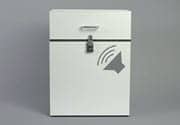
Exposure to noise levels above 85 dB for 8 hours is the federal threshold for hearing protection. Levels above 90 dB can cause permanent hearing loss with relatively short exposure. Chris Hilton and Emiro Caicedo, both resident otolaryngologists at the University of Minnesota, tested the toys. What they found surprised them. We were especially surprised that the toy guitar was so loud, Hilton said. With toys, you need to think like a kid. An adult wouldnt put his ear up to a speaker, but a child would. This can dramatically increase the sound levels. Also, the number of times a child plays with the toy will play a role in exposure time and this could pose a risk, Caicedo added. Because of a childs shorter arm span, noisy toys are potentially more dangerous to hearing because children hold them closer to their ears. In the SHA study, the toys were repeatedly tested at distances simulating how a child might hold the toy, directly near the ear (0 inches) and at arms length (10 inches). A sound-proof acoustic chamber was used to ensure accurate measurements. Until recently, there were no regulations in the United States regarding the loudness of toys. A new acoustics standard (ASTM F963), adopted and revised in March 2004 by the American Society of Testing and Materials, states that a hand-held, table-top, or crib toy cannot exceed 90 dB at 25 cm (eg, about 10 inches) from the surface of the toy. Compliance with the standard is voluntary. As advocates for hearing conservation and safety, SHA is thrilled that the toy industry and consumer safety groups have finally realized that acoustics are an important part of overall toy safety. It should be pointed out that none of the toys we tested pose an immediate risk for hearing damage; however, some could pose a risk in a matter of minutes. SHA wants consumers to know what sound levels the toys are capable of producing so they can make their own decisions. Despite the new acoustics standard, the toy industry continues to assert that toys are not harmful to hearing. In the Toy Industry Associations statement regarding the sound level of toys, it writes what makes people call a toy too noisy is a matter of opinion and personal preferencejust as some people prefer soft classical music to loud rock music. I disagree. A toy that features sound levels of 100 dB is still cranking out 100 dB, whether its Mozart, Metallica or Mattel. Unlike toys with choking hazards and other injuries, there are no injury statistics on toys and hearing loss. Thats because noise-induced hearing loss is extremely difficult to track relative to its origination. Noise-induced hearing loss is cumulative. It doesnt typically happen from one event; it gradually happens over time. Thats why its important to start protecting hearing at a young age. What to Do About Noisy Toys Listen to a toy before you buy it. If it sounds loud to you, its too loud for your child. What Message Are We Giving Kids? Much of the hearing health care fields current educational activities focus on the working population, those people who are old enough to be drawing a paycheckand trying not to go deaf as a result of their noisy jobs and leisure pursuits. As important as this education is, one cannot help but wonder if we shouldnt be focusing more attention on teaching youth that cumulative noise exposure over a persons life is deleterious to hearing. After all, they have the most to lose. If we dont educate our children about proper hearing health care and hearing conservation,1,2 our message may eventually be falling on the deaf(ened) ears of adults who should have received that education long ago as children. Hearing conservation is something that should be taught at a young age, and noisy toys that are antithetical to a healthy hearing concept. Some people may think of this idea as being a kill-joy or Grinch, but when todays children reach their later years in life, they will thank us!
Acknowledgement Correspondence can be addressed to HR or Julee Sylvester, Sight and Hearing Association, 674 Transfer Road, St. Paul, MN 55114-1402; email: jlps@sightandhearing.org; Web site: www.sightandhearing.org. References |
|
|
Featured Jobs
Find a Job |
ADDITIONAL ONLINE RESOURCES |
Featured Employer
|