Issue StoriesLet's Get Real! Understanding the Distinctions Between Aided SRT and WRSby Bailey K. Wang, PhD The 50%-point on the Performance-Intensity function curve is just a pointnot the whole picture The SRT has little bearing on overall word recognition ability. Although there appears to be a working assumption or approach in our field (and even within the research community) for using the 50% data point to predict maximum speech processing performance, this is, in fact, an effort without any clinical or theoretical foundation. Is it feasible to use the Speech Recognition Threshold (SRT) as a predictive measure of an individuals Word Recognition Score (WRS)? During the course of the hearing aid selection process, a decision needs to be made between two hearing aids or between the performance settings on a single hearing aid. One performance setting yields a SRT that is better than the other. What major factors behind a clinical decision weigh into the equation among todays dispensing professionals? When viewing a device being able to provide a better SRT at a lower signal presentation level or at a better signal-to-noise ratio (SNR, or S/N ratio) as compared to other devices, what should the professional expect from a device that has a better SRT? Will we choose this device because it would, as expected in our professional judgment, lead to better speech understanding performance in the real world? When a digital hearing aid with a directional system is found to be associated with slightly better SRTs in terms of SNR, many of us would select that hearing aid and expect to see better speech intelligibility scores when the directional system engages. Likewise, when an assistive listening device (ALD), such as a FM system, shows slightly more benefit in SRT over other devices, many clinicians would also tend to make a reasonable inference that the ALD is going to yield superior speech understanding performance.1 Indeed, the literature has even tried to predict subjects speech understanding performance from the sentence recognition threshold based on the slope of the Performance-Intensity (P-I) function curvefrom which the sentence recognition threshold was obtained. As only one example, we might read in the literature that according to the test manual, a 1 dB S/N ratio difference is equivalent to 9 percentage points in the intelligibility of sentences. Thus, a 4 dB difference in S/N ratio between groups implies speech intelligibility scores approximately 36% poorer in the bilingual than the monolingual native speakers. Evidently, the underlying assumption for all these approaches is that one can make a prediction or an estimation of an individuals speech intelligibility performance from the SRT. However, is this widely accepted approach precise enough for clinical use? Can we actually be able to estimate or predict a hearing aid users speech understanding score simply based on that 50% point? Theoretical Considerations On the other hand, the Word Recognition Score (WRS) represents all possible responses when the speech signal is presented at various loudness levels above the individuals threshold.3-5 The WRS shows how well the patient can hear and process speech signals at various supra-threshold levels; in contrast, the SRT indicates how sensitive the person is to hearing speech signals at specific barely perceptible levels. Therefore, compared to plotting all possible WRS responses as a function of signal presentation levels, the SRT is known in the field as the 50%-point on the Performance-Intensity curve. The take-home point here is that the SRT is the threshold level response whereas the WRS is the supra-threshold level response to speech stimuli; by no means does the SRT indicate or hint at supra-threshold responses. Examining SRT and WRS for Different Types of Hearing Loss
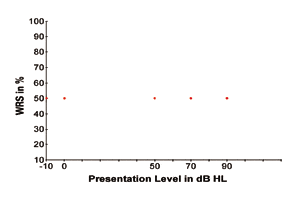
Then, what would the performance-intensity curve look like when speech signals are presented at their suprathreshold levels? Based on these four data points, can we estimate their maximum word recognition scores when speech signals are presented at various higher levels? Similarly, if these four data points represent the SRTs with an appropriately-fitted hearing aid in use, are we able to predict a subjects maximum speech intelligibility score after receiving the benefit of a hearing aid?
Figure 2 may serve to answer these questions. Based on clinical experiences and theoretical considerations, examples of some hypothetical Performance-Intensity (P-I) curves were plotted to demonstrate the interrelationship and response pattern of subjects word recognition scores for individuals with normal-hearing status and various degrees of hearing losses. For normal-hearing status. In Figure 2, the curve on the far left (eg, passing the 0 dB presentation level) may be used as the curve representing normal-hearing individuals. This is the one frequently seen in textbooks indicating that performance increases along with the increase of signal presentation level with a fixed slope, if measured with a fixed testing procedure and a given speech-testing material. Performance reaches the maximum WRS at about 40 dB Sensation Level (SL) above the SRT. For 50 dB-hearing losses. In Figure 2, to the right of the curve for normal-hearing individuals, a group of curves passing the 50 dB presentation level represents typical responses on the WRS for the 50 dB-hearing-loss category of listeners. Among this 50 dB-hearing-loss category (5 solid-line curves), the curve on the left shows the P-I function when the 50 dB hearing loss is a conductive hearing loss in nature. Note that the curve is exactly the same slope and reaches the same maximum WRS as the one of normal-hearing subjects because conductive hearing loss is, by nature, a sensitivity loss involving no pathology in the inner ear and higher structures. When the 50 dB hearing loss involves mixed hearing loss in nature (eg, a mild component of sensorineural hearing loss), then the subjects signal processing ability is reduced. Their P-I curves (the other 4 solid curves in this group of curves) might still ascend, but with a steeper slope and become flattened at a lower maximum WRS, compared to the curve of the normal-hearing subjects or of the conductive hearing loss. From this 50 dB-hearing-loss category, it can be seen that all curves show the same SRT but with large individual difference in the maximum WRSranging possibly from near 70% to 100%. For 70 dB hearing-losses. Further to the right in Figure 2, there are 4 dashed-line curves passing through the 70 dB SRT data point, culminating a different maximum WRS. These represent the possible response patterns and individual differences on the P-I function for the 70 dB-hearing-loss category. The category of hearing loss around 70 dB SRT is usually the majority of the client population seen in the typical hearing aid clinic. It should be immediately apparent that greater variations in the maximum WRS, as shown in Figure 2, can result from this type of loss. It is also interesting to note that some dashed-curves reach a WRS performance higher than those in the 50 dB-hearing-loss category, while others show a performance that is, in general, lower. One curve (the bottom dashed-line curve) shows a small degree of rollover phenomenon: poorer WRS at higher presentation levels once the highest WRS is reached. The great amount of individual variation revealed from the P-I curves is often related to sensorineural hearing loss (SNHL) with hair-cell and neural-fiber pathology involved. These losses often feature both a sensitivity loss and a clarity loss component, with the clarity loss in speech signals varying dramatically depending on such factors as, but not limited to, degree of hearing loss, shape of hearing loss, etiology of hearing loss, pathological condition of the ear-brain structure, extent of damage to outer hair cells and/or inner hair cells, damage and effect on active cochlear amplification, residual function of inner hair cells, damage to retrocochlear nerve fibers, effect on neural discharge synchrony, proportion of retrocochlear lesion versus cochlear lesion, effect of tonotopic reorganization of auditory cortex, length of hearing loss, history of hearing aid use, amount of time associated with (in)adequate auditory stimulation, prelingual versus postlingual cases, lifestyle and living surroundings, an an individuals linguistic ability (see sidebar, Is There Such a Thing as a Typical 70 dB Hearing Loss?). Clearly, myriad factors as discussed in the sidebarincluding those in pathological and linguistic domainsinteract with each other as the underlying mechanisms influencing the speech signal processing performances. Therefore, large individual differences on the response pattern of speech signal processing, slope of the P-I curve, and maximum WRS, should be reasonably expectable among subjects. For the 70dB-hearing-loss category of SNHL, what is displayed in Figure 2 is only a portion of the possible P-I functions with various maximum WRS achievedall with a same SRT. Therefore, Figure 2 and common sense suggest that predicting the possible maximum WRS from the SRT is a foolhardy approach without appropriate caveats. For 90 dB hearing losses. When the degree of hearing loss moves to the 90 dB-hearing-loss category, the SNHL would normally involve the neural component to complement the sensory component, yielding far greater losses in signal clarity along with sensitivity loss. These types of losses suggest more damage in the retrocochlear region and other neural relay stations along higher auditory pathways. Thus, more neurological impairments on higher pathways, with a greater chance of neural discharge dys-synchrony and auditory processing disorders, may become a possibility and reveal even poorer signal processing performance (compared to the 70 dB-hearing-loss category). All the factors discussed abovesuch as the actual degree of hearing loss across frequencies, particular etiology, location and severity of the damage in the inner ear and auditory pathways, tonotopic reorganization, individuals linguistic ability, etcwould interact with each other and result in different response patterns and slopes of the P-I curve. Again, large variations in the maximum speech signal processing performance would be expected. In Figure 2, three curves (two dashed and one solid line curves passing the 90 dB data point) were plotted to show varying slopes with various maximum WRS that may be achieved by individuals in this category of hearing loss. The solid-line curve shows even greater roll-over phenomenon as compared to that of the 70-dB-hearing-loss category. All three curves are placed to show that their maximum WRS is likely to be lower than that of the 70-dB-hearing-loss category. Of course, we know that some subjects with around 90 dB hearing loss would show extremely and exceptionally good WRS in comparison to those with even mild hearing loss. This kind of exception is not altogether uncommon; it further supports the great variability in signal processing performance functions and the auditory system. The unique point of discussion here is that all these curves are passing through the same 90 dB SRT data point and yielding a radically different maximum WRS. As with the 70 dB loss group, there are large individual differences. In the right-bottom corner of Figure 2, three more curves are displayed, showing some possible P-I curves for those with hearing loss greater than 90 dB HL. With this profound degree of hearing loss and confounding factors (as discussed above), large individual differences in the slope of the response curve and the maximum WRS should be anticipated. The uniqueness of these three curves is that the subjects ascending speech recognition performance may not even be able to reach the 50% point. Additionally, both the maximum WRS and rollover phenomenon may be even poorer or more pronounced, respectively, than 70 dB losses.
Clinical Evidence
Referring to Figures 3-5, it is clear that different subjects WRS performances may be exactly the same at the 50% point, while the slope of the curve and the maximum performance are completely different from one another. All these curves show that the SRT is, indeed, only the 50% data point along the response curve; great differences with respect to the slope of the curve and maximum processing performance exist in the real world. The figures indicate that the 50% data point has no close relationship with the maximum processing performance that would be accomplished by the individuals. Thus, the SRT should not be used as being representative for the performance-intensity responses.
This information also suggests that, when advising graduate students and formulating research projects, it may not be wise to use the SRT as the primary criteria of the study. Although quite a few tests are now designed to find the 50% point of subjects speech processing performance, the interpretation of the 50% point or SRTeither expressed in terms of the presentation level or SNRshould be made with caution. Speech processing performance is a more complicated phenomenon.
Summary 2) Speech recognition threshold is just the 50% data point on the P-I curve of subjects speech processing performance. 3) An individuals 50% data point (SRT) on the P-I curve could be at unity with another patients, but the slope and the processing performance of these two patients could be completely different from each other. 4) The relationship among the response pattern, the SRT, the slope of the P-I curve, and the maximum processing performance is extremely dynamic and unpredictable due to the individual variability. 5) A response with better SRT is not necessarily associated with better WRS. Although there often appears to be a working assumption/approach in our field for using the 50% data point to predict the maximum speech processing performance, this is in fact an effort without clinical/theoretical foundation and accuracy. 6) When performing hearing aid or ALD fittingssuch as selecting, modifying, and fine-tuning, or when establishing realistic expectations for the benefits of amplificationone should not be over-reliant on the 50% data point. Instead, obtaining a more complete P-I curve with maximum speech processing performance is a more pragmatic approach for the real-world clinician.
References Correspondence can be addressed to HR or Bailey K. Wang, PhD, 1201 West University Drive, Edinburg, TX 78541; email: bwang@utpa.edu.
|
|
|
|
ADDITIONAL ONLINE RESOURCES |
Featured Employer
|