Issue StoriesBoundaries of Real Open Fittings: Clinical Experiencesby Monika Bertges Reber A discussion of limiting factors in open-ear fittings, as well as fitting advice for these devices. The idea of using open fitting to alleviate hearing instrument users complaints of occlusion has been around for a long time. In the past, this was accomplished with large vents and/or non-occluding earmolds. In the last 2-3 years, we have seen the development of a new type of BTE system using thin tubing in place of an earhook and a small, flexible non-occluding ear plug instead of an earmold. For the purpose of this article, we will call these Real Open Fittings to distinguish them from the older methods of open fitting. Real Open Fittings have been successfully developed as a solution for first-time hearing instrument users. This population is particularly likely to complain of occlusion, but it should be noted that many experienced hearing aid users also appreciate the comfort of this solution. Despite the initial resistance of dispensing professionals due to doubts about the feasibility of Real Open Fittings, we are now seeing a steadily increasing market for these systems. Real Open Systems are especially applicable to the emerging Baby Boomer population, as they begin to seek hearing help.1 A high percentage of these first-time users have a typical sloping mild-to-moderate high-frequency hearing loss pattern. Real Open Systems, such as Bernafons SwissEar that is discussed in this article, offer a tailor-made solution for this group of patients. Limiting Factors for Open Fittings Practically speaking, it is impossible to make a Real Open Fitting feedback-free under all conditions. Consequently, feedback-free should be defined differently for Real Open Fittings than for closed fittings or fittings with venting. In order to establish a practice-oriented definition, we measured feedback with a group of experienced hearing aid users fitted with thin sound tubes and open domes. (Authors note: For ease of reading, the term thin sound tubes will be used in this article to mean a thin tube with an open dome.) A Real Open Fitting is considered to be feedback-free if it meets two primary conditions: The Upper Hand on Feedback: Determining Threshold of Feedback
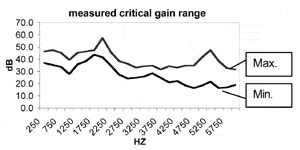
Figure 1 shows the minimum and maximum feedback threshold measurements for 7 subjects in the same wearing condition. The range is large because there are many factors that can influence the acoustics in a Real Open Fitting simply because it is so open. Changes in the acoustic surroundings can cause dramatic changes in the tendency for feedback. For example, entering a car, putting on a hat, or using the telephone all provide acoustic reflections likely to result in feedback. For this reason, an additional security reserve over and above the normal safety margin has been introduced to increase comfort and achieve a higher resistance against feedback during wearing. The larger the value of the safety margin, the less likely the device is to exhibit feedback. The hearing instruments also contain an internal reserve to ensure sufficient stability against feedback as the hearing instrument ages. The security reserve (safety margin plus the hearing instrument reserve) is purposely set high for thin tube fittings. The individual threshold of feedback can be measured using the hearing instrument itself as a measurement tool. The internal signal generator in the instrument produces a defined signal through the receiver. The hearing instrument microphone becomes a measurement microphone and passes the received signals to the integrated sound-level meter. It is very important to measure in a quiet surrounding, as background noise will cause the measured level to be artificially elevated resulting in over-restriction by the Feedback Manager.
Figure 2 shows the threshold of feedback measurement. The threshold of feedback is also called the critical gain. In this case, critical gain is defined as the maximum amount of gain you can give to the hearing aid in this wearing position without expecting feedback to occur. How Much Gain Can You Getin the Open Ear? Safe Gain Limit (f) = Threshold of feedback Feedback margin + Effectiveness of the Adaptive Feedback Canceller All these values are physical realities. This is why the effectiveness of the Adaptive Feedback Canceller is key to the equation. Typically, only with an Adaptive Feedback Canceller can one achieve sufficient effectiveness in Real Open Fittings. The safe gain limit is a value that changes with the venting in traditional fittings. When fitting a hearing aid there is always the following trade-off: The more open the fitting, the less resistant the system is to feedback. Especially for thin tube fittings: The safety margin allows wearing comfort with no whistling in changing acoustic environments. As soon as you choose different acoustic parameters in OASIS plus, the software automatically adjusts the threshold of feedback and the safe gain limit accordingly to ensure that an accurate simulation of the acoustics in the real ear for any Bernafon hearing aid results. Fitting Tips for Open Instruments
Generally, the deeper the wearing position in the ear canal, the more feedback occurred. SwissEar provides two different insertion depths, labeled A for deeper and B for shallower insertion. We recommend the use of Tube Depth B, because the shorter length makes it easier to achieve a shallow placement in most ear canals, with less likelihood of feedback. Figure 3 shows data on two test subjects for whom insertion depth had a significant impact on the threshold of feedback (ie, critical gain). Tip 2: Understanding the hearing instrument fitting range. Current fitting theories recognize that there are some cases where high frequency gain should be limited,5 particularly when losses are very severe and when the slope is very steep. In these cases, providing more gain is not helpful and may even degrade speech understanding.6 Although feedback is still a limiting factor,7 we were able to achieve surprising fitting results with SwissEar relative to acceptance, wearing time, and increased understanding of speech for ski-slope hearing losses. Even for broad-band losses up to 40 dB in the low frequencies, we received good results in terms of patient satisfaction. Despite the absence of significant low-frequency gain, sounds entering the open ear canal in a natural fashion provide sufficient low-frequency input. In these fittings, we found that additional low-frequency gain was not required. In case the hearing loss changes or different acoustic preferences occur, SwissEar can be converted to an earhook-and-earmold combination for higher gain and output if needed. This flexibility allows the hearing instrument to be a long-term hearing solution. Though many dispensing professionals restrict the use of Real Open Fittings to patients with very mild losses, our clinical studies suggest that SwissEar is applicable to a wider range of candidates than we had expected. It pays to experiment.
References |
|
|
Featured Jobs
Find a Job |
ADDITIONAL ONLINE RESOURCES |
Featured Employer
|