Issue StoriesSelling in the Professional Settingby Kelly Riggs The truth is that savvy medical professionals understand that selling is an integral and necessary part of running a practice. Consultative selling is a win-win process that relies on communication and the alignment of expectations. In the professional setting, selling has generally been regarded as a dirty word. Prior to 1975, professional advertising was extremely limited and very narrowly defined, to the extent that a professional could not properly advertise prices, claim to possess any special abilities, or even appear in a radio or television advertisement. However, a couple of landmark Supreme Court decisions changed the rules, and not long afterward professional advertising and marketing had become rather commonplace. In the hearing industry, different segments of the industry look at selling in different ways: Generally, audiologists tend to prefer the term patient advocacy or consulting while hearing aid specialists are comfortable with the word selling. Similarly, while both hearing aid specialists and audiologists advertise and market their respective businesses, the audiologist is usually more reluctant to engage in the art of selling within the clinic. Consultative Selling: A Professional Obligation The word selling conjures up cliche images of the used-car salesman and characters like Herb Tarlek, the high-pressure, plaid-pants advertising salesman on WKRP in Cincinnati. In reality, selling is little more than the transference of passion in the presence of need. Consider the golfer who buys a brand-new putter and immediately experiences lower golf scores. As most any golfer will attest, after 18 holes on the course with that individual, you may be convinced there is no better putter on the market, regardless of price. All of that passion communicated in the presence of need (eg, a couple of missed 4-foot putts will do the trick) and you are well on your way to being sold. Closer to home, consider a client who is experiencing serious difficulties in her social and family life created by a hearing loss. If she is fortunate enough to have a cherished friend who has recently experienced a significant life transformation after experiencing the benefits of a hearing aid, she may well be sold before she ever walks into your clinic. People dont mind being sold if there is not a hidden agenda or a selfish motive involved that does not also include their own benefit or well-being. Selling is simply communicating, and communication is, by definition, a two-way process. Real selling is mostly listening and understandinga form of counseling or, more specifically, consultative selling. We already know that the individual with a hearing loss has a need, so a hearing care professional with empathy, and a passion for helping hearing-impaired individuals, is well-positioned to provide a solution.
TABLE 1. Influence strategies. Source: Hellriegel & Slocum.2 What many professionals fail to see is that they are always selling, whether they care to admit it or not. In any health-related field, there is bound to be one or two treatment options that the professional views as optimal for that individual client. In any transaction, a strategy is used to influence the purchasing decision (Table 1). As mentioned previously, pressure is the strategy most commonly associated with sales tactics, and the one most likely to create a negative impression. In many instances, legitimacy (see Table 1) is afforded to the dispensing professional, but while few clients will fail to have a knee replacement if necessary (despite the costs involved), there are many who will decide against a hearing aid if they perceive the price to be too highregardless of your legitimating influence. This leads us to a sobering, yet inevitable, conclusion: The consequences of doing a poor job of selling the hearing-impaired client on a positive treatment option is that he/she will likely become more socially isolated, will see their quality of life continue to deteriorate, and may even experience serious depression and a variety of other problems that can be viewed as symptoms of their hearing loss.1 From this perspective, it is the professionals responsibility not only to sell, but to be very good at selling. Bringing Sales into the Professional Setting 1) To treat each customer with courtesy and respect. These three items can be categorized as dealing with 1) interpersonal issues, 2) quality issues, and 3) support issues. In each of these three areas, selling has a significant role to play. Interpersonal issues. People rarely purchase products or services from someone they do not like or trust. In other words, consumers are sold first on the individual from whom they seek care. Starting with the initial phone call, the patient is making conscious and subconscious decisions about you, your organization, and your products. Therefore, every part of your business is important in the sales process! It is startling how little time and attention is given to items like how the receptionist answers the phone and deals with questions, the cleanliness and professionalism of the waiting area, or how much time is actually spent establishing expectations. Quality issues. Todays consumers are fairly sophisticated. People buy products that meet or exceed their needs and expectationsin other words, they have made the conscious decision that the benefits of the product are greater than or equal to the amount of money they must spend. Whether they are buying or you are selling is a matter of perspective; the fact remains that customers must be sold on every product before they buy. Support issues. People will almost never buy a second time from a company that doesnt provide adequate follow-up services or deal effectively with post-purchase issues. Despite any favorable first impressions, customers can get unsold very quickly. For the professional, the key to embracing selling as a productive business concept is to understand that serving (or selling to) an individual with a hearing loss is encapsulated in the following principles: 1) Provide an atmosphere of dignity and respect throughout the process.
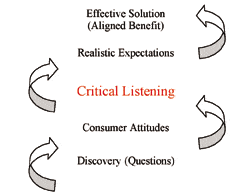
Despite prevailing wisdom, the most common reason consumers dont buy a hearing instrument (and experience the value of better hearing) actually has less to do with cost than perceived value. A common question I have asked dispensing professionals around the country is, How much is too much to charge for hearing aids in your area? The answers vary dramatically, but the real answer is that any amount of money is too much for the consumer to invest if the hearing aid doesnt provide the value (benefit) the client expects. That is the primary reason why a significant percentage of hearing aids wind up in a drawer.3 In fact, Kochkin has shown that its virtually impossible to please a customereven if you give them a free hearing aidif the device provides them with little or no benefit.4 Therefore, all communications with the client should be carefully planned to promote the proper expectations for both the dispensing professional and the consumer. In essence, starting with your initial meeting, you are forging a contract between the client and yourself. Patient needs are elicited by using specifically targeted questions, then listening very closely to the answers. The failure to provide an effective solution (ie, the failure to sell a hearing aid) is usually a direct result of failing to meet expectations (either before or after the actual dispensing of the device). This is most often created by erroneous assumptions that stem from a failure to listen and/or ask the proper questions. Some health care professions are adept at mentally placing the patient into the typical scenario where pain or discomfort occurs. This has the benefit of showing the professional what may be causing the pain, but it also illustrates the affect that the patients health problem poses for his/her quality of life. Hearing care professionals should spend the time doing exactly the same thing. Rather than simply asking if the individual has trouble hearing in a restaurant or in the car, time should be taken to place the individual mentally into the situation where hearing loss has negatively impacted their quality of life. Asking the following questions will allow you to establish what their expectations: When did you first become aware that it was having an effect on you? Selling is Integral to the Health Care Process The secret to productive selling is that it is most effectively accomplished by asking the right questions, setting the proper customer expectations, and understanding the customers needs. It takes more time to dispense this way, but the results are more satisfied customers who are passionate about your servicesand that cant help but result in more direct referrals. References Correspondence can be addressed to HR or Kelly Riggs at kriggs@tulsaconnect.com. |
|
|
Featured Jobs
Find a Job |
ADDITIONAL ONLINE RESOURCES |
Featured Employer
|