Issue StoriesAssociations In Action
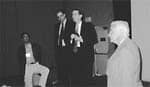
Symposium Reviews 25 Years of Binaural Hearing Research Leading hearing scientists presented information and discussed the latest findings on binaural hearing and its scientific, clinical, social, and economic implications during the International Binaural Symposium 2005 held in Manchester, United Kingdom, at the end of October. About 200 researchers and clinicians from Europe, North America, Asia, Australia, and Africa attended the conference, which marked the 25th anniversary of the landmark publication, Binaural Hearing and Amplification, by E.R. Cy Libby. The three-day symposium was organized by the Medical Research Councils (MRC) Hearing and Research Group and was supported by Siemens Hearing Instruments, as well as the International Society of Audiology. Far-Reaching Implications
However, most people dont seek hearing help, and fewer still receive a hearing instrument. In the UK, for example, Davis says that 3-4% of the population uses hearing aids, and only about half of these people use their aids most of the time. In the UK during the last 5 years, the National Health Service (NHS) has seen exceptional service upgradesincluding the provision of two hearing aidsand these improvements have led to significant benefits for patients. However, it has not been clear whether these benefits stem from bilateral fitting of hearing aids, Davis says. The answer to this and other questions concerning binaural hearing, benefit, and candidacyparticularly in the context of developing economies and vastly changing demographics with respect to agingwill profoundly influence the worldwide provision of hearing health care and its efficacy in the future. Why Two Beats One
The vast majority of speakers agreed that bilateral amplification can offer huge benefits, especially in difficult environments like understanding speech in competing noise (eg, cocktail party effect). Bilateral amplification also helps to localize sound sources and to make it less tiring when trying to follow conversations. The symposium also highlighted the need for improved and harmonized scientific methods to evaluate the benefit of bilateral amplification and advanced signal processing features in hearing aids, Davis says. Traditional laboratory-based methods often do not adequately reflect the challenging environments of todays workplaces and social life. Further research is urgently needed to show the benefits of personalized support from the new generation of hearing aids that are being made possible by miniaturization, by new approaches to making aids more comfortable, and by demonstrating the benefits of hearing instrument technology [immediately] in an initial appointment. The presentations covered topics ranging from psycho-acoustics and public health policy considerations on bilateral fitting to signal processing of binaural devices and fitting strategies. Session chairs were Adrian Davis, John Bamford, Richard Tyler, William Noble, Kevin Munro, Stig Arlinger, Hans Vershuure, Michael Akeroyd, and Stuart Gatehouse, and presenters included George Mencher, Arthur Boothroyd, Chris Darwin, Steve Colburn, Pauline Smith, Thomas Powers, Blake Wilson, Jan Wouters, Therese Walden, Juergen Kiessling, Wouter Dreschler, Louise Hickson, Ruth Litovsky, Teresa Ching, Beverly Wright, and Quentin Summerfield. Papers from the conference are currently in peer review and are scheduled to be published in 2006. |
|
|
Featured Jobs
Find a Job |
ADDITIONAL ONLINE RESOURCES |
Featured Employer
|