Issue StoriesPortable Music and Its Risk to Hearing Healthby Brian J. Fligor, ScD As hearing care experts and hearing loss preventionists, it is our responsibility to consider critically the level of risk and educate our patients and the public appropriately about the use of personal music players. How concerned should we be about MP3 and other personal music players? What should we define as too much or too loud? At the writing of this article, just over a year has passed since the publication of Output Levels of Commercially Available Portable Compact Disc Players and the Potential Risk to Hearing by Fligor and Cox in Ear and Hearing.1 The timing of this publication was fortuitous, as this topic has since been deemed sexy by the popular media, and a considerable amount of press coverage has been given to the current discussion. Since August 2005, many within our profession, including this author, have given radio, television, and print interviews about whether or not the use of headphones is inherently dangerous. It is this authors opinion that all this press coverage is, on the whole, good for the profession and the patients we serveif for no other reason than to promote the concept of hearing conservation and that the word audiologist has been used with greater frequency than any other time in this young audiologists career. This is not, however, a new controversy, as was pointed out by Robert (Bob) Sanderson, MA, owner of Boston Hearing Services, who was co-author of the 1982 Katz et al2 study Stereo Earphones and Hearing Loss published in the New England Journal of Medicine. According to Sanderson, when that study was published over 20 years ago, news outlets were hot for the topic at that time as well. The current sensitivity of the topic has, this author believes, been heightened by the timing of the popularity of the Apple iPod MP3 player. According to Internet reports from Canalys,3 a market research company, 25.6 million iPod players were sold in the first half of 2005. With all due respect to the professionalism of many journalists who have given hearing and hearing loss prevention a voice in the public conscience, the popular media has a product to sell, and often that products value is increased by hype and perceived controversy. Some inaccuracies have resulted, and this author hopes to clarify a few of the myths. It is important to approach this topic with as careful scientific rigor as any other research, or else we risk watering-down the message and invalidating our efforts. It is this authors desire to approach this article with all respect deserved by those who have worked carefully to understand the mechanisms of noise-induced hearing loss (both in the occupational and recreational settings). Understanding Issues in Protecting Ears from Overexposure to Music
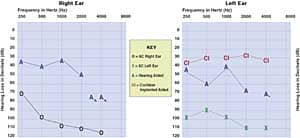
The motivation for the Fligor and Cox1 article was one such accident. A 15-year-old boy came to the clinic at Boston Medical Center (where I was doing my student clinical placement) complaining of difficulty hearing in his right ear. Otoscopy showed an earwax impaction in that ear. After having the earwax cleaned out, his hearing was tested. The results showed that hearing in the ear that was plugged with wax was normal, but in the other good ear that wasnt plugged with wax, his hearing test results were suggestive of noise-induced hearing loss (Figure 2). When asked what noise he was exposed to, the only possible source was the CD player he pulled out. When asked what level he turned it up to, he said, All the way up! Thats where it sounds best. It seems the earwax plug was actually protecting his hearing in one ear, but now we were faced with counseling him how to safely use his headphones.
To date, hearing care professionals have not had useful guidelines for telling people what listening levels are OK and what levels are not. Such guidelines would help counsel the patient on how to keep from regularly exceeding maximum safe exposures. True, its likely that a good number of people appropriately self-regulate their listening, and so are not at risk, but the literature suggests that between 5% to 25% do not.4-8 Anecdotally, it seems there is potential for headphones to cause hearing loss. Published studies have fallen on both sides of the fence, but the sum of the literature suggests that a person could choose to listen chronically at high enough levels and long enough durations to cause a permanent threshold shift (or other auditory injury). But what is the cut-off level? How loud is too loud on the volume control of the personal stereo system? Those in hearing conservation should cringe at that question; its not just how loud (that is, the level), but its the exposureexpressed as the Time-Weighted Average (TWA) or the analogous Noise Dosethat should be considered. Numerous studies into occupational noise exposure and regulations to protect the hearing of the noise-exposed worker tell us that a significant percentage of people who regularly exceed the maximum safe exposure (greater than a 100% noise dose) will eventually sustain noise induced hearing loss.9 As Chasin noted succinctly in his article in this issue of The Hearing Review, there are important physical differences between industrial noise and music. These physical differences may affect the actual risk for noise induced hearing loss, and thus it may be inappropriate to apply damage-risk criteria adopted by the National Institute for Occupational Safety and Health (NIOSH)10 or by the Occupational Safety and Health Administration (OSHA).11 Likewise, in the studies establishing our current damage-risk criteria, the industrial noises to which people were exposed were ambient (in the free-field), as opposed to in the near-field of the ear or ear canal. So, Wheres the Danger Point on the Volume Control?
Shown in Figure 3 are the A-weighted free-field equivalent levels of different CD players. Large differences can be seen between the different manufacturers. For example, the Panasonic CD player output levels were on average considerably less than the Sony CD Walkman, which in turn had considerably lower output levels than the Optimus and RCA CD players. Given that headphones are available for purchase separately, output levels were measured using different types of earphones, including earphones that surround the pinnae (circum-aural), earphones that are oriented vertically in the concha (vertical), and earphones that sit in or directly on the ear canal (in-the-ear or insert). These levels were compared to the earphones that came with the CD players (stock earphones), which were typically the type of earphone that rest on top of the pinna (supra-aural).
An observation was made that output levels from the vertical style and insert style earphones were higher than the stock earphones. To demonstrate this finding, the average levels across models of Sony CD players were compared using stock earphones and two insert earphones. Shown in Figure 4 are the output levels across models of both new and used Sony CD players with stock earphones and new Sony CD players with insert earphones (shown at maximum volume control only for simplicity of presentation). The comparison of new and used CD players was to consider if output levels drifted as systems aged, and there was no obvious difference (the Analysis of Variance comparing seven new and seven used CD players did not yield a significant difference, controlling for type of earphone used in the measure). The comparison between the two insert earphones and the supra-aural earphones revealed a statistically significant difference; Sony in-the-ear earphones were 7 dB higher, and Koss in-the-ear earphones were 9 dB higher, than supra-aural earphones. A conservative damage-risk criterion was used for considering whether or not the output levels of the CD players could pose a risk to hearing. The damage-risk criterion considered appropriate by NIOSH10 considers 85 dBA for 8 hours to represent a maximum exposure, and an equal exposure is achieved in half the time with every 3 dB increase in level. This 85 dBA Time-Weighted Average (TWA) is considered sufficient to protect 85%-90% of the population12 from sustaining a material hearing impairment after decades of industrial noise exposure.
According to the 85 dB TWA damage-risk criterion, a person could be exposed to 94 dBA for 60 minutes before reaching a 100% noise dose. The volume control setting that resulted in output levels of 94 dBA was roughly 70% of maximum. Considering that people are exposed to other high sound levels during the day, and several factors could cause a person to be exposed to greater than 94 dBA for 1 hour even if that is the target, Fligor and Cox1 recommended that a person should not listen for longer than 60 minutes at 60% of the maximum volume control setting. Work has continued to consider if the blanket recommendation by Fligor and Cox1 should be applied to the use of MP3 players. This author hopes to publish, with co-author Cory Portnuff, a PhD student from the University of Colorado at Boulder, the follow-up study in the next few months considering the output levels of three different manufacturers of MP3 players used with different types of earphones. It is premature to suggest that stock in-the-ear earphones provided with MP3 players are 7-9 dB higher than the output level from supra-aural earphones with CD players (as has been misinterpreted in some media reports). Provided in Table 1 are the output levels from an Apple iPod Nano using the stock earbud earphones across volume control settings, and the corresponding time to reach the 85 dBA TWA maximum exposure.
Even though these levels were recorded using stock earbud earphones, these free-field equivalent levels are not appreciably different from the Sony CD Walkman using stock supra-aural earphones. Further work will confirm if these levels are consistent across different models of iPods, and if these levels are typical of MP3 players from different manufacturers. But What Do People Really Do? Considering the levels a person may choose to listen to their personal stereo systems, Williams8 documented listening levels under what was considered worst case conditions where the listening environment was noisy (ambient noise level was 73.2 dBA, standard deviation of 2.3 dB). The average 8-hour TWA was 79.8 dBA (standard deviation of 9.0 dB), with a small but statistically significant difference between listening levels of men (80.6 dBA) and women (75.3 dBA). Williams8 concluded that, on average, noise exposure from personal stereo system use did not constitute a risk to hearing. However, 13 of the 55 personal stereo system users in the study exceeded an 85 dBA TWA, with two users exceeding an 8-hour TWA of 100 dBA.
Work this author is currently undertaking with Dr. Terri Ives from the Pennsylvania College of Optometry School of Audiology considers if the type of earphone affects listening behavior. This study, sponsored by Etymotic Research Inc, has benefited from the technical assistance of Drs. Mead Killion and Gail Gudmundsen, and from fellow author in this issue of HR, Patty Niquette. We propose to assess the chosen listening level in quiet and in varying levels of background noise. Pilot study data (Figure 5) demonstrated that, above a threshold ambient noise level, subjects increased chosen listening level as a function of ambient noise level. Even with only four subjects, the slope of the change in chosen listening level above this threshold ambient noise was significantly associated with the amount of ambient noise attenuation provided by the earphone. The baseline listening level (in quiet) was not associated with earphone type (in-ear vs over-the-ear). Conclusion Have listening behaviors changed with the advent of compressed music file (MP3) players that dont require the user to change tape cassettes or compact discs? If people are on average listening for much longer periods of time than they did using older technology, then it is possible we will start seeing hearing loss from using headphones on a more regular basis. If listening behaviors have not changed, the current perceived level of risk may well be overstated. As hearing loss preventionists, it is our responsibility to consider critically the level of risk and educate our patients and the public appropriately. Popular media attention of the topic can be very useful to promote our agenda of hearing loss prevention and educate the public about who we are as a profession. Ultimately, this is a win-win situation, as long as we hold ourselves to very high professional standards (state the problem appropriately without adding to the hype) and realize that, ultimately, what is best for the patient is best for everyone.
Correspondence can be addressed to HR or Brian Fligor, ScD, LO-367, 300 Longwood Ave, Boston, MA 02115; email: Brian.Fligor@childrens.harvard.edu. References |
|
|
|
ADDITIONAL ONLINE RESOURCES |
|