Issue StoriesDigital Noise Reduction: Yes, There Is Research Supporting Its Effectivenessby Pamela Burton, MA, Carolyn Smaka, AuD, and Thomas A. Powers, PhD A review of four different research studies that show outcomes favoring Digital Noise Reduction (DNR). As we move toward evidence-based practice in the selection and fitting of hearing instruments, studies such as these will lead the way in showing that DNR is an effective treatment strategy in the provision of amplification. One of the most researched and discussed hearing instrument features in the past 10 years has been digital noise reduction (DNR). As reviewed by Mueller and Ricketts,1 DNR algorithms are typically designed with the goal of improving speech understanding in background noise. It has also been suggested that additional benefits include relaxed listening, ease of listening, and an overall reduction of listening fatigue. Today, several models of hearing instruments have DNR as a feature. When these products are recommended for patients, it is important to consider if there is research supporting the efficacy of this signal processing strategy. In recent years, health care professionals in several disciplines have used evidence-based practice (EBP). A component of EBP is that, rather than basing patient-care decisions on prior knowledge, experience, or authority figures, practitioners (dispensing professionals) should use the best available research data when treatment (hearing instrument fitting) decisions are made. As discussed by Cox,2 it is reasonable and appropriate to use evidence-based practice in the selection and fitting of hearing instruments. She states: EBP is an orientation that promotes continuous patient-driven overhaul of treatment protocols to incorporate new knowledge about treatment effectiveness.2 Published research concerning the efficacy of DNR in hearing instruments was recently reviewed by Bentler.3 Two points were evident to us in her paper. First, in contrast to the general popularity of DNR algorithms, and the numerous field studies that have been conducted, there is very little published research concerning the real and potential patient benefits of DNR algorithms. Secondly, several of the studies that have been published do not agree with the general positive anecdotal comments that we have heard from patients over the years. Bentler, in fact, summarizes the DNR research as equivocal,3 and some studies reviewed by Bentler3 did not even show a preference for DNR for ease of listening or listening comfort.4,5 In reviewing research involving DNR in hearing instruments, it is important to consider that each manufacturer uses different DNR algorithms in their products. How this influenced different research results is not clear. In this paper, therefore, we would like to briefly review recent research using the DNR algorithms that have been available in Siemens products for the past 4 years. While the algorithms have been enhanced with each new product development, two basic components have remained constant. One DNR algorithm is modulation-based (frequency and depth), and is an advanced version of the DNR processing described by Powers et al.6 This DNR strategy reduces channel-specific gain (within up to 16 independent channels, depending on the product) whenever the signal, or a portion of the signal, is classified as noise. The onset of this DNR is gradual (2-5 seconds) and the offset is relatively quick (<500 msec). This algorithm is the most robust when noise is the dominant signal in a given channel. The second DNR is fast acting (~10 msec) and is modeled after Wiener filter processing. This algorithm does not reduce gain per se, but filters the speech and noise signal, removing inter-word and inter-syllabic noise. This algorithm is most robust when speech and noise are both present at a positive SNR in a given channel. These two algorithms can operate simultaneously, are complimentary, and the strength can be programmed. The following is a review of four studies that have been conducted recently using hearing instruments with the DNR processing just described. While not all of these studies meet the strict EBP review criteria of Bentler,3 they do offer strong support for DNR technology. Study 1: Realistic Expectations This issue was addressed in research by Palmer et al9 using Siemens TRIANO hearing instruments and the DNR strategy described earlier. A group of 49 hearing-impaired subjects (31 experienced, 18 new users) rated their unaided and aided (DNR-on) annoyance for two different stimuli: dinner party noise and traffic noise. The noises were rated on an 11-point scale ranging from 0 (very annoying) to 10 (not annoying at all). The annoyance level of the same two noises also was rated by a group of 30 normal-hearing individuals (unaided).
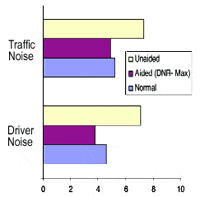
Figure 1 summarizes the key findings from the Palmer et al9 research. First, observe that for the unaided condition, the two noises were not considered very annoying (eg, ratings around the No. 7 level). When the same subjects were aided, using hearing instruments with DNR activated, the noises became significantly more annoying (note ratings around 4 to 5). Importantly, however, as shown in Figure 1, these aided annoyance ratings for the hearing-impaired subjects were not significantly different from the annoyance ratings provided by normal-hearing individuals. In other words, while patients may not believe that the DNR is working appropriately (unwanted sounds are more annoying), the use of hearing instruments with DNR actually restored their percept of noise to normal levels. Study 2: Acceptable Noise Levels The ANL has been researched extensively at the University of Tennessees auditory laboratories, and Nabelek summarizes this research in her article.10 Perhaps the most intriguing finding from this body of research is highlighted in their recent study revealing that the clinical measure of the ANL can be used to predict success with hearing instruments. Nabelek et al11 report that individuals with smaller ANLs (eg, acceptance of background noise at a level close to their MCL) are more successful hearing instrument wearers than people with larger ANLs. In summarizing her data, Nabelek10 states that ANLs of 10 dB or less tend to be predictive of successful hearing instrument use. Given that low ANLs are related to hearing instrument satisfaction, it is reasonable to question if DNR alters the aided ANL. This research was recently conducted by Mueller et al12 using Siemens ACURIS hearing instruments. These authors conducted ANL testing for 22 hearing-impaired individuals for three different conditions: unaided, aided DNR-off, and aided DNR-on. Their findings showed that unaided and aided (DNR-off) ANLs did not differ significantly, that ANLs were not influenced by the degree of hearing loss, and that individual ANLs were not significantly correlated to performance on the HINT. These findings were all consistent with previous research from the University of Tennessee.10 The most notable finding from the research of Mueller et al,12 however, was that when the DNR algorithms of the hearing instruments were activated, there was a significant decrease in the measured ANL (compared to the DNR-off condition). A summary of the individual aided ANL data from Mueller et al12 is shown in Figure 2.
As can be observed from Figure 2, the DNR processing improved the ANL for 20 of the 22 subjects. Moreover, in general, the greatest benefit was for the individuals who had the largest ANLs with DNR-off (eg, the people who needed the most help). In fact, if we use the 10 dB cut-off mentioned by Nabelek for predicting hearing instrument success, only 45% of the subjects had ANLs of 10 dB or less for the DNR-off condition, whereas 86% of subjects met this ANL criterion with DNR-on. Mueller et al12 attribute the ANL improvement observed in this testing to the fast-acting algorithm of the DNR system rather than the modulation-based DNR component. Most ANLs were in the +5 dB or greater rangean SNR that usually does not result in much channel-specific gain change for the modulation-based DNR (the background noise signal was filtered to match the long-term average speech spectrum of the sentences in this study). While this was not a real-world study, the real-world link has already been established,11 and therefore these findings suggest an encouraging relationship between DNR and successful hearing instrument use. Study 3: User Preference for DNR A recent study concerning wearer preference for DNR, as implemented with the Siemens TRIANO hearing aids, was published by Ricketts and Hornsby.13 These authors had 14 hearing-impaired subjects rate their preference for DNR-off versus DNR-on for four conditions: 1) directional low noise; 2) directional high noise; 3) omnidirectional low noise; and 4) omnidirectional high noise. The low-noise condition was 71 dBA/+6 SNR; the high-noise was 75 dBA/+1 SNR. The preferences were established using a paired-comparison procedure. The speech stimuli used was the sentences of the Connected Speech Test (CST). The competing noise was the CST six-talker babble, which was presented uncorrelated from four speakers surrounding the listener.
The results of this study are shown in Figure 3. For all four listening conditions there is a distinct preference for DNR-on. As expected, the preference is the greatest for the omni high-noise condition; however, even for directional low-noise, DNR-on is preferred over DNR-off by a 2:1 margin. The authors report in fact that 8 subjects preferred DNR-on for all four conditions while only one subject preferred DNR-off for all four conditions. These findings clearly show that the signal processing of DNR (at least as implemented in these hearing instruments) provides more desirable listening for a speech-in-noise communication situation. The signal-to-noise ratios and the background noise used in this study are commonly encountered in real-world day-to-day activities. And, importantly, the authors report that, while implementation of this DNR strategy resulted in improved listening comfort, it did not adversely affect speech intelligibility. Study 4: Real-World Preference for Digital Noise Reduction An article which extends the question of DNR preference to real-world listening conditions was recently published by Powers et al.14 As with the other studies reported here, these authors used a Siemens hearing instrument (ACURIS S BTE model) employing the combined modulation-based DNR with the fast-acting filtering DNR algorithm. The subjects were 21 adults (14 males, 7 females) from two independent research sites. All subjects were experienced hearing instrument wearers, had bilateral symmetrical, sensorineural, downward sloping hearing loss, and were fitted bilaterally. After the hearing instruments were fitted, the subjects participated in a 10-day field trial of the instruments (the subjects were blinded regarding which program was DNR-off and which program was DNR-on). The authors report that during the field study, the hearing instruments had the ACURIS e2e wireless technology enabled (see Powers and Burton15 for review), which links the sound classification system controlling the activation of the DNR, resulting in symmetrical DNR steering. During the first 6 days of the field trial, the subjects alternated programs day-to-day, resulting in three completed ratings for each program setting. For the final 4 days of the field trial, subjects were encouraged to switch between the two programs in a variety of listening situations. At the end of the last day, they completed a final rating where they selected a favorite overall program for all listening situations. They also had the option of stating no preference.
The primary results of the Powers et al14 study are shown in Figure 4. Note that 6 (28%) of the 21 subjects did not have a DNR-off versus DNR-on preference. Of the remaining 15 subjects, however, 11 (73%) preferred the DNR-on program. Only 4 of the 21 subjects favored the DNR-off setting. These findings are very similar to the laboratory data of Ricketts and Hornsby.13 This real-world study suggests that the majority of hearing instrument wearers prefer DNR technology for everyday listening experiences. Since this is one of the only real-world studies that has isolated DNR as a variable, it is difficult to determine if this positive outcome is specific to the unique DNR algorithms of the hearing instruments, the e2e symmetrical steering of the DNR employed by the hearing instruments, or if these findings can be generalized to DNR technology in general. Evidence Points to DNR Effectiveness In this article, we have reviewed four different research studies in which the investigators used the same (or similar) Siemens DNR technology. In all cases, an outcome favoring DNR resulted. As we move toward evidence-based practice in the selection and fitting of hearing instruments, we believe that studies such as these will lead the way showing that DNR is an effective treatment strategy in the provision of amplification.
Correspondence can be addressed to HR or Pamela Burton, Siemens Hearing Instruments, 10 Constitution Ave, Piscataway, NJ 08854; email: pburton@siemens.com. References |
|
|
|
ADDITIONAL ONLINE RESOURCES |
|